


Managed SOC as a Service: Safer Healthcare Security in India
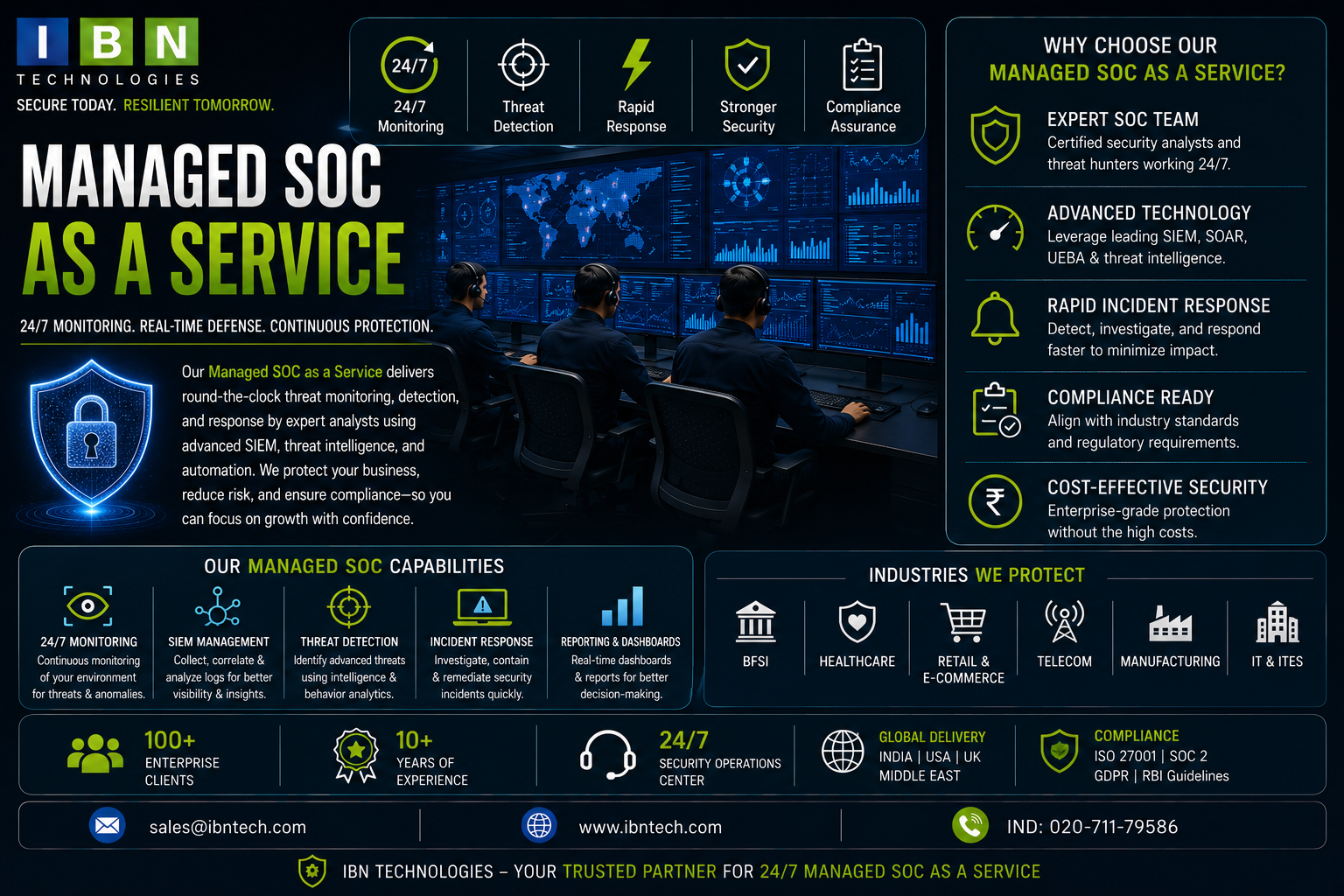
A Stronger Security Operations Model for Indian Healthcare
Healthcare organizations face a security challenge that extends beyond protecting corporate IT systems. Hospitals, clinics, diagnostic providers, healthtech companies, and pharmaceutical organizations rely on digital systems to manage sensitive information and support day-to-day operations.
Patient information, employee credentials, clinical applications, cloud platforms, and connected environments can all become targets.
A managed soc as a service model provides healthcare organizations with continuous security monitoring and specialist security operations support without requiring them to build every component of an internal SOC.
What Does Managed SOC as a Service Mean for Healthcare?
Managed SOC as a Service is a security operations model in which an external cybersecurity team continuously monitors an organization's environment, investigates suspicious events, and supports incident response.
For healthcare, the model should connect security monitoring with the protection of sensitive information and operational continuity.
The objective is not merely to detect malware. It is to identify unusual activity, investigate potential threats, escalate important incidents, and help the organization respond through established processes.
Why Healthcare Needs Continuous Security Visibility
Healthcare systems can remain active around the clock.
Hospitals may operate continuously, digital healthcare platforms can serve users outside traditional business hours, and administrative systems may support operations across multiple locations.
Cybersecurity incidents do not follow office schedules.
A compromised account could be used at night. Suspicious endpoint activity could begin during a weekend. A ransomware event could affect systems while security staff are unavailable.
This is why continuous monitoring matters.
IBN Technologies' healthcare cybersecurity services address threats such as ransomware, PHI breach risks, legacy-system vulnerabilities, and compliance complexity. Its healthcare capabilities include 24/7 SOC and SIEM monitoring, VAPT, and cybersecurity services designed for healthcare and pharmaceutical organizations.
Why Healthcare Teams May Struggle to Operate a Full SOC Internally
Healthcare IT teams have a demanding operational role.
They may manage clinical applications, infrastructure, networks, user support, cloud systems, access management, and technology projects. Security monitoring adds another responsibility that requires specialized skills and constant attention.
Building an internal SOC also involves considerable operational planning.
The organization needs analysts, monitoring technology, detection processes, incident-response procedures, escalation workflows, reporting, and appropriate coverage.
For healthcare organizations with limited security resources, building all these capabilities internally may not be the most efficient approach.
A managed SOC can supplement internal teams by providing continuous security operations while healthcare leadership retains control over business priorities and response decisions.
How healthcare managed SOC Operations Work
A managed SOC brings security monitoring, technology, and human analysis into a coordinated process.
Relevant events can be collected from security devices, endpoints, cloud environments, identity systems, and other appropriate sources. Security technology helps identify potential threats, while security professionals investigate events that require attention.
IBN Technologies' SOC/SIEM services include 24/7 monitoring, threat detection, threat intelligence, incident response, and compliance-oriented reporting. Its MDR capabilities extend this model through endpoint detection and response, threat hunting, forensic analysis, and threat containment.
For healthcare organizations, this can create a more consistent path from security signal to investigation and response.
The Difference Between Alerts and Security Operations
Healthcare organizations may already have multiple security products.
Endpoint security can detect suspicious files. Firewalls can identify unusual traffic. Identity platforms can flag unusual authentication. Vulnerability scanners can identify weaknesses.
But individual alerts do not automatically create a security operation.
Someone must determine which events matter, investigate the surrounding context, and establish whether an incident requires escalation.
This is where a managed SOC can add value.
Rather than expecting internal IT staff to interpret every alert, the organization can establish a dedicated monitoring function that evaluates security events continuously.
What Healthcare Leaders Should Look for
The right managed SOC provider should be evaluated against healthcare's specific operational and security requirements.
Coverage: Determine which systems, applications, endpoints, networks, and cloud environments are monitored.
Sensitive-data protection: Understand how security monitoring supports environments containing patient and other sensitive information.
Continuous monitoring: Confirm how the service operates outside normal business hours.
Incident investigation: Ask how suspicious events are analyzed and prioritized.
Response process: Establish how critical incidents are escalated and what actions the provider can support.
Integration: Review compatibility with existing security technologies and infrastructure.
Healthcare understanding: Ensure security operations recognize the operational importance of clinical and patient-facing systems.
Reporting: Assess whether reports support security leadership, management, and compliance teams.
Scalability: Confirm that the service can adapt as facilities, users, applications, and cloud workloads increase.
A Healthcare Use Case: Protecting a Multi-Location Provider
Consider an Indian healthcare organization operating several facilities.
The organization uses centralized applications alongside cloud services and remote access. Its internal IT team handles infrastructure and user support, while a small security function manages cybersecurity alongside other responsibilities.
One evening, unusual authentication activity appears on an employee account.
Without continuous monitoring, the event might remain unnoticed until the following morning. By that point, additional suspicious activity could have occurred.
With a managed SOC, the event can be monitored and investigated as it develops. Analysts can assess the activity alongside other available security signals and escalate the incident according to established procedures.
The internal healthcare team can then make decisions about account controls, affected systems, operational continuity, and remediation.
The managed SOC does not replace internal accountability. It provides the security operations layer needed to maintain visibility.
Managed SOC Benefits for Healthcare Organizations
A properly structured managed SOC can provide several practical advantages.
Continuous monitoring helps reduce dependence on business-hour availability. Specialist analysts provide additional security expertise. Centralized reporting can improve visibility for security leadership. A defined escalation model can make incident response more organized.
The model can also support growth.
Healthcare organizations frequently introduce new applications, services, facilities, and digital workflows. Security monitoring needs to evolve with those changes.
A managed SOC provides an operational framework that can adapt without requiring the healthcare organization to build a completely new internal capability each time its environment expands.
Healthcare Managed SOC Checklist
- Identify systems containing or accessing sensitive healthcare information.
- Map critical clinical, administrative, cloud, and identity environments.
- Determine which security events require immediate escalation.
- Establish responsibilities between internal teams and the managed SOC.
- Confirm 24/7 monitoring and incident-response arrangements.
- Review SIEM and security-tool integration requirements.
- Define incident communication and escalation procedures.
- Assess security reporting and evidence requirements.
- Align monitoring with applicable healthcare and privacy obligations.
- Review SOC coverage whenever technology or operations change.
Compliance and Healthcare Security
Healthcare organizations may face multiple security and privacy obligations depending on their activities, data, contracts, and jurisdictions.
Relevant frameworks and requirements may include HIPAA, HITECH, ISO 27001, SOC 2, DPDPA, and other applicable contractual or regulatory requirements.
IBN Technologies' healthcare cybersecurity services address HIPAA and HITECH considerations and identify ISO 27001:2022 and SOC 2 Type II among its healthcare security and compliance areas. Its broader cybersecurity portfolio includes cybersecurity audit and compliance, VAPT, SOC/SIEM, MDR, and vCISO services.
A managed SOC can support compliance through monitoring, reporting, incident records, and security processes. However, organizations remain responsible for determining and meeting their specific legal and regulatory obligations.
Making Security Operations Part of Healthcare Resilience
Healthcare cybersecurity is ultimately about protecting sensitive information while helping essential technology remain secure and available.
The right managed soc as a service model can provide Indian healthcare organizations with continuous monitoring, threat detection, specialist investigation, incident-response support, and structured security reporting. IBN Technologies combines managed SOC/SIEM with healthcare cybersecurity, VAPT, MDR, and compliance capabilities.
For healthcare CIOs, CISOs, CTOs, security managers, and compliance leaders, the strongest approach is to view a managed SOC as an extension of the security team rather than simply an outsourced monitoring service. It can provide the operational depth needed to identify threats consistently while allowing internal teams to remain focused on healthcare technology, risk, governance, and patient-focused operations.
Contact Us:
IND- 02067680404
IBN Technologies Ltd.
E-mail: - sales@ibntech.com

 English
 Arabic
 French
 Spanish
 Portuguese
 Deutsch
 Turkish
 Italiano
 Russian
 Romaian
 Portuguese (Brazil)
 Greek
Greek
