


Global Mineral Feed Market to Reach USD 6.89 Billion by 2036
The global mineral feed market is entering a pivotal "Precision or Perish" phase, according to latest insights by Future Market Insights. Driven by rising global protein consumption, tightening environmental discharge limits on agricultural phosphorus and nitrogen, and the adoption of precision feeding technologies in mega-farm operations, traditional bulk inorganic mineral mixes are rapidly giving way to species-specific, bioavailability-optimized chelated mineral formulations.
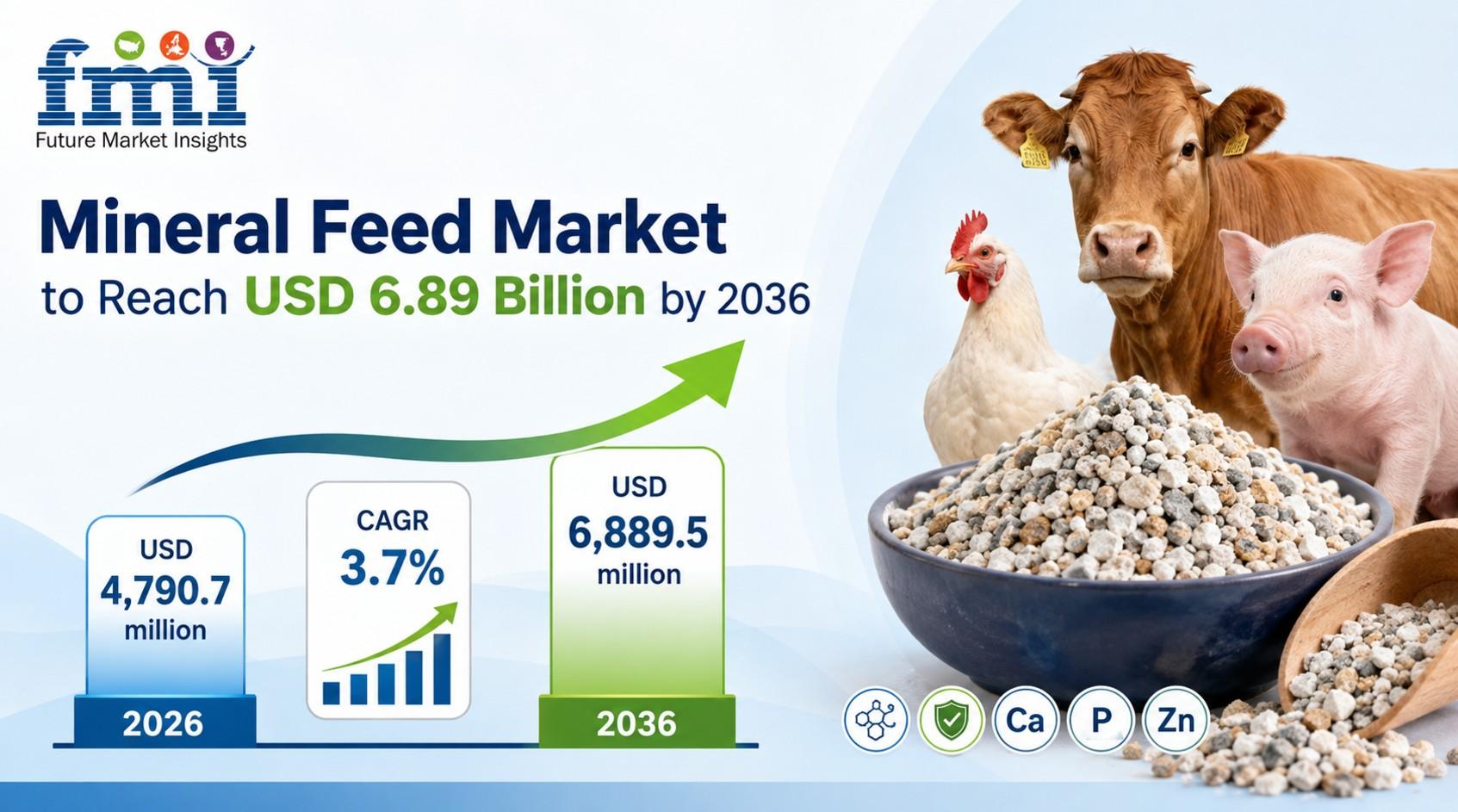
The global market, valued at USD 4,619.8 million in 2025, is estimated to reach USD 4,790.7 million in 2026. Advancing at a Compound Annual Growth Rate (CAGR) of 3.7% over the ten-year forecast period, total market valuation is projected to achieve USD 6,889.5 million by 2036, delivering an absolute incremental opportunity of USD 2.098 billion.
Request a Sample Report: https://www.futuremarketinsights.com/reports/sample/rep-gb-1159
Market Performance Overview (2026–2036)
To map out the primary mineral types, core end-use livestock applications, and regional growth vectors guiding this USD 2.098 billion market expansion, key segment allocations highlight where global commercial demand is concentrated:
· Phosphorus Mineral Type Segment (28.4% share): Commands the leading mineral category in 2026, essential for energy metabolism (ATP), skeletal bone development, and cell membrane integrity across poultry, dairy, swine, and aquaculture.
· Calcium, Zinc, Iron, & Magnesium Segments: Represent high-volume secondary mineral pillars, where chelated zinc and iron are increasingly specified for gut integrity, immune response, and skin/hoof health.
· Poultry End-Use Application Segment (35.7% share): Dominates application demand over dairy, swine, equine, and aquaculture, anchored by intensive broiler feed conversion ratios (FCR) and layer eggshell calcium/phosphorus requirements across Asia-Pacific and Latin America.
· India & Japan Regional Growth Leadership: Lead national expansion rates at 6.4% CAGR and 5.4% CAGR respectively through 2036, driven by dairy herd nutrition modernization (India) and aquaculture feed intensification (Japan)
.
Technical Drivers and Precision Livestock Shifts
The commercial expansion of mineral feeds across commercial feed mills and livestock integrators is propelled by three primary industry catalysts:
Environmental Discharge Limits and High-Bioavailability Chelates
Strict environmental regulations (such as EU Nitrates/Phosphorus Directives and US state-level nutrient management plans) penalize excessive mineral excretion in manure. To comply, feed nutritionists are replacing low-cost inorganic salts (zinc oxide, copper sulfate) with organic chelated trace minerals that offer higher gut absorption at lower inclusion levels, reducing environmental runoff.
Precision Feeding and Phase-Adjusted Nutrition
Large-scale commercial farms are transitioning from generic bulk mineral mixes to precision feeding. Matching exact mineral ratios to the animal's specific life stage (e.g., broiler starter vs. finisher, lactating vs. dry dairy cows) improves feed conversion efficiency and reduces expensive nutrient waste.
Rumen Energy Optimization and Digital Formulation Integration
Innovations in additive matrixes such as ADM's Digest Carb unveiled for dairy cows optimize rumen energy utilization and fiber digestion. Integrating mineral premix matrix values directly into commercial linear feed formulation software allows feed mills to dynamically optimize cost-per-gain.
Industrial Constraints & Sourcing Risks
Mineral feed refiners and commercial feed mills navigate specific operational hurdles:
· Phosphate Rock Supply Concentration: Feed-grade dicalcium/monocalcium phosphate relies on mined phosphate rock concentrated in a small number of geographic jurisdictions (Morocco, China, US). Geopolitical disruptions or trade tariffs create spot-price spikes that impact global feed costs.
· Heavy Metal Contamination Screening: Raw inorganic mineral sources must undergo rigorous testing to ensure heavy metal levels (cadmium, lead, arsenic) remain strictly below regional food safety thresholds (such as FDA and EFSA animal feed safety rules).
Regional Growth Profile
Regional demand reflects rapid protein production expansion in developing economies alongside compliance and efficiency upgrades in mature markets:
· India (6.4% CAGR): The global growth frontrunner, driven by formalization of the dairy cooperative sector, expanding commercial poultry production, and government livestock health initiatives.
· Japan (5.4% CAGR) & South Korea: Leading East Asian growth through high-density aquaculture feed intensification, precision dairy nutrition, and strict import feed safety standards.
· Brazil (5.3% CAGR): Supported by massive poultry and beef export competitiveness, expanding pasture-based cattle mineral supplementation, and regional soy/corn feed production.
· China (4.7% CAGR): Driven by large-scale swine herd rebuilding in automated mega-farms, precision feeding technology adoption, and national feed efficiency targets.
· United States (3.2% CAGR): Represents a high-value replacement market focused on feed conversion plateaus, chelated mineral adoption, and phosphorus discharge compliance.
Competitive Landscape
The global mineral feed landscape features a combination of global animal nutrition conglomerates, specialized premix manufacturers, and regional feed ingredient refiners.
Key market participants profiled in the report include Cargill Inc., Purina Animal Nutrition LLC, Nutreco N.V. (Trouw Nutrition), dsm-firmenech, Kemin Industries Inc., Novus International, Kent Feeds, Avitech Nutrition, Kalmbach Feeds Inc., and Pancosma S.A.. Major players compete by constructing high-capacity regional premix plants (e.g., dsm-firmenich's Sadat City plant and Nutreco's Indonesian/China facilities), offering mobile NIR on-site feed testing tools, and expanding chelated mineral portfolios.
Exclusive Discounts on Full Report: https://www.futuremarketinsights.com/reports/mineral-feed-market
Frequently Asked Questions
What is the projected valuation of the global mineral feed market by 2036?
The global mineral feed market is projected to reach USD 6,889.5 million by 2036, expanding from an estimated baseline valuation of USD 4,790.7 million in 2026 at a CAGR of 3.7%.
Why does Phosphorus hold a 28.4% market share?
Phosphorus leads the mineral type category in 2026 because it is a non-negotiable macronutrient essential for cellular energy transfer (ATP), bone skeletal development, and metabolic function across all livestock species.
What main end-use application dominates mineral feed consumption?
Poultry accounts for 35.7% of total mineral feed demand in 2026, driven by high-density broiler growth rates, layer eggshell formation needs, and intensive feed conversion optimization across Asia-Pacific and Latin America.
FMI Custom Research: Strategic Intelligence for Confident Decision-Making
In today's rapidly evolving business environment, leadership teams need clear, actionable intelligence tailored to their strategic objectives. FMI's Custom Research solutions are designed around specific business questions, enabling executives to evaluate growth opportunities, validate investments, assess competitive dynamics, and reduce uncertainty before making critical decisions.
Key Executive Benefits
· Decision-Ready Insights: Research tailored to your specific business challenges, growth plans, and investment priorities.
· Reduced Strategic Risk: Validate market opportunities, customer demand, and competitive positioning before committing resources.
· Market Entry Confidence: Assess opportunity size, regulatory barriers, channel dynamics, and competitive landscapes with precision.
· Competitive Advantage: Gain proprietary intelligence unavailable through syndicated reports or internal datasets.
· Faster Growth Decisions: Accelerate expansion, product development, portfolio optimization, and investment planning.
· Primary Market Validation: Access real-world customer, buyer, and stakeholder insights that support high-confidence decision-making.
Business Impact
FMI helps organizations transform market complexity into strategic clarity, enabling leadership teams to identify growth opportunities faster, optimize resource allocation, strengthen competitive positioning, and make high-stakes business decisions with confidence.
To explore how FMI Custom Research can support your strategic priorities, connect with our team at - sales@futuremarketinsights.com
About Future Market Insights (FMI)
Future Market Insights (FMI) delivers actionable, decision-focused market intelligence that goes beyond traditional research reports. The company provides:
· In-depth pricing and cost benchmarking analysis
· Demand forecasting based on real industry inputs
· Procurement and buyer behavior insights
· Supply chain and trade flow intelligence
· Technology and application trend analysis across industries
FMI follows a robust bottom-up research methodology, combining insights from industry experts, procurement leaders, manufacturers, and technical professionals to ensure accurate and practical market intelligence.

 English
 Arabic
 French
 Spanish
 Portuguese
 Deutsch
 Turkish
 Dutch
Dutch
 Italiano
 Russian
 Portuguese (Brazil)
 Greek
Greek
