


Why Does Warpage Form Inside Cycles Of RDmould Plastic Box Mould
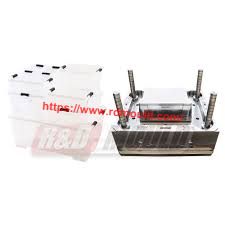
Plastic storage and packaging containers rely on flat, uniform geometry to fit assembly and stacking workflows, and the Plastic Box Mould generates finished units through repeated melt injection, cooling and ejection cycles where unbalanced internal stress leads to visible warpage that breaks dimensional consistency, while industrial technicians gathering stress simulation data and cavity optimization blueprints may access categorized technical archives stored by rdmould that compile field test records collected from global packaging molding workshops, yet many mold buyers overlook subtle structural flaws that amplify shrinkage imbalance across long run production, so what hidden design and cycle factors create continuous warpage during box molding operations?
All polymer materials contract volume while transitioning from molten fluid to solid rigid shape after cavity filling, and any difference in cooling speed across separate wall zones creates uneven shrink force that pulls finished box surfaces out of preset flat outlines. Thin side panels and thick reinforced bottom frames release stored stress at different timelines after ejection, and such asynchronous contraction generates subtle bending or twisting that turns qualified blank design into unstackable finished goods unable to match assembly fixture dimensions.
Cavity cooling channel layout stands as a key structural factor that shapes heat extraction speed across box wall sections, and asymmetric pipeline placement leaves localized hot zones that extend solidification periods for thick structural ribs adjacent to thin vertical panels. Heat trapped inside unreachable cavity corners delays full stress release during standard cycle timelines, and residual thermal tension remains locked within polymer matrix long after box units separate from mold core surfaces.
Gate positioning and melt flow path control define molecular fiber alignment inside cavity space, and single side feeding pushes polymer chains to stretch along one directional trajectory that creates directional shrink gap between flow and cross-flow zones. Box frames with long horizontal spans show obvious edge lifting when melt molecules maintain unbalanced orientation after complete cooling phases, and multi-point gate layouts distribute incoming fluid to balance chain arrangement across full cavity coverage.
Cycle parameter coordination covers injection speed, holding pressure and cooling duration that regulate stress accumulation during each molding loop, and overextended holding stages lock excessive compression force inside thick base sections while insufficient cooling leaves partial solid layers prone to shape shift after ejection. Moderate, steady pressure input paired with matched heat extraction windows reduces tension buildup without cutting daily output capacity of active molding lines.
Material grade matching also interacts with cavity geometry to adjust shrink range across repeated cycles, and semi-crystalline resin grades carry wider contraction gaps than amorphous alternatives for thin-wall box structures. Pre-drying procedures eliminate internal moisture bubbles that disrupt uniform heat transfer during cooling steps, removing secondary stress sources that worsen minor warpage generated from mold structural limits.
Workshop technicians collecting warpage simulation reports, cavity redesign sketches and one-to-one mold tuning consultation for the Plastic Box Mould may browse categorized industrial knowledge bases at https://www.rdmould.com/, where RuiDing engineering teams sort verified stress balance schemes and targeted structural revision plans to remove recurring deformation defects across all box molding production cycles.

 English
 Arabic
 French
 Spanish
 Portuguese
 Deutsch
 Turkish
 Dutch
Dutch
 Italiano
 Russian
 Portuguese (Brazil)
 Greek
Greek
