


Regulatory Considerations for AI Use in Finance and Accounting
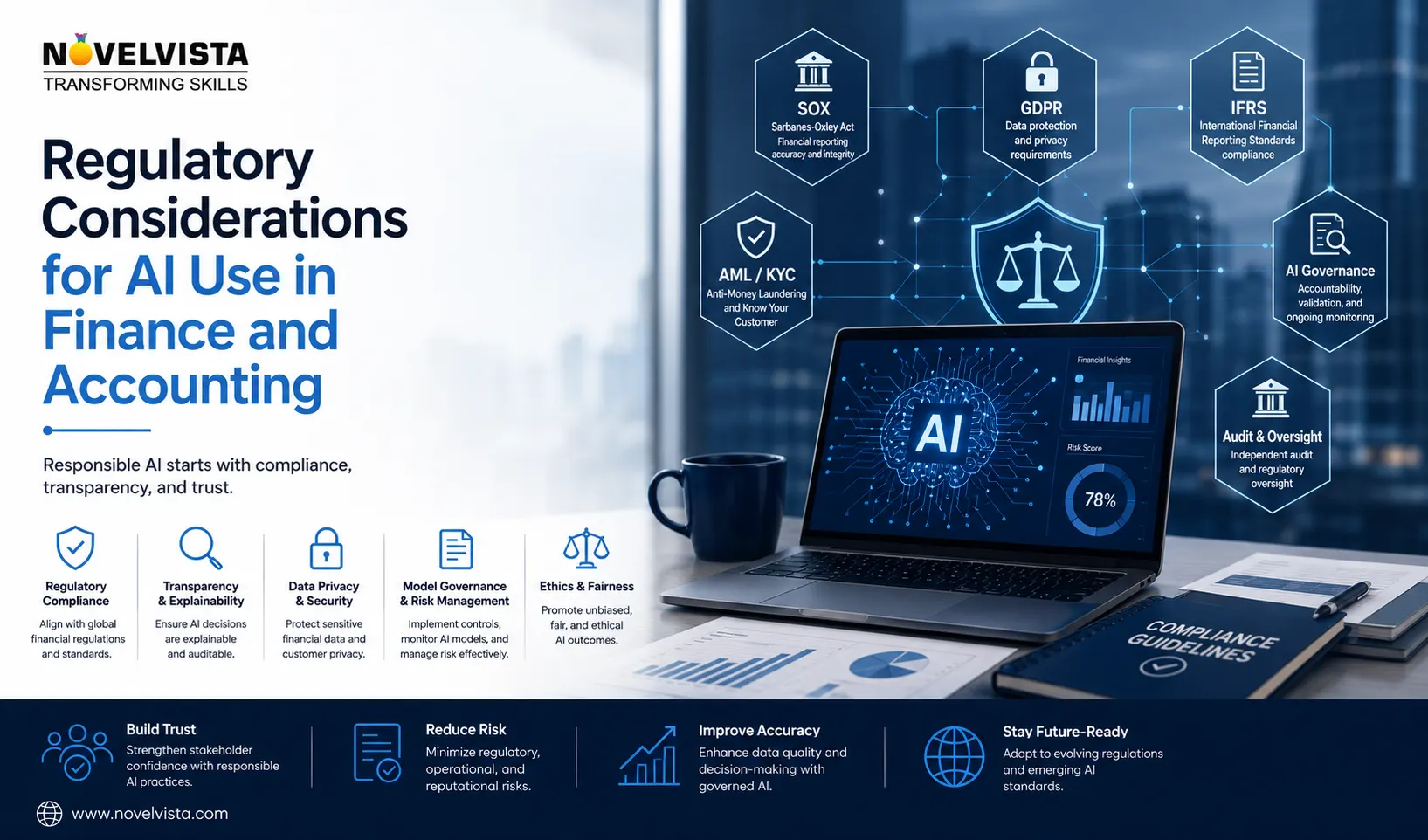
Artificial intelligence is becoming part of everyday work in finance and accounting. Organizations are using AI for Professional to analyze transactions, detect anomalies, prepare forecasts, summarize financial information, automate reconciliations, support audits, and assist employees with reporting tasks.
The productivity benefits are clear, but finance is also one of the areas where mistakes can have serious consequences. An inaccurate recommendation, an unexplained calculation, or inappropriate use of sensitive financial data can create regulatory, operational, and reputational risks.
For this reason, organizations should approach AI adoption in finance with strong governance from the beginning.
Understand Which Regulations Apply
There is no single global regulation governing every use of AI in finance. Requirements can depend on the country, industry, type of organization, data being processed, and purpose of the AI system.
Businesses may need to consider financial-services regulations, accounting standards, privacy requirements, cybersecurity rules, consumer-protection obligations, record-retention requirements, and emerging AI-specific legislation.
The European Union's AI Act, for example, uses a risk-based approach and places stronger obligations on certain high-risk AI systems, including requirements around documentation, logging, human oversight, accuracy, cybersecurity, and risk management.
Organizations operating internationally therefore need to understand where an AI system is being used and which regulatory requirements may apply.
Maintain Human Oversight
AI should support professional judgment rather than automatically replace it.
This is especially important when AI contributes to financial reporting, credit-related decisions, fraud investigations, tax calculations, investment analysis, or other high-impact activities.
For example, an AI system may identify an unusual transaction and recommend that it be investigated. However, a qualified employee should review the relevant evidence before taking action.
Human oversight also provides an important checkpoint when AI produces information that appears convincing but is incorrect.
Organizations should clearly define which decisions AI can make independently and which require human approval.
Protect Financial and Personal Data
Finance departments work with some of the most sensitive information inside an organization.
This can include customer records, employee payroll information, bank details, invoices, tax documents, revenue data, contracts, and confidential business forecasts.
Employees should not copy sensitive financial information into public AI tools unless the organization has explicitly approved that use.
Businesses should understand how AI providers store data, whether information is used for model training, where data is processed, how long it is retained, and who can access it.
Strong access controls, encryption, data minimization, and approved AI platforms should form part of the organization's AI governance strategy.
Make AI Decisions Explainable
Explainability becomes particularly important when AI influences a financial decision.
Imagine an AI system identifies a customer transaction as suspicious. Simply stating that "the AI flagged it" may not provide enough information for an auditor, compliance officer, regulator, or customer.
Finance teams should be able to understand the important factors behind AI-assisted conclusions.
The level of explainability required will depend on the use case. A chatbot summarizing an internal policy may require less oversight than a model influencing credit decisions or financial reporting.
Risk management frameworks such as NIST's AI Risk Management Framework encourage organizations to manage AI risks throughout the lifecycle rather than treating governance as a one-time compliance activity.
Keep Proper Records and Audit Trails
Finance and accounting already depend heavily on documentation.
AI should not become a black box that removes that visibility.
Organizations should maintain records showing which AI systems are being used, what data they access, who approved them, what versions are deployed, and where their outputs influence business processes.
For important financial workflows, it may also be necessary to record AI-generated recommendations and subsequent human decisions.
This creates an audit trail that can help internal auditors, external auditors, compliance teams, and regulators understand how a decision was reached.
Validate AI-Generated Financial Information
Generative AI can produce confident answers even when its information is incomplete or incorrect.
This makes validation essential.
An AI-generated financial summary may misunderstand an accounting treatment, use an incorrect number, invent a reference, or overlook important context.
Finance professionals should verify calculations, source data, assumptions, accounting interpretations, and regulatory claims before relying on AI-generated output.
AI is useful for accelerating analysis, but accountability still belongs to the organization and its professionals.
Manage Third-Party AI Risk
Many organizations will not build their own AI systems. Instead, they will use AI capabilities provided through accounting platforms, cloud services, analytics applications, or financial software.
Third-party AI should still go through appropriate risk assessment.
Organizations should evaluate vendor security, privacy practices, model governance, contractual protections, availability, data handling, and incident-management processes.
They should also understand what happens if the vendor changes the underlying AI model.
A tool that behaves correctly today may produce different results after a model update.
Monitor AI Systems Continuously
AI governance should continue after deployment.
Organizations need processes for monitoring accuracy, unusual behavior, cybersecurity risks, bias, data quality, and changes in model performance.
If an AI system begins generating unreliable recommendations, the organization should be able to identify the issue quickly and limit its impact.
Regular testing and review are especially important for systems connected to financial reporting or regulated business processes.
Build AI Governance into Existing Controls
Organizations do not necessarily need to create an entirely separate governance structure for AI.
AI controls can often be integrated into existing risk management, information security, internal audit, compliance, privacy, and financial-control processes.
Responsibilities should be clearly assigned between finance, IT, legal, risk, security, and business teams.
AI literacy is also becoming increasingly important. Employees should understand both what AI can do and where its limitations create risk.
Final Thoughts
AI can make finance and accounting faster, more analytical, and more efficient, but regulatory responsibility does not disappear because a task has been automated.
Organizations need to understand applicable regulations, protect sensitive data, maintain human oversight, document important decisions, validate AI outputs, and continuously monitor deployed systems.
The most sustainable approach is not to avoid AI because of regulation. It is to introduce AI within a governance framework that matches the level of risk.
When finance teams combine AI capabilities with professional judgment, strong controls, and clear accountability, organizations can gain the benefits of automation while maintaining the trust that financial operations depend on.

 English
 Arabic
 French
 Spanish
 Deutsch
 Turkish
 Dutch
Dutch
 Italiano
 Russian
 Romaian
 Portuguese (Brazil)
 Greek
Greek
