


Building AI-Assisted Sales Playbooks and Battlecards
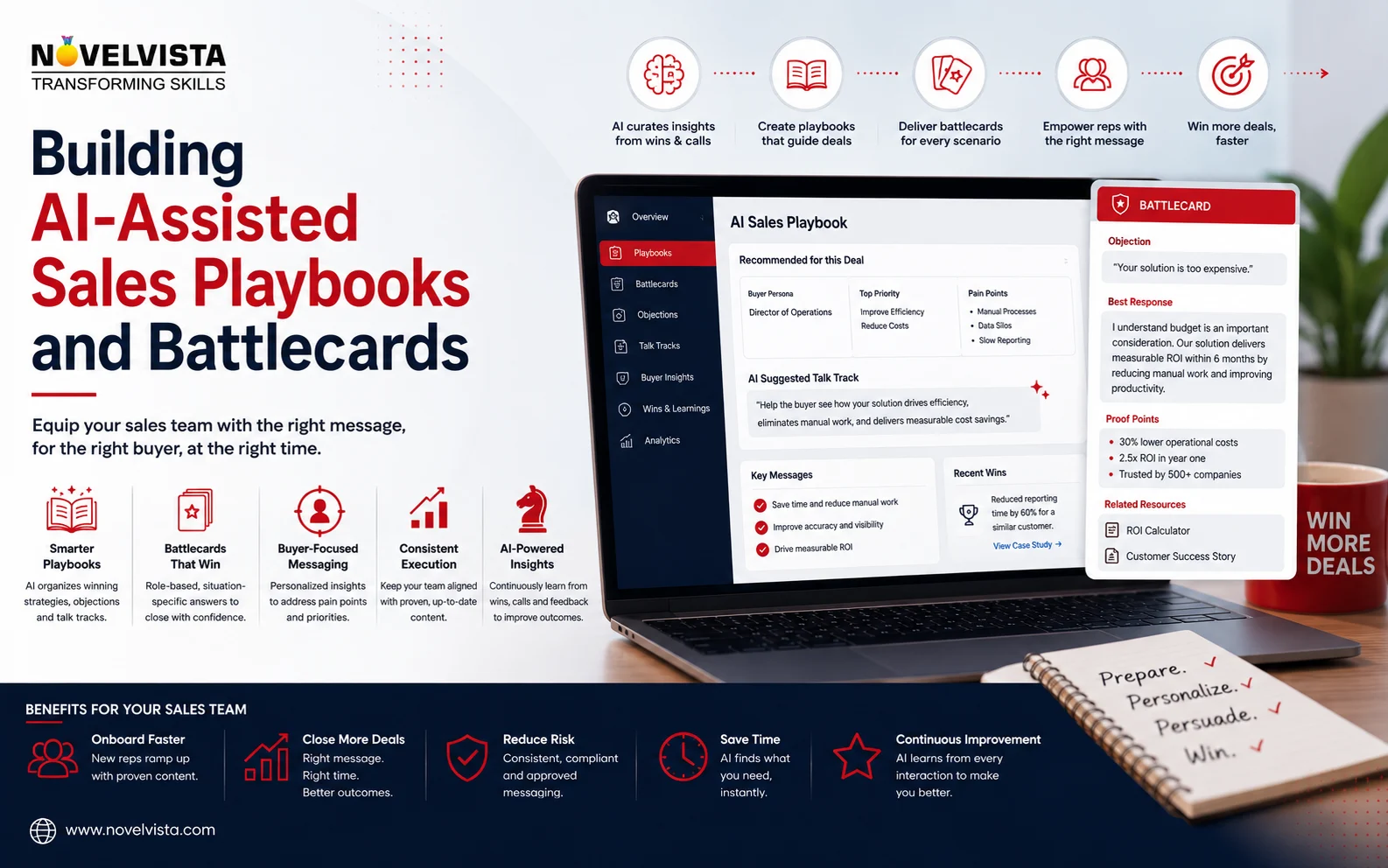
Sales teams today operate in an environment where buyers are more informed, competitors move quickly, and product messaging changes frequently. Traditional sales playbooks and battlecards can still be useful, but they often become outdated soon after they are created.
AI can help solve this problem.
AI-assisted sales playbooks and battlecards allow organizations to organize sales knowledge, analyze customer conversations, identify competitive trends, and provide AI for Sales & Business Development representatives with more relevant guidance when they need it. Instead of relying only on static documents, sales teams can use AI to create a more dynamic and practical sales enablement system.
The goal is not to replace sales experience. It is to give salespeople better information, faster.
Start with a Clear Sales Strategy
Before using AI, organizations should first define what their sales playbook needs to accomplish.
A playbook may include information about target customers, buyer personas, discovery questions, qualification criteria, messaging frameworks, objection handling, product positioning, sales stages, and follow-up strategies.
If the underlying sales process is unclear, AI will not automatically fix it.
Sales leaders should identify the most important situations representatives face. For example, a team may need stronger guidance for enterprise discovery calls, competitor conversations, pricing objections, or cross-selling opportunities.
AI can then be used to strengthen those specific areas.
Use AI to Organize Existing Sales Knowledge
Most organizations already have valuable sales information scattered across different systems.
It may exist in CRM records, sales presentations, product documentation, recorded calls, emails, proposal templates, customer success notes, and training materials.
AI can help analyze and organize this information into a structured playbook.
For example, AI can summarize successful sales conversations and identify common questions asked by prospects. It can also highlight recurring objections and show how top-performing representatives respond to them.
This allows sales enablement teams to build playbooks based on real customer interactions rather than assumptions.
Build More Useful Battlecards
Battlecards are designed to help sales representatives respond confidently when competitors are mentioned during a sales conversation.
Traditional battlecards usually include competitor strengths, weaknesses, pricing information, positioning statements, and suggested responses.
AI can make these resources more actionable.
For example, AI tools can help summarize publicly available competitor information, product updates, customer reviews, and market positioning. Sales enablement teams can then use these insights to update competitive messaging.
A useful battlecard should answer practical questions such as:
- Why do customers choose this competitor?
- Where is our solution stronger?
- Where might the competitor have an advantage?
- What discovery questions should the salesperson ask?
- Which claims should sales representatives avoid making?
- What proof points support our positioning?
The objective should be to improve sales conversations, not simply criticize competitors.
Personalize Playbooks for Different Buyer Personas
Different buyers care about different outcomes.
A technical leader may focus on integration, security, scalability, and architecture. A finance leader may care more about cost, efficiency, risk, and return on investment.
AI can help sales teams adapt messaging for different personas.
For example, a salesperson preparing for a meeting with a CIO could use an AI-assisted playbook to identify technology-focused talking points. For a CFO meeting, the same product could be positioned around financial impact and operational efficiency.
This helps sales representatives move away from generic pitches and have more relevant conversations.
Improve Objection Handling
Objections are one of the most valuable areas for AI-assisted sales enablement.
Sales teams regularly hear questions about price, implementation time, product capabilities, existing vendors, security concerns, and purchasing priorities.
AI can analyze historical conversations and group objections into common categories.
Sales leaders can then develop recommended responses, supporting evidence, follow-up questions, and escalation paths.
For example, instead of responding immediately to a pricing objection with a discount, the playbook might recommend asking:
“What part of the investment is creating the most concern?”
This helps sales representatives understand the real issue before responding.
AI can also help generate role-play scenarios so teams can practice handling difficult objections.
Connect Playbooks with CRM and Sales Tools
AI-assisted playbooks become much more valuable when they are connected to the tools salespeople already use.
Integrating playbooks with CRM platforms, call intelligence tools, email systems, and sales engagement platforms can provide guidance in context.
For example, before a customer meeting, AI could summarize previous conversations, identify open questions, highlight potential risks, and recommend relevant case studies.
After the meeting, it could suggest follow-up actions or update CRM notes.
This reduces the amount of time representatives spend searching through documents.
Keep Human Review in the Process
AI-generated sales content should not automatically become approved sales messaging.
AI can misunderstand information, produce outdated claims, or generate statements that are not supported by company data.
Sales, marketing, legal, product, and compliance teams should review important messaging before it is included in official playbooks.
This is especially important for competitor comparisons, pricing claims, regulatory statements, and product capabilities.
Clear governance helps ensure that AI improves speed without reducing accuracy.
Measure What Actually Helps Salespeople
The success of an AI-assisted playbook should not be measured by how much content it contains.
It should be measured by whether sales representatives actually use it and whether it improves results.
Organizations can track metrics such as playbook usage, sales cycle length, conversion rates, win rates, objection success rates, competitor win-loss trends, and onboarding time.
Sales teams should also provide direct feedback.
If representatives repeatedly ignore a battlecard, the problem may not be adoption. The content may simply not be useful enough.
Final Thoughts
AI-assisted sales playbooks and battlecards can transform sales enablement from a static documentation exercise into a continuously improving knowledge system.
AI can help organizations capture insights from customer conversations, organize sales knowledge, personalize messaging, improve objection handling, and maintain competitive intelligence.
However, the strongest results come when AI is combined with experienced sales judgment and strong governance.
A successful sales playbook should make it easier for representatives to understand the buyer, ask better questions, respond confidently, and communicate value clearly.
When built thoughtfully, AI-assisted playbooks do not tell salespeople exactly what to say. They give them the context and guidance needed to have better conversations and make better sales decisions.

 English
 Arabic
 French
 Spanish
 Portuguese
 Deutsch
 Turkish
 Dutch
Dutch
 Russian
 Romaian
 Portuguese (Brazil)
 Greek
Greek
