


LASIK Eye Surgery vs. Traditional Vision Correction Methods
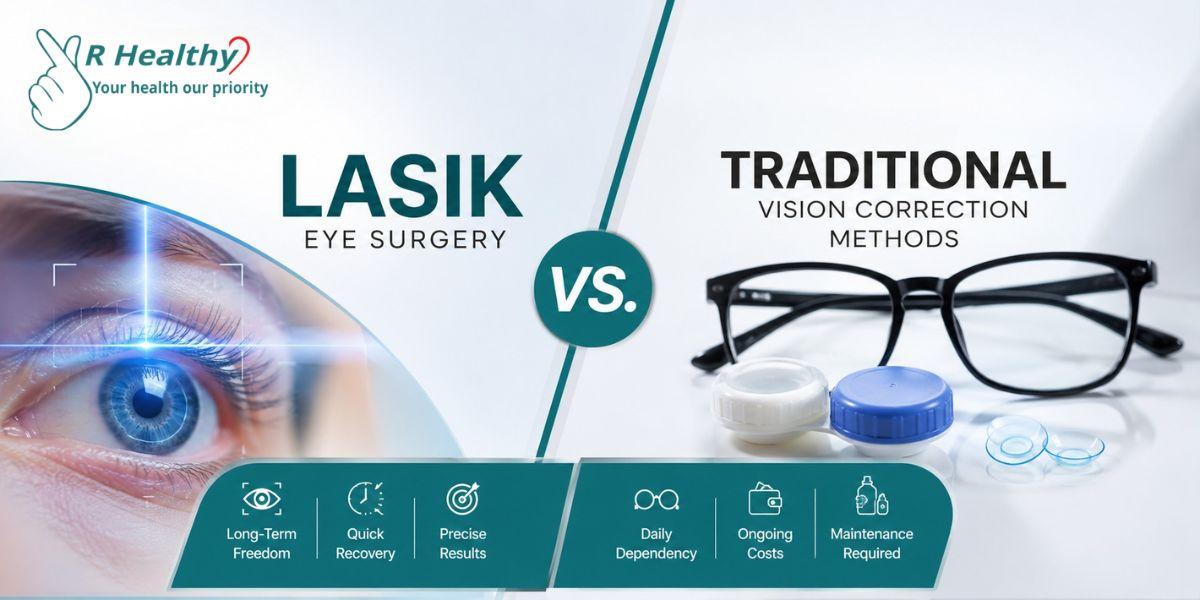
For those who rely on glasses or contacts, contemporary solutions provide several options to consider. LASIK eye surgery is one of the most proven surgical techniques, and conventional methods like glasses and contacts can still be used effectively by a variety of patients.
Learning about the distinctions among these procedures can help you in deciding what works best for you when talking about LASIK eye surgery during consultations.
What Is LASIK Eye Surgery?
LASIK is a type of refractive surgery that utilizes a laser technique in order to correct some refractive issues, including myopia, hyperopia, and astigmatism, by changing the shape of the cornea.
In LASIK laser eye surgery, the surgeon accesses the corneal tissue with the help of a special cutting tool and makes necessary changes to its shape using the excimer laser. The aim is to modify the way light enters the retina.
LASIK eye surgery is usually an outpatient surgery, but your eligibility will need to be assessed during a thorough eye examination.
Corrective Vision Methods Using Glasses
Using glasses is one of the safest methods to fix visual problems. The glasses modify the way the light travels in order to focus properly on the retina.
Benefits of Glasses
-
Non-invasive method
-
Easily used
-
No post-operative period is required
-
Prescription can be adjusted in case of vision modification
-
Existence in various kinds of glasses with different types of coatings
Nevertheless, some patients consider that glasses can be uncomfortable in the process of exercising, travelling, doing something outdoors or even working.
Contact Lenses - Alternative Traditional Method
The contact lenses are placed right on the eye surface and fix the vision problems without modifying the face appearance.
The lenses can provide a better visibility area than the glasses; however, proper maintenance, handling and replacements are required in order to prevent possible complications for the eyes.
Those who want to decrease dependency on glasses and contact lenses should discuss the eye laser surgery option with the refractive surgeon.
Various Forms of Laser Vision Correction
During a lasik eye surgery consultation, the specialist can compare different laser vision correction procedures and determine which option may be appropriate based on your prescription, corneal measurements, and overall eye health.
However, LASIK is not the only laser procedure available nowadays. Depending on the measurement of your eyes, an ophthalmologist may recommend other treatments to you.
Traditional LASIK
Traditional LASIK involves the use of a proven laser technique for correcting the cornea.
LASIK laser treatment precisely reshapes the cornea to correct eligible refractive errors and may reduce the need for glasses or contact lenses.
Femto or Bladeless LASIK
This treatment involves a femtosecond laser to cut the cornea flap without using a mechanical blade.
Customized LASIK
In customised LASIK surgery, a unique treatment strategy for the correction of the patient's eye problem is developed based on individual measurements.
Contoura Vision
Contoura Vision treatment includes the use of special topography for taking into consideration detailed surface features of the cornea. Its applicability depends on individual diagnostic results.
PRK
It is a surface laser procedure where the surface of the cornea is removed before the laser correction. PRK recovery is usually longer than LASIK, but PRK can be recommended for some people who are not suitable for LASIK.
SMILE
SMILE is a laser surgery that involves a small corneal incision and removal of a specially prepared lenticule inside the cornea.
What about ICL & lens procedures?
All those seeking to escape wearing spectacles are good candidates for corneal laser surgery.
An ICL procedure is where one undergoes an implantation of lenses into the eye without having the natural lens removed. Refractive Lens Exchange (RLE) and Clear Lens Extraction (CLE) are other options that can be recommended for consideration.
Individuals looking for the price of ICL, RLE, or CLE must realise that they are not like the LASIK procedure and that they require different prices.
How much does LASIK cost?
The cost of LASIK eye surgery depends on many factors, including the procedure, the technology used, the surgeon, and even the place where one seeks treatment.
Some factors that might affect the LASIK eye surgery cost in India include the following:
Laser Procedure type
-
Standard or custom
-
Diagnostic tests
-
Surgical Expertise of the surgeon
-
Technology
-
Facilities available in Hospital/clinic
-
Postoperative Treatment Costs
Patients comparing laser eye surgery for vision correction costs in India should request a detailed treatment estimate.
Is LASIK Eye Surgery Always the Cheapest Solution?
While searching for affordable LASIK low-cost surgery might seem sensible, price shouldn't be the decisive factor in selecting an eye operation.
The right eye surgery treatment should depend upon clinical suitability, safety, skills of the doctor, diagnostics, technology, and postoperative care.
LASIK eye surgery consultation is a way to establish if LASIK or other methods of vision correction are indicated for you.
A detailed LASIK eye surgery consultation can also help patients understand the expected results, potential risks, recovery requirements, and approximate treatment expenses before making a decision.
Choosing the Right Method of Treatment
Before undergoing LASIK laser eye surgery, detailed measurements of the cornea and an assessment of overall eye health are important to determine whether the procedure is suitable.
When trying to find the best laser eye surgery, do not choose an operation just because it's more modern or expensive.
During the consultation, an eye laser specialist may conduct a series of tests, including:
-
Your eye prescription
-
Cornea thickness
-
Cornea shape
-
Tear film condition
-
Eye pressure
-
Retina health
-
Past eye conditions or operations
-
General health
This will allow establishing whether you need LASIK, PRK, SMILE or other procedures.
Eye Lasik Surgery in Delhi
LASIK eye surgery in Delhi should be chosen not only based on its location and price but also considering the expertise of the surgeon, diagnostic infrastructure, laser equipment, pre-operative patient assessment, and aftercare services provided.
It is especially important to give due consideration to a comprehensive consultation, as two individuals having similar glasses prescriptions can vary greatly when it comes to their cornea thickness and treatment candidacy.
Conclusion
Conventional methods of vision correction and laser vision correction both play an important role in ocular care. Glasses and contact lenses are the safest and most convenient choices for many people, whereas LASIK laser eye surgery can help minimise dependence on correction devices in suitable candidates.
The other options include procedures such as PRK, SMILE, Contoura, Femto LASIK, ICL, and lens surgery.
Instead of making a decision on LASIK price, SMILE surgery price, PRK price, or other laser treatments offered, it is recommended to go through a thorough eye evaluation and consult a professional refractive surgeon regarding the most suitable procedure for your eye condition and lifestyle.
FAQS
1. What is the difference between LASIK and traditional methods of vision correction?
While LASIK uses a laser to reshape the cornea and correct specific refractive disorders, glasses and contact lenses correct vision without any alteration to the anatomy of the eye.
2. Is LASIK surgery better than wearing glasses?
While LASIK surgery may make people less dependent on glasses, there is no guarantee that this method is better than wearing glasses in all cases; a consultation with an ophthalmologist is necessary.
3. How does lasik laser eye surgery work?
With the help of the laser, the surgeon will be able to reshape the cornea to improve the focusing of the incoming light onto the retina.
4. Which option is safer – LASIK or glasses?
Since wearing glasses is completely safe and does not imply any risks, people should consult an ophthalmologist regarding the risks of LASIK before choosing this option.
5. What are the alternatives to LASIK surgery?
Depending on the patient's eye condition, alternatives may include glasses, contact lenses, PRK, SMILE, ICL, or other refractive procedures.
6. Are all people eligible for LASIK surgery?
Not at all. Factors that affect eligibility include prescription stability, corneal thickness and shape, eye health and tear film quality and general health condition.
7. What is the difference between LASIK and PRK?
These procedures involve a laser to change the shape of the cornea, but PRK involves correction without making a LASIK-type corneal flap.
8. What is Femto LASIK?
Femto LASIK makes a corneal flap using a laser instead of the blade used in regular LASIK. The most suitable option will be determined by the patient's specific eye measurements.
9. How much does LASIK eye surgery cost in India?
This will depend on the type of procedure, laser technology used, diagnostic test done, surgeon's experience, and facilities, among others. Patients should ask for the treatment price.
10. Should I go for the lowest-priced LASIK surgery?
Not at all. While comparing LASIK prices, factors such as safety, suitability for the patient, surgeon's experience, diagnostic tests, technology, and aftercare, among others, should be considered.

 English
 Arabic
 French
 Spanish
 Portuguese
 Turkish
 Dutch
Dutch
 Italiano
 Russian
 Romaian
 Portuguese (Brazil)
 Greek
Greek
