


Building a Computer Vision System That Actually Works in the Real World
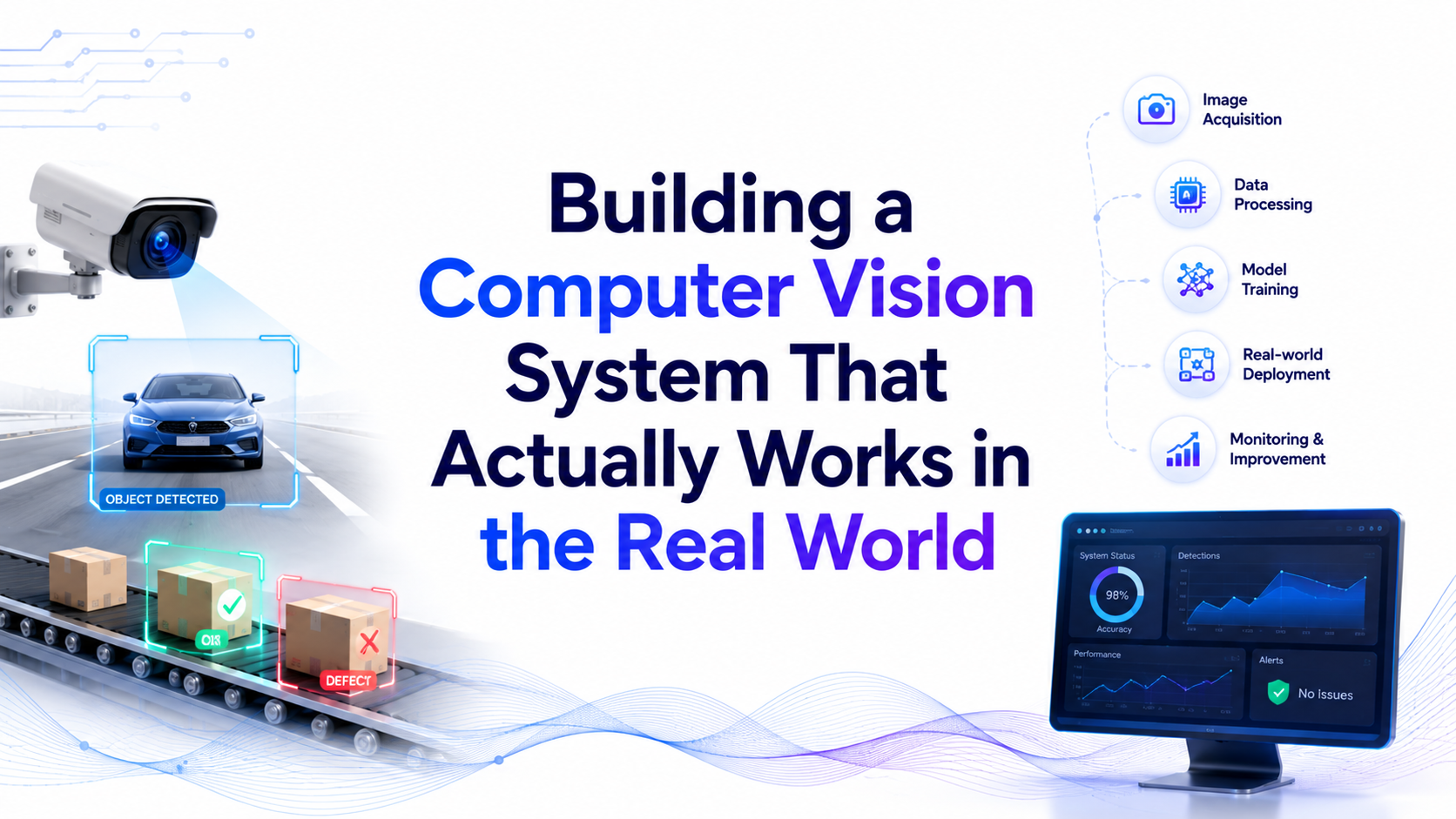
Computer vision is a technology that has matured enough to be used in practice: from manufacturing and retail to healthcare, logistics, security, and self-driving cars. However, getting a model to perform well on a controlled test set is significantly easier than getting it to work in real-world conditions. One must carefully consider a variety of factors when building a computer vision system that will be used outside of carefully controlled conditions, including data, architecture, hardware, and more. Here are the key considerations that one should think through when building a computer vision system for practical applications.
Start With a Clearly Defined Business Problem
Before anything else, one should identify the problem that they're trying to solve with their computer vision system. This process necessitates working backward from the desired outcome. For example, a manufacturing company might want to inspect products on a conveyor belt for flaws, whereas a retail store may want to monitor inventory on shelves. Both applications will have different requirements in terms of algorithms, cameras, and metrics. The following five criteria should be taken into account when developing a computer vision system:
- What objects or events need to be detected?
- How accurate should predictions be?
- How quickly should predictions come out?
- How to respond to false predictions?
- Where will the system operate?
Having clearly defined requirements is essential because it helps avoid wasting time and effort on unimportant performance gains. Many organizations partner with providers of Computer Vision services to help scope these requirements from the outset.
Build a Dataset That Represents Reality
It is essential to have data that reflects real-world conditions in order to develop an accurate and robust computer vision system. Even more crucial is having a comprehensive dataset that covers a wide variety of corner situations.
The data should include a vast range of lighting circumstances, backgrounds, and object positions if the computer vision system will be used in various locations. Additionally, the data should contain a wide range of shot distances and qualities, and, if applicable, weather conditions. It's typical to utilize data augmentation to create additional images by applying transformations such as cropping, rotating, scaling, and adjusting brightness. However, it's crucial not to rely only on artificial data: rather, it should supplement genuine images.
It's vital to label the data correctly so that the model learns the correct associations. Bounding box location inaccuracies, missing objects, or incorrect labels might cause the model to learn incorrectly, resulting in time-consuming debugging later in the development cycle.
Choose the Right Computer Vision Architecture
The most important aspect of computer vision architecture choices is defining the problem. Object detection, image segmentation, image classification, pose estimation, and other computer vision tasks each have their own set of challenges. For example, one should use object detection algorithms in situations when there are several objects in an image that need to be identified separately. Image classification, on the other hand, enables one to classify the whole image into different categories. Meanwhile, image segmentation is useful when one has to determine the precise locations of certain objects within the image.
It is vital to choose a computer vision architecture that is appropriate for the task at hand. The following variables should influence this decision:
- Accuracy and recall
- Speed of predictions
- Model size
- Required hardware for inference
- Simplicity of training
- Ability to scale the model
One should keep in mind that a slightly less accurate but much smaller and faster model may be a far better choice in certain cases. Businesses building these systems often work with an experienced AI development services provider to select and implement the right architecture for their use case.
Design for Real-World Hardware and Deployment
Computer vision systems' performance is highly dependent on the hardware platform. For example, the camera's characteristics, such as its focal length and sensor size, influence what the model can see. Furthermore, the choice of hardware depends on the use case: using edge computing for time-critical applications or cloud infrastructure for analytics at scale.
The computer vision system's deployment architecture should also account for different possible failures. For example, one should define what actions the system should take if cameras fail, pictures are not captured successfully, connections are dropped, or confidence ratings are too low. In short, it is vital to thoroughly evaluate all of the system's components' reliability aspects before physically implementing it. Organizations navigating these tradeoffs frequently invest in broader AI development solutions that combine hardware selection, edge deployment, and cloud infrastructure.
Test Beyond the Training Environment
A high validation accuracy does not necessarily imply that a model will function properly in actual conditions. Thus, it is necessary to go beyond the standard validation procedures and test the model in actual conditions as well. One should do this even if the model performs exceptionally well on standard benchmarks.
The model should be tested in actual operating conditions, including potentially extreme ones. For example, one should test how the model reacts to poor lighting, motion blur, occlusions, and other challenging conditions. It's also a good idea to test how the model performs on different types of images separately: for instance, if the model is supposed to recognize different types of items on a shelf, but it performs considerably worse on certain items.
Monitor Performance After Deployment
Once a computer vision model has been deployed in a live setting, it is critical to continue to observe its performance. There's no question that the system will eventually encounter new and previously unknown data. This challenge is also known as data drift in the data science community. New seasons, new product designs, new cameras, new assembly lines, and other variables might cause the data that the model receives to differ from the data it was trained on.
The following five factors should be monitored during the model's operation:
- Confidence ratings in predictions
- False positives and negatives
- Latency
- Performance trends in relation to various environments and equipment
- Incoming data changes
If the model's performance begins to degrade, it may be necessary to retrain it using additional data. Companies maintaining these systems at scale often rely on a trusted AI development services partner to manage ongoing monitoring and retraining.
Make Reliability the Core Design Principle
A real-world computer vision system should be constructed with reliability in mind, rather than simply focusing on obtaining the highest possible accuracy. An optimal combination of robustness, appropriate algorithms, data, hardware, human control, and continuous performance monitoring will result in a reliable computer vision system in practice. One should also define what actions should be taken when the model is unsure about its predictions. In such situations, instead of attempting to force a prediction, it may be preferable to let humans examine the image.
To summarize, building practical computer vision systems necessitates a comprehensive understanding of all of the key aspects of the process. One should pay special attention to hardware, algorithms, data, and model performance in actual operating conditions. It is critical to thoroughly evaluate all of the variables, including potential system failure points. By following these recommendations, one will be able to design a reliable computer vision system for their application.

 English
 Arabic
 French
 Spanish
 Portuguese
 Turkish
 Dutch
Dutch
 Italiano
 Russian
 Romaian
 Portuguese (Brazil)
 Greek
Greek
