


How Indian MSMEs Can Save 40% Operational Time Through Automation
How Much Time Are Indian MSMEs Actually Losing?
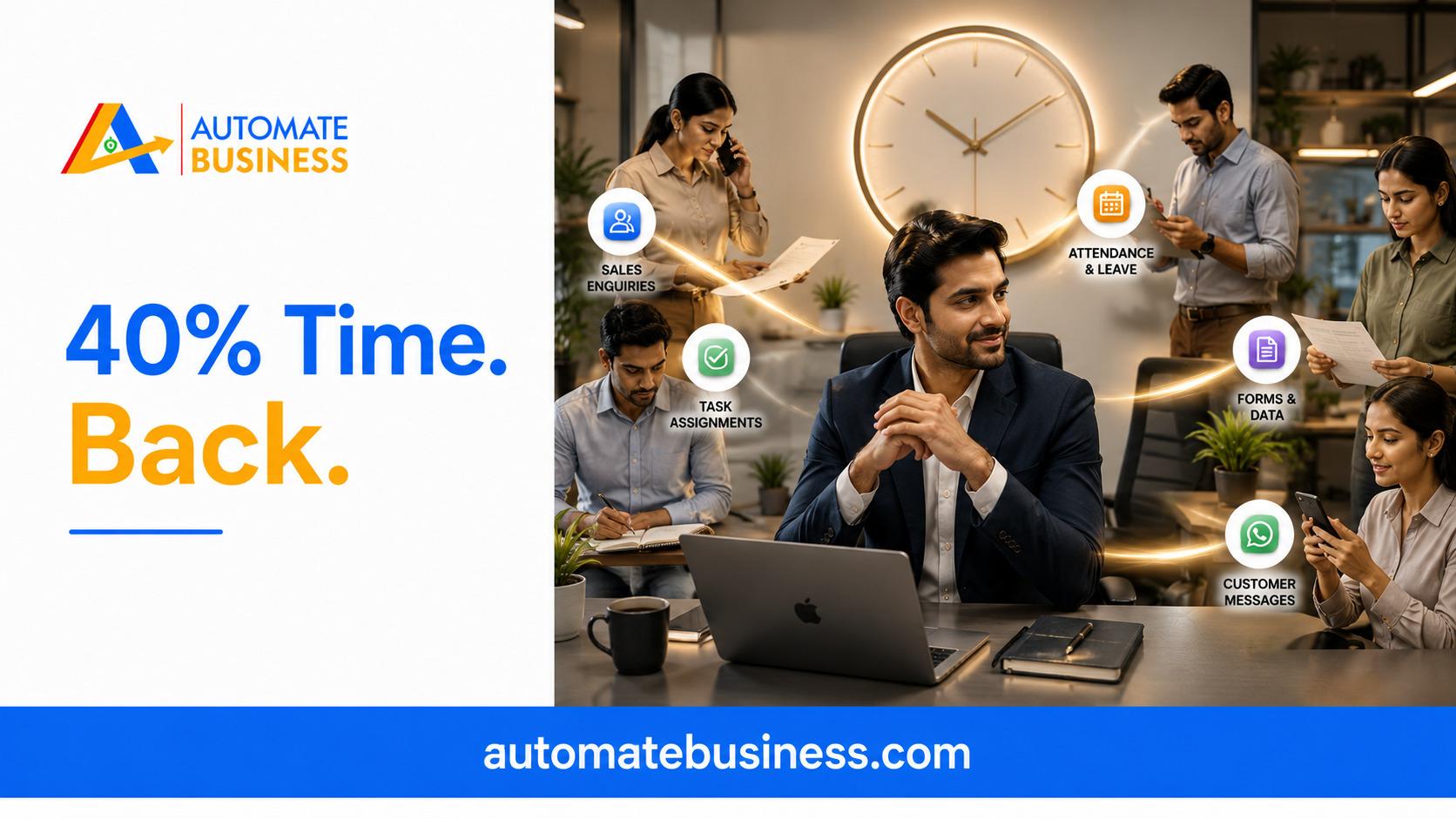
If you run a small or mid-sized business in India, there is a number worth knowing: 40 percent. That is the share of operational time that most MSME teams spend every week on tasks that could be automated following up on leads manually, updating spreadsheets, chasing employees for attendance, re-entering data from one system into another, and coordinating work over WhatsApp threads that nobody can actually track.
Forty percent is not a rounding error. For a team of 10 people working 8 hours a day, that is 32 hours of productive capacity lost every single day to repetitive, low-value work. For a team of 50, it is closer to 160 hours per day. That is the equivalent of hiring 20 people just to stand still.
The automate businesses saving that time in 2026 are the ones that have replaced manual processes with automation. They are using tools like Automate CRM to capture leads from IndiaMART and TradeIndia automatically, manage their entire sales pipeline without spreadsheets, and trigger follow-ups without a single manual reminder. The time they recover goes back into selling, serving customers, and scaling. This blog breaks down exactly where that time is being lost and how Indian MSMEs are getting it back.
Where Does the 40% Go? The Real Time Drains in an MSME
Before you can save operational time, you need to know where it is disappearing. For most Indian MSMEs, the losses fall into five clear categories.
- Manual Follow-Ups and Lead Management
Every sales enquiry that comes in through IndiaMART, TradeIndia, your website, or a referral needs a timely response and consistent follow-up. In a manually operated business, this means someone has to check the inbox, copy the contact details somewhere, message the salesperson on WhatsApp, hope it gets seen, and then remember to follow up three days later.
In reality, most leads get a slow first response and inconsistent follow-ups. Research consistently shows that the speed of the first response is one of the biggest drivers of conversion in B2B sales. When your competition responds in 5 minutes and you respond in 5 hours, the deal is already lost. - Task Assignment and Team Coordination
Ask any MSME owner how they assign tasks to their team and the answer is almost always the same WhatsApp, phone calls, or verbal instructions. None of these create a record. None of them have built-in accountability. And when a task is missed or delayed, hours are spent figuring out who was responsible and what happened.
This kind of coordination overhead scales badly. A team of 5 can manage it with effort. A team of 25 cannot. - Attendance and Leave Management
Tracking attendance for a workforce spread across locations, shifts, or field roles is one of the most time-consuming HR tasks in any MSME. Paper registers, WhatsApp check-in messages, and self-reported logs are easy to manipulate, hard to verify, and nearly impossible to convert into payroll reports without hours of manual calculation.
Disputes over attendance and leave are also one of the most common sources of friction between employees and management in small businesses friction that costs time, morale, and sometimes the employee themselves. - Data Collection and Form Processing
Whether it is a customer enquiry form, a vendor registration, a site inspection report, or an employee feedback survey most MSMEs still collect data on paper or through generic tools that have no connection to the rest of the business. Someone then has to manually transfer that data somewhere useful. Errors creep in. Data gets lost. Decisions get made on incomplete information. - Customer Communication and Support
Responding to customer queries, sending order updates, sharing promotional messages, and handling complaints all of this typically runs through a single phone number or personal WhatsApp account in most MSMEs. There is no shared record of what was said, no way for a teammate to pick up a conversation, and no system to handle queries when the primary person is unavailable.
How Automation Recovers That Time Department by Department
- Automating Sales with a CRM Built for MSMEs
The fastest return on automation investment for most MSMEs comes from the sales function. When you connect your lead sources directly to a CRM, the entire top-of-funnel process becomes automatic. Leads from IndiaMART, TradeIndia, your website, and other sources land in your pipeline instantly, assigned to the right salesperson, with follow-up sequences triggered automatically.
Automate CRM is built specifically for this. It eliminates the copy-paste step entirely, keeps your pipeline visible to everyone on the sales team, and ensures no lead ever goes cold because someone forgot to follow up. Sales teams using this approach report spending significantly more of their time on actual conversations and closures not on admin. - Automating Task Management for Operational Teams
With a proper task management system, you stop coordinating work through WhatsApp and start running your operations on a shared, trackable platform. Tasks are assigned with clear owners, deadlines, and priorities. Everyone knows what they are supposed to be doing and by when. Managers get real-time dashboards showing what is on track, what is delayed, and where help is needed.
AI-powered WhatsApp reminders mean your team gets notified automatically when a task is due or overdue without you having to personally chase anyone. For teams of 10 to 200-plus people, this single change can recover multiple hours of management time per day. - Automating Attendance and Leave for HR Teams
Geo-fenced punch-in with facial recognition removes the possibility of proxy attendance and eliminates the need for anyone to manually verify who was present and when. Employees mark their own attendance from their phones, but only from the approved location. The system records everything in real time.
Leave requests go through a digital approval flow. Managers approve or reject from their phones. The system automatically updates leave balances and generates payroll-ready attendance reports at the end of the month. What used to take your HR team hours every week now takes minutes. - Automating Data Collection with Smart Forms
AI-powered form builders eliminate the manual data transfer step entirely. When a customer fills in an enquiry form, that data goes directly into your CRM. When an employee submits a field report, the response is synced to Google Sheets and a WhatsApp notification is sent to the relevant manager instantly. No re-entry, no errors, no delays.
Multi-page intelligent forms can also be set up to show different questions based on earlier answers, making them faster for respondents and richer in the data they collect. - Automating Customer Communication via WhatsApp
A shared team inbox for WhatsApp means every customer conversation is visible to your entire support or sales team. No more depending on one person's phone. No more lost conversation history when an employee leaves. Smart chatbots handle routine queries pricing, availability, order status around the clock, with a human stepping in only when genuinely needed.
Broadcast campaigns let you send targeted messages to segmented customer lists with a few clicks, replacing the slow and manual process of sending individual WhatsApp messages to hundreds of contacts.
What 40% More Time Actually Means for Your Business
Saving 40 percent of operational time does not mean your team works 40 percent less. It means they redirect that time toward work that actually grows the business. Sales teams make more calls and close more deals. Operations teams focus on quality and delivery rather than coordination overhead. HR spends time on hiring and culture rather than spreadsheets. And you, as the business owner, finally have the visibility and bandwidth to think strategically instead of spending your day firefighting.
Businesses on the Automate Business platform consistently report a 70 percent increase in team productivity after automating their core workflows, alongside a 20 percent reduction in operational costs and the 40 percent time saving at the heart of this article.
These are not aspirational numbers. They are what happens when you stop asking your team to do what a system can do better.
The Right Way to Start Saving Time Through Automation
The mistake most MSME owners make is waiting until everything is broken before they act. By then, fixing the problem requires far more time and investment than it would have taken to prevent it.
The right approach is to pick the single most painful manual process in your business right now and automate that first. If leads are being lost, start with CRM. If tasks are falling through the cracks, start with task automation. If attendance is a constant dispute, start there.
Once you see the time saving in one area, the business case for expanding automation across the rest of your operations becomes obvious.
Automate Business brings all five automation tools Tasks, CRM, Leave and Attendance, Forms, and WhatsApp Chats into a single workspace built for Indian MSMEs. No complex setup. No IT team required. Just a smarter way to run your business. Explore all five products and book a demo.

 English
 Arabic
 French
 Spanish
 Portuguese
 Deutsch
 Dutch
Dutch
 Italiano
 Russian
 Romaian
 Portuguese (Brazil)
 Greek
Greek
