


Integrating AIOps with ITIL Processes: What Changes and What Doesn't
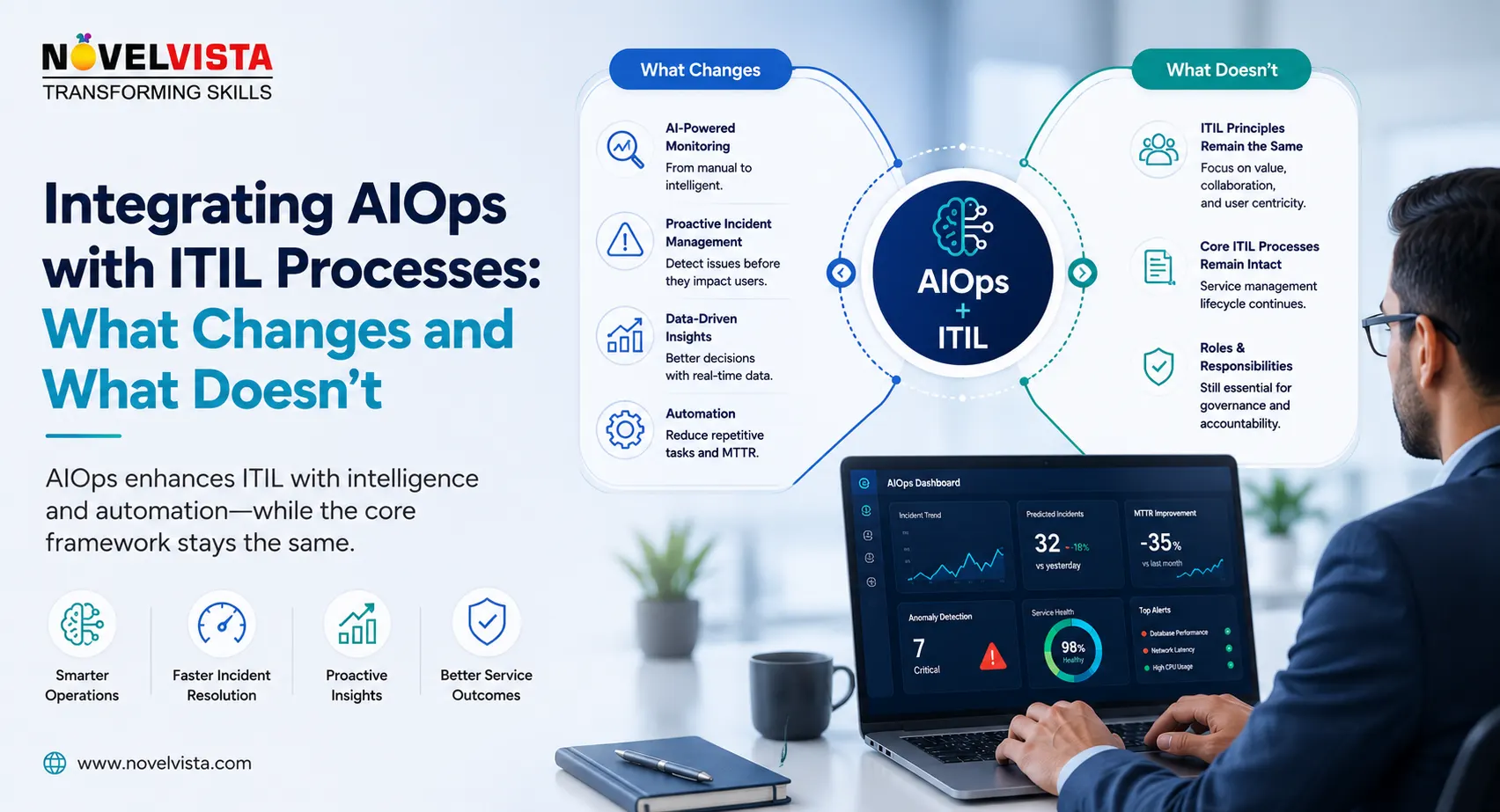
For years, ITIL has helped organizations bring structure to IT service management. Incident management, problem management, change enablement, service monitoring, and continual improvement give IT teams a consistent way to operate complex environments.
Then came AIOps.
Artificial Intelligence for IT Operations, or AIOps, introduces machine learning, automation, event correlation, anomaly detection, and predictive analytics into day-to-day IT operations. Naturally, this raises an important question for IT leaders:
Does AIOps replace traditional ITIL processes, or does it simply change how those processes are performed?
In most organizations, the answer is somewhere in the middle.
AIOps can dramatically change the speed, intelligence, and level of automation inside IT operations. However, the fundamental goals of ITIL—delivering reliable services, managing risk, restoring services quickly, and continuously improving performance—remain highly relevant.
Incident Management Becomes Faster, Not Unnecessary
Consider a typical incident environment.
Monitoring systems may generate thousands of alerts every day. Operations teams need to determine which alerts matter, whether several alerts are related, and which systems are actually affected.
Traditionally, much of this analysis depends on people.
AIOps can perform part of that work automatically.
Machine learning models can correlate alerts from servers, cloud platforms, databases, applications, and network devices. Instead of presenting twenty separate alerts, an AIOps platform may recognize that they are symptoms of the same underlying service failure.
It can then prioritize the incident and provide responders with relevant context.
What changes is the speed of detection and diagnosis.
What does not change is the objective of incident management: restore normal service as quickly as possible while minimizing business impact.
Human ownership, escalation procedures, communication, and service restoration responsibilities still matter.
Problem Management Becomes More Proactive
Traditional problem management often begins after incidents occur repeatedly.
Teams investigate historical incidents, identify common causes, and work toward permanent solutions.
AIOps can shift some of this activity earlier.
By continuously analyzing operational data, AI systems can identify unusual behavior before users report a problem. For example, a system might detect increasing database latency, unusual memory consumption, or recurring application failures.
The platform may identify patterns that would be difficult for humans to notice across millions of events.
This allows problem management teams to investigate emerging risks before they become major incidents.
However, AI-generated correlations should not automatically be treated as confirmed root causes.
An AI platform may detect that two events frequently occur together, but experienced engineers still need to determine whether one actually causes the other.
The discipline of root-cause analysis remains important.
Event Management Becomes Highly Automated
Event monitoring is one of the areas where AIOps can deliver immediate value.
Modern IT environments produce enormous amounts of operational data.
Cloud services, containers, APIs, applications, infrastructure, security tools, and end-user systems continuously generate telemetry.
Without automation, operations teams can easily experience alert fatigue.
AIOps platforms can filter duplicate events, group related signals, identify anomalies, and prioritize events based on potential business impact.
Instead of asking engineers to investigate every alert, the system helps direct attention toward situations that are more likely to require action.
The ITIL principle remains the same: understand events and determine the appropriate response.
The difference is that AI performs much of the initial interpretation.
Change Enablement Still Requires Risk Management
AIOps can also support change management.
Historical operational data can help organizations understand whether similar changes caused incidents in the past. AI systems may analyze deployment history, application dependencies, service performance, and previous failures to estimate the risk associated with a proposed change.
This can help teams make better decisions.
For example, a deployment affecting a heavily interconnected service during a high-traffic period may receive a higher risk score than a routine configuration change.
However, automation should not eliminate appropriate governance.
High-impact changes may still require testing, approvals, rollback planning, and stakeholder communication.
AIOps can provide better evidence for decision-making, but accountability remains with the organization.
Automation Changes the Role of IT Operations Teams
One of the biggest changes is not the ITIL framework itself.
It is the role of the people operating within it.
Engineers may spend less time manually reviewing alerts and more time improving automation, validating AI recommendations, analyzing complex incidents, and designing resilient systems.
Service management professionals may also need new skills.
Understanding data quality, observability, automation rules, AI confidence levels, and model limitations becomes increasingly important.
The goal is not simply to automate existing processes. Organizations should use AIOps as an opportunity to redesign inefficient workflows.
Automating a bad process only makes the bad process run faster.
What Doesn't Change?
Despite the technology shift, several IT service management fundamentals remain.
Organizations still need clearly defined responsibilities. Service owners still need to understand business impact. Incident communication still matters. Changes still need appropriate risk controls. Problems still require investigation. And continual improvement remains essential.
Governance is particularly important.
AI-generated recommendations should be traceable, understandable, and subject to human oversight when decisions could significantly affect business services.

 Arabic
 French
 Spanish
 Portuguese
 Deutsch
 Turkish
 Dutch
Dutch
 Italiano
 Russian
 Romaian
 Portuguese (Brazil)
 Greek
Greek
