


How Gemini Uses Your Workspace Data and What That Means for Privacy
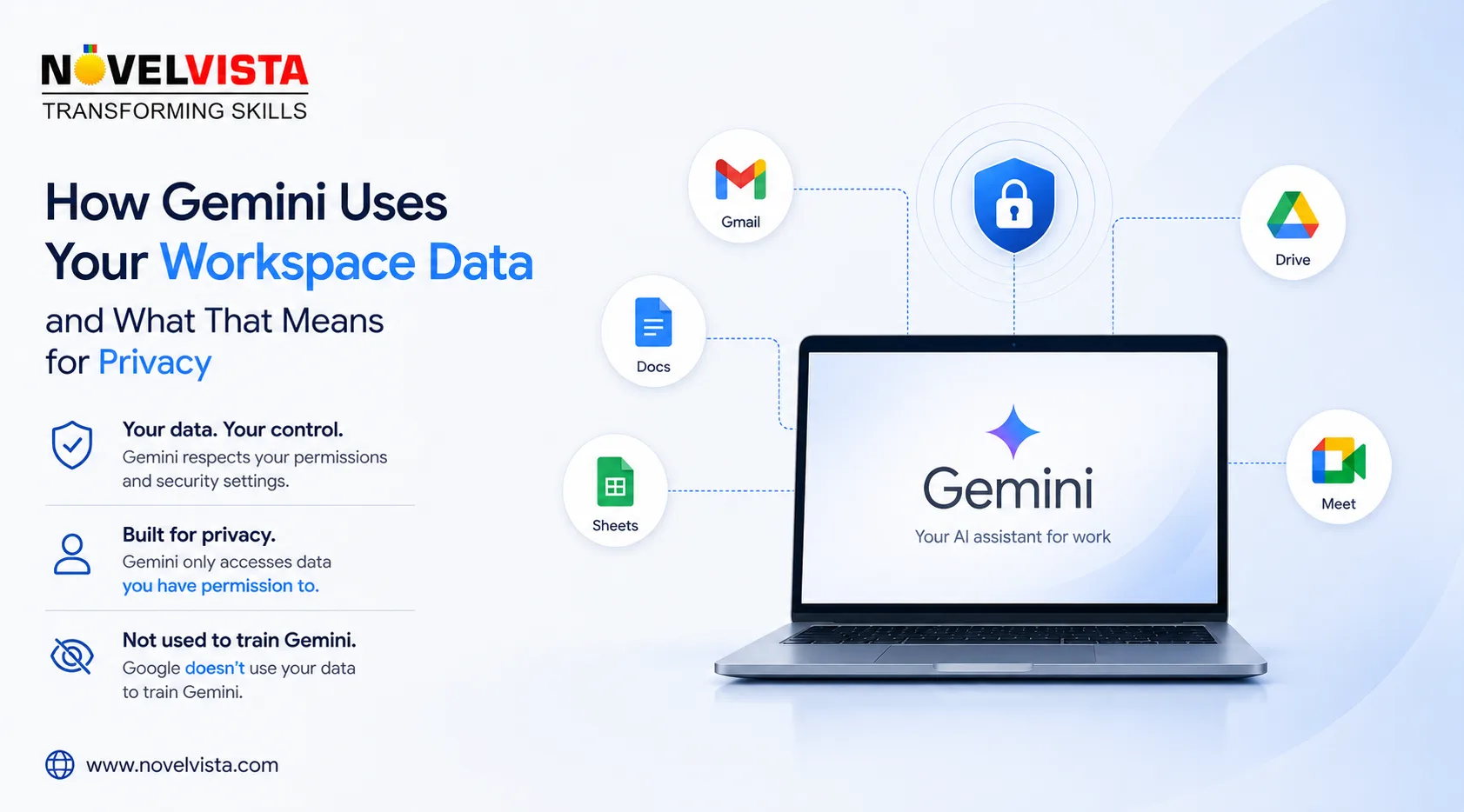
Artificial intelligence is becoming deeply integrated into everyday workplace tools. Google Gemini can now help summarize emails, draft documents, analyze spreadsheets, prepare presentations, find information across files, and assist with meetings. That convenience naturally raises an important question: What happens to your company data when Gemini uses it?
The answer depends partly on which Gemini experience you are using, but for organizations using qualifying Google Workspace editions, Google has established specific enterprise privacy protections.
Gemini Can Use Workspace Data to Answer Your Request
When Gemini is integrated with Google Workspace, it can use information from services such as Gmail, Drive, Docs, Sheets, Slides, Calendar, Chat, Meet, and other supported Workspace applications.
For example, you might ask Gemini:
“Summarize the latest updates from the Acme project.”
Gemini may locate emails, documents, presentations, or other relevant Workspace content that you already have permission to access. It can then use that information as context to generate the response.
This does not mean Gemini receives unrestricted access to everything inside the organization.
Google states that Gemini only accesses Workspace content that the signed-in user already has permission to access. Existing Workspace access controls continue to apply.
If an employee cannot normally open a restricted finance document, for example, Gemini should not suddenly give that employee access to its contents.
Is Your Workspace Data Used to Train Gemini?
This is one of the biggest concerns organizations have about generative AI.
According to Google's current Workspace privacy documentation, prompts, Workspace content, webpage context, and generated responses are not used to train Google's generative AI models outside the customer's domain without permission. Google also states that Workspace customer content is not human-reviewed for generative AI model training under these enterprise protections.
This is an important distinction from some consumer AI experiences where interactions may be processed differently depending on the service and privacy settings.
For corporate users, it means an employee asking Gemini to summarize an internal strategy document does not automatically turn that strategy document into public training material for future AI models.
Your Existing Workspace Security Still Matters
Gemini does not replace the security model of Google Workspace. It operates within it.
Controls such as user permissions, organizational policies, data loss prevention, and certain data-region policies can continue to apply when organizations use Gemini with Workspace.
That is good news, but it also exposes an important reality:
AI can amplify existing permission mistakes.
Imagine that hundreds of employees already have access to a folder that should have been restricted to ten people. Before AI, employees might never discover the sensitive documents hidden inside it.
With an AI assistant capable of retrieving relevant information, poorly configured permissions can become much more visible.
The privacy challenge is therefore not simply:
“Can we trust Gemini?”
Organizations should also ask:
“Have we properly governed the information Gemini is allowed to find?”
Gemini Does Not Automatically Share Your Content With Other Organizations
Google states that interactions with Gemini under qualifying Workspace protections stay within the organization and that customer content is not shared with other customers for their use.
This provides an important enterprise boundary around AI-assisted work.
However, employees can still create risks themselves.
For example, someone could use Gemini to generate a summary containing confidential information and then manually send that summary outside the company.
AI privacy controls cannot compensate for poor information-handling practices.
Organizations therefore still need clear policies covering confidential data, external sharing, generated content, verification, and acceptable AI usage.
Personal Gemini and Workspace Gemini Should Not Be Confused
This distinction is particularly important.
Gemini inside a qualifying business or enterprise Workspace environment comes with specific Workspace protections.
The consumer Gemini experience can operate under different privacy rules and settings. Gemini Apps can process prompts, uploaded files, connected-app information, location information, device information, and other interaction data according to the Gemini Apps Privacy Notice.
Google also specifically notes that personal Workspace users who choose to share Workspace information with certain Gemini Apps or Search experiences may have that information processed according to those separate services' policies, potentially including model improvement depending on the circumstances and settings.
That is why companies should clearly define which AI accounts and services employees are approved to use for business information.
What Organizations Should Do Before Expanding Gemini Usage
Companies should treat Gemini adoption as an information-governance initiative, not simply a software rollout.
Before giving employees broad access, organizations should review Workspace permissions, clean up outdated shared drives, classify sensitive information, configure administrative controls, establish AI usage policies, and train employees on what information should and should not be included in AI workflows.
Security teams should pay particular attention to historical permissions. AI systems make information easier to discover, which means forgotten access rights can become more consequential.
Organizations should also educate employees about the difference between approved enterprise AI services and consumer AI accounts.
Privacy Is Ultimately a Shared Responsibility
Gemini can significantly improve the way employees work with organizational knowledge. Finding information across documents, summarizing lengthy email discussions, preparing reports, and analyzing business information can become dramatically faster.
But powerful information retrieval also makes good governance more important.
Google's enterprise protections provide important safeguards around how Gemini processes Workspace information. Those protections, however, work alongside the organization's existing access controls and employee behavior.
The biggest privacy risk may therefore not be that Gemini suddenly ignores your company's security boundaries.
It may be that Gemini becomes extremely good at finding information inside boundaries your organization configured poorly years ago.
For enterprises adopting generative AI, the winning formula is therefore straightforward:
Secure the data. Govern access. Educate employees. Then let AI accelerate the work.

 English
 Arabic
 Spanish
 Portuguese
 Deutsch
 Turkish
 Dutch
Dutch
 Italiano
 Russian
 Romaian
 Portuguese (Brazil)
 Greek
Greek
