


Global Fermented Mycoprotein Market to Reach USD 766.7 Million by 2036
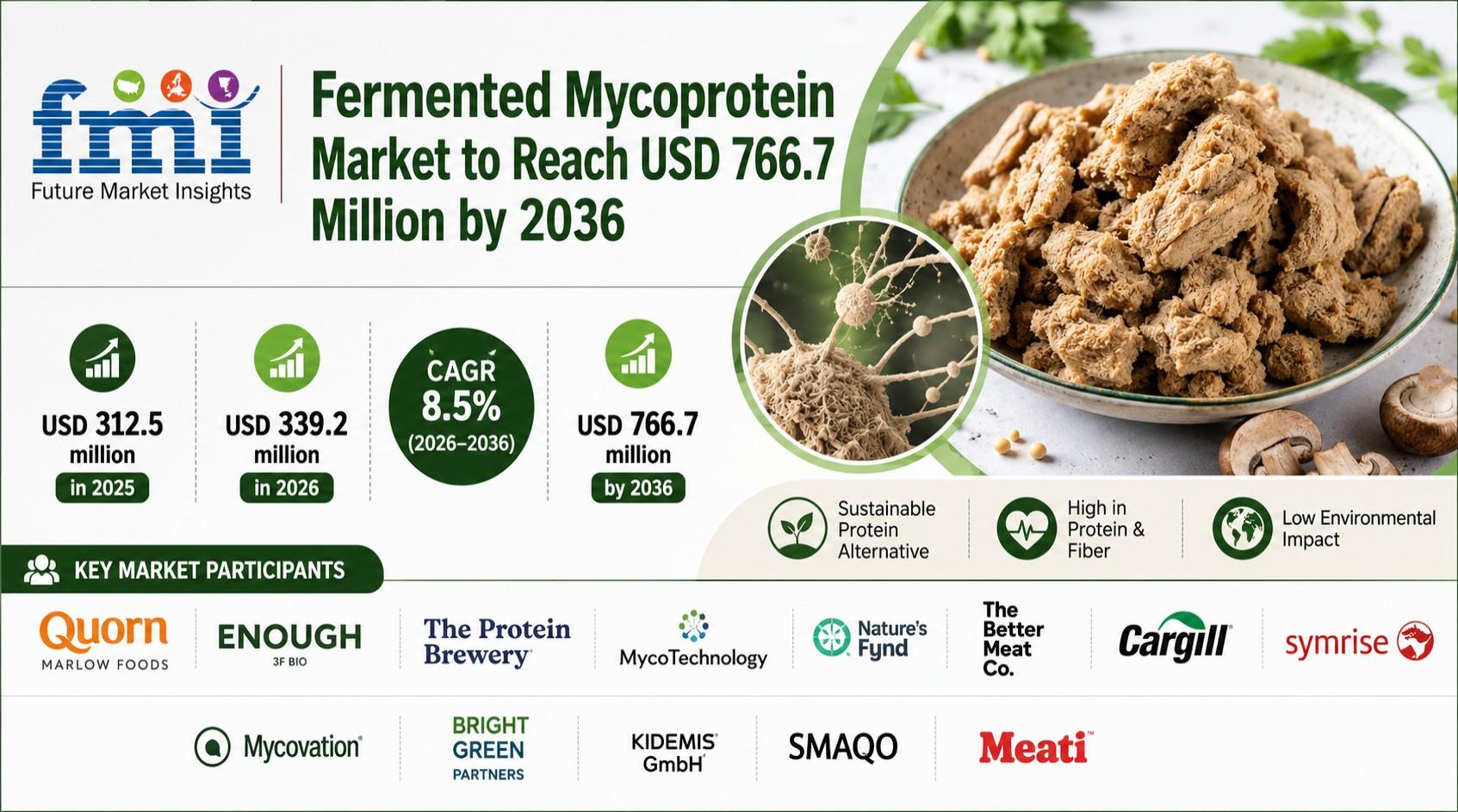
The global fermented mycoprotein market is undergoing a structural expansion, pivoting from a niche vegetarian offering into a mainstream, high-efficiency sustainable protein platform, according to latest insights by Future Market Insights. Produced via aerobic submerged fermentation of filamentous fungi (Fusarium venenatum), mycoprotein offers superior fibrous, whole-muscle texture fidelity, a complete amino acid profile (PDCAAS of 0.996), and natural dietary fiber content that unfermented plant proteins struggle to match.
The global market, valued at USD 312.5 million in 2025, is estimated to reach USD 339.2 million in 2026. Advancing at a Compound Annual Growth Rate (CAGR) of 8.5% over the ten-year forecast period, total market valuation is projected to achieve USD 766.7 million by 2036, delivering an absolute incremental opportunity of USD 427.5 million.
Request a Sample Report: https://www.futuremarketinsights.com/reports/sample/rep-gb-32104
Market Performance Overview (2026–2036)
To map out the key product forms, primary application channels, distribution pathways, and regional growth vectors guiding this USD 427.5 million market scale-up, key segment allocations highlight where global commercial demand is concentrated:
· Meat Alternatives Application Segment (55.0% share): Commands category leadership in 2026, driven by high consumer demand for whole-muscle chicken, burgers, nuggets, and sausage substitutes that match animal meat texture without soy or wheat allergen profiles.
· Minced Product Form Segment (38.0% share): Represents the leading product form by volume, anchored by three decades of grocery freezer presence (such as Quorn) and high utility in everyday ground meat dishes (bolognese, tacos, shepherd's pie).
· Whole-Cut Analogues (11.3% CAGR): Serves as the fastest-growing product form through 2036, enabled by B2B ingredient partnerships (such as ENOUGH's ABUNDA mycoprotein co-developed with Cargill) to supply industrial-scale poultry and seafood alternatives.
· Supermarkets and Hypermarkets Channel (47.0% share): Dominates retail sales, serving as the essential distribution vehicle for chilled and frozen meat alternative sections across Europe and North America.
· China & South Korea Regional Leadership: Lead national growth rates at 9.5% CAGR and 9.3% CAGR respectively through 2036, driven by state-backed food security investments, precision fermentation innovation, and functional food integration.
Technical Drivers and Precision Fermentation Shifts
The commercial scaling of fermented mycoprotein across food manufacturing and foodservice is propelled by three primary industry catalysts:
CRISPR Strain Engineering and Feedstock Optimization
Precision genetic tools are addressing mycoprotein's historical cost parity barrier versus commodity soy and pea isolates. Recent breakthroughs in CRISPR-mediated F. venenatum strain engineering have demonstrated an 88% increase in protein production rates while requiring 44% less carbohydrate feedstock, significantly lowering unit bioreactor manufacturing costs.
Regulatory Clearances and Novel Food Approvals
Positive regulatory opinions such as EFSA's scientific approval for Fermotein (The Protein Brewery) in Europe and FDA GRAS notifications in the United States are establishing clear market access pathways. Clear regulatory guidance enables large CPG brand owners to formulate with fungal biomass without legal ambiguity.
Hybrid Meat-Mycoprotein Formats and B2B Ingredient Platforms
Brand owners are expanding beyond full vegetarian substitution into hybrid protein formats (e.g., 50% conventional meat / 50% mycoprotein blends). Hybrid products allow QSR chains and food manufacturers to lower production costs, reduce carbon footprints, and improve nutritional profiles without alienating mainstream flexitarian consumers.
Industrial Constraints & Production Hurdles
Mycoprotein refiners and food processing companies face specific operational hurdles:
· High Bioreactor CAPEX and Energy Costs: Aerobic submerged fermentation requires sterile, continuously oxygenated bioreactor systems and high-purity glucose feedstocks, resulting in capital-intensive facility expansion requirements.
· Consumer Education in Non-Western Markets: While mycoprotein holds deep penetration in the UK and Western Europe, consumer unfamiliarity with fungal-derived ingredients across North America and Asia requires targeted communications emphasizing complete amino acids, fiber content, and clean-label purity.
Regional Growth Profile
Regional demand reflects deep, established grocery category penetration in Western Europe alongside rapid food-tech scaling in North America and Asia-Pacific:
· United Kingdom (9.1% CAGR) & Netherlands (8.9% CAGR): Lead Western European demand, anchored by deep retail penetration (Quorn) and state-of-the-art regional production hubs (such as ENOUGH's co-located facility in the Netherlands).
· China (9.5% CAGR) & South Korea (9.3% CAGR): The global growth frontrunners, driven by government food security initiatives, high precision fermentation biotech investment, and strong functional beverage/snack integration.
· United States (8.8% CAGR): Represents the largest single regional market by value (accounting for $\sim 34\%$ of global revenue in 2026), supported by venture-backed fermentation infrastructure investments (Nature's Fynd, Meati) and flexitarian health trends.
· India (10.2% CAGR) & Brazil (7.5% CAGR): Represent high-potential long-term growth markets, where adoption is catalyzed by institutional food programs, biotech research, and expanding urban health awareness.
Competitive Landscape
The global fermented mycoprotein landscape features a combination of pioneering consumer brand owners, integrated B2B fungal ingredient refiners, and global agricultural CPG partners.
Key market participants profiled in the report include Marlow Foods Ltd. (Quorn Foods), ENOUGH (3F Bio Ltd.), The Protein Brewery, MycoTechnology, Inc., Nature's Fynd, The Better Meat Co., Cargill, Inc., Symrise AG, Mycovation, Bright Green Partners B.V., KIDEMIS GmbH, Smaqo, and Meati Foods. Leading players compete by expanding continuous fermentation capacity, partnering with multinational food distributors, and securing B2B supply contracts for hybrid and whole-cut food formulations.
Exclusive Discounts on Full Report: https://www.futuremarketinsights.com/reports/fermented-mycoprotein-market
Frequently Asked Questions
What is the projected valuation of the global fermented mycoprotein market by 2036?
The global fermented mycoprotein market is projected to reach USD 766.7 million by 2036, expanding from an estimated baseline valuation of USD 339.2 million in 2026 at a CAGR of 8.5%.
Why do Meat Alternatives command a 55.0% market share?
Meat alternatives lead application demand in 2026 because mycoprotein's naturally fibrous structure and complete protein profile make it the ideal base for whole-muscle chicken, burger, and sausage substitutes.
What product form dominates mycoprotein sales volume?
Minced mycoprotein leads product forms with a 38.0% volume share in 2026, supported by established retail freezer aisle presence and versatile utility in everyday home cooking.
FMI Custom Research: Strategic Intelligence for Confident Decision-Making
In today's rapidly evolving business environment, leadership teams need clear, actionable intelligence tailored to their strategic objectives. FMI's Custom Research solutions are designed around specific business questions, enabling executives to evaluate growth opportunities, validate investments, assess competitive dynamics, and reduce uncertainty before making critical decisions.
Key Executive Benefits
· Decision-Ready Insights: Research tailored to your specific business challenges, growth plans, and investment priorities.
· Reduced Strategic Risk: Validate market opportunities, customer demand, and competitive positioning before committing resources.
· Market Entry Confidence: Assess opportunity size, regulatory barriers, channel dynamics, and competitive landscapes with precision.
· Competitive Advantage: Gain proprietary intelligence unavailable through syndicated reports or internal datasets.
· Faster Growth Decisions: Accelerate expansion, product development, portfolio optimization, and investment planning.
· Primary Market Validation: Access real-world customer, buyer, and stakeholder insights that support high-confidence decision-making.
Business Impact
FMI helps organizations transform market complexity into strategic clarity, enabling leadership teams to identify growth opportunities faster, optimize resource allocation, strengthen competitive positioning, and make high-stakes business decisions with confidence.
To explore how FMI Custom Research can support your strategic priorities, connect with our team at - sales@futuremarketinsights.com
About Future Market Insights (FMI)
Future Market Insights (FMI) delivers actionable, decision-focused market intelligence that goes beyond traditional research reports. The company provides:
· In-depth pricing and cost benchmarking analysis
· Demand forecasting based on real industry inputs
· Procurement and buyer behavior insights
· Supply chain and trade flow intelligence
· Technology and application trend analysis across industries
FMI follows a robust bottom-up research methodology, combining insights from industry experts, procurement leaders, manufacturers, and technical professionals to ensure accurate and practical market intelligence.

 English
 Arabic
 French
 Spanish
 Portuguese
 Deutsch
 Turkish
 Dutch
Dutch
 Russian
 Romaian
 Portuguese (Brazil)
 Greek
Greek
