


How Industrial Edge Connectivity Platforms Enable Smart Industrial Operations
The industrial sector is experiencing a massive transformation driven by digitalization, automation, Industrial IoT (IIoT), and artificial intelligence. Modern manufacturing facilities generate enormous amounts of data from machines, sensors, PLCs, SCADA systems, robotics, and other operational technologies. However, much of this data remains trapped in siloed systems that use different communication protocols and data formats, making integration and analysis difficult. As organizations pursue Industry 4.0 initiatives, the ability to connect, standardize, and securely distribute industrial data has become a critical business requirement. This is where Industrial Edge Connectivity Platforms are playing a pivotal role.
Industrial organizations increasingly require seamless connectivity between plant-floor assets, enterprise applications, cloud environments, and analytics platforms. Without a robust connectivity layer, digital transformation initiatives often struggle due to interoperability challenges and fragmented data architectures. Industrial Edge Connectivity Platforms address these challenges by creating a unified framework for collecting, contextualizing, and distributing industrial data across the enterprise.
Click Here For More Information: https://qksgroup.com/market-research/spark-matrix-industrial-edge-connectivity-platforms-q4-2025-10311
Understanding Industrial Edge Connectivity Platforms
Industrial Edge Connectivity Platforms are software solutions designed to connect diverse industrial assets, translate and normalize protocol data, enrich information with operational context, and securely deliver data to enterprise and cloud systems. These platforms act as a bridge between operational technology (OT) and information technology (IT), enabling organizations to unlock the value of industrial data.
A modern connectivity platform supports a wide range of industrial communication protocols and device types, ensuring interoperability across complex industrial environments. These platforms can connect legacy equipment, modern IoT devices, control systems, industrial historians, MES applications, ERP systems, cloud services, and advanced analytics tools.
Core capabilities typically include:
- Broad industrial device connectivity
- Protocol translation and normalization
- MQTT and Sparkplug communication
- Unified Namespace (UNS) enablement
- Data modeling and transformation
- Store-and-forward functionality
- Edge-to-cloud data delivery
- Role-based access control
- Certificate and security management
- Remote device configuration
- Fleet management capabilities
- Enterprise application integration
By standardizing industrial data at the source, these platforms establish a scalable and reliable foundation for analytics, automation, and AI-driven decision-making.
Check SPARK Plus Study Here: https://qksgroup.com/sparkplus?market-id=955&market-name=industrial-edge-connectivity-platforms
Why Industrial Edge Connectivity Matters Today
Manufacturers are increasingly dependent on real-time operational intelligence to improve productivity, optimize asset performance, and accelerate innovation. However, industrial environments often consist of equipment from multiple vendors operating across different generations of technology.
This diversity creates significant interoperability challenges. Data generated by one system may not be easily accessible or usable by another. Without a centralized connectivity strategy, organizations struggle to gain end-to-end visibility across operations.
Industrial Edge Connectivity Platforms solve these issues by creating a common data framework that enables seamless communication across industrial ecosystems.
Key business benefits include:
- Improved interoperability across industrial systems
- Faster integration of operational data
- Enhanced operational visibility
- Reduced infrastructure complexity
- Greater data consistency and accuracy
- Improved cybersecurity and governance
- Higher operational reliability
- Accelerated digital transformation
- Simplified cloud adoption
- Stronger foundation for AI and analytics initiatives
As organizations continue expanding connected operations, these benefits become increasingly important for maintaining competitiveness and operational efficiency.
Emerging Market Trends
Several technology trends are accelerating the adoption of Industrial Edge Connectivity Platforms worldwide.
Unified Namespace Adoption
Many organizations are adopting Unified Namespace architectures to create a centralized and structured framework for industrial data. Connectivity platforms play a critical role in enabling and maintaining these architectures.
MQTT and Sparkplug Standardization
MQTT and Sparkplug have emerged as leading communication standards for industrial data exchange. These technologies enable efficient, secure, and scalable communication between industrial assets and enterprise systems.
IT and OT Convergence
The convergence of information technology and operational technology continues to drive demand for solutions that facilitate secure data sharing between traditionally separate environments.
Industrial AI and Advanced Analytics
AI initiatives require reliable and contextualized industrial data. Connectivity platforms provide the infrastructure necessary to deliver high-quality operational data to analytics and machine learning systems.
Edge-to-Cloud Architectures
Organizations increasingly rely on hybrid architectures that combine local edge processing with cloud-based analytics and enterprise applications. Connectivity platforms serve as the backbone of these architectures.
Deployment Approaches
Industrial Edge Connectivity Platforms can be deployed in several ways depending on operational requirements and infrastructure maturity.
On-Premises Deployment
Organizations requiring strict control over data and operations often deploy connectivity platforms entirely within their industrial facilities.
Hybrid Deployment
Hybrid deployments combine edge-based connectivity with cloud services, enabling real-time operational responsiveness while supporting enterprise-scale analytics.
Multi-Site Enterprise Deployment
Large manufacturing enterprises deploy connectivity platforms across multiple plants to create standardized data architectures and centralized governance models.
Competitive Landscape
The Industrial Edge Connectivity Platform market continues to expand as organizations prioritize interoperability, data governance, and scalable digital transformation initiatives.
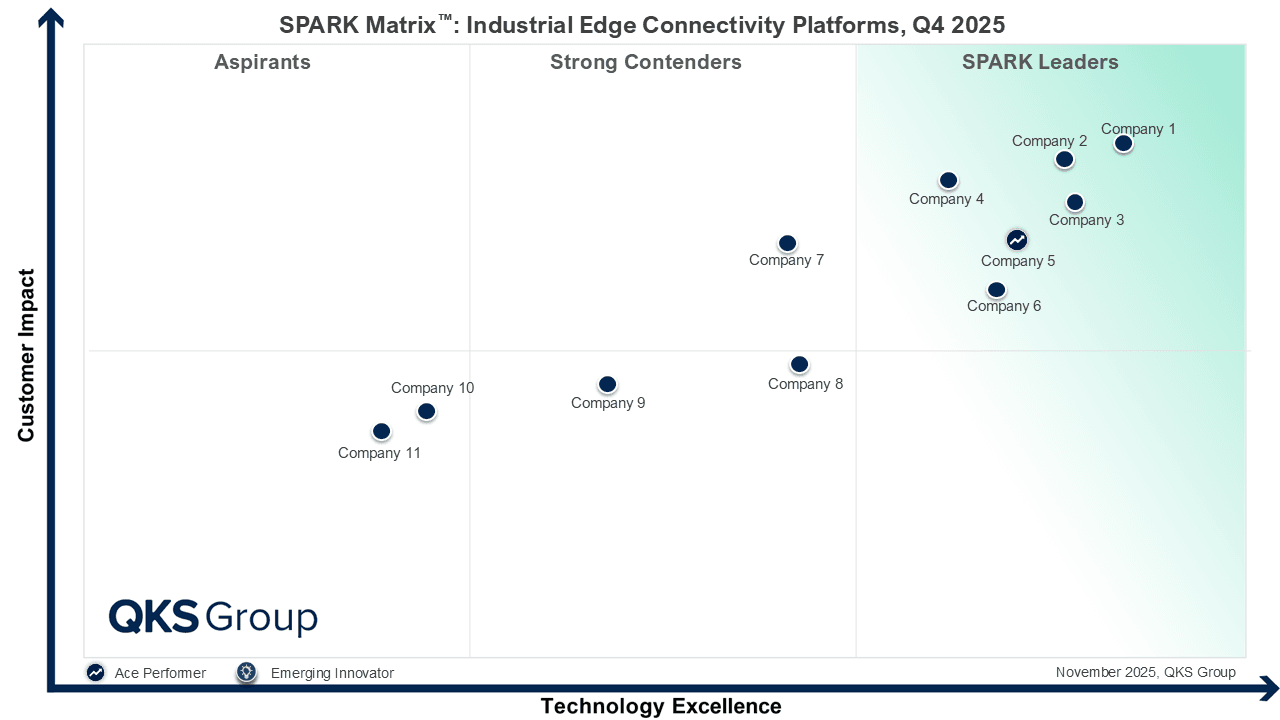
QKS Group’s proprietary SPARK Matrix™ provides a comprehensive evaluation of leading vendors based on Technology Excellence and Customer Impact. The assessment helps technology providers benchmark innovation while enabling buyers to identify vendors best aligned with their operational requirements.
Leading vendors evaluated in the SPARK Matrix include PTC, Softing, Matrikon, Takebishi, Litmus, HiveMQ, HighByte, EMQ, Codra, Cybus, and Telit Cinterion. These vendors offer diverse capabilities focused on industrial connectivity, protocol management, data integration, security, and edge-to-cloud communication.
As competition intensifies, vendors continue investing in advanced connectivity frameworks, industrial data operations, cloud integration, and AI-ready architectures.
Future Outlook
The future of industrial operations will depend heavily on the ability to connect and contextualize data across increasingly complex ecosystems. As Industry 4.0 initiatives mature, organizations will require connectivity platforms capable of supporting larger volumes of data, more devices, and increasingly sophisticated analytics workloads.
Future Industrial Edge Connectivity Platforms will incorporate AI-assisted data management, automated data modeling, advanced security capabilities, digital twin integration, and autonomous infrastructure management. These innovations will further simplify industrial interoperability while improving operational efficiency.
Organizations that establish robust connectivity foundations today will be better positioned to leverage emerging technologies such as industrial AI, predictive analytics, autonomous operations, and smart manufacturing.
Download Sample Report Here: https://qksgroup.com/download-sample-form/spark-matrix-industrial-edge-connectivity-platformsq42025-10311
Conclusion
Industrial Edge Connectivity Platforms are becoming a critical component of modern industrial architectures. By connecting diverse assets, standardizing industrial data, and enabling secure edge-to-cloud communication, these platforms provide the foundation for digital transformation, analytics, and AI-driven innovation.
As industrial enterprises continue modernizing their operations, Industrial Edge Connectivity Platforms will play an increasingly important role in enabling interoperability, operational resilience, and data-driven decision-making. Organizations that invest in scalable connectivity solutions today will be better equipped to unlock the full potential of connected industrial ecosystems tomorrow.

 Arabic
 French
 Spanish
 Portuguese
 Deutsch
 Turkish
 Dutch
Dutch
 Italiano
 Russian
 Romaian
 Portuguese (Brazil)
 Greek
Greek
