


Fertility Supplement Market to Reach USD 2.8 Billion by 2036
The global fertility supplement market is experiencing a structural realignment, evolving from transactional, trial-led purchases into structured, monthly nutrition routines. Spurred by delaying parenthood, rising awareness of reproductive wellness in both men and women, and the expansion of digital health platforms, consumers are seeking foundational preconception nutrition systems.
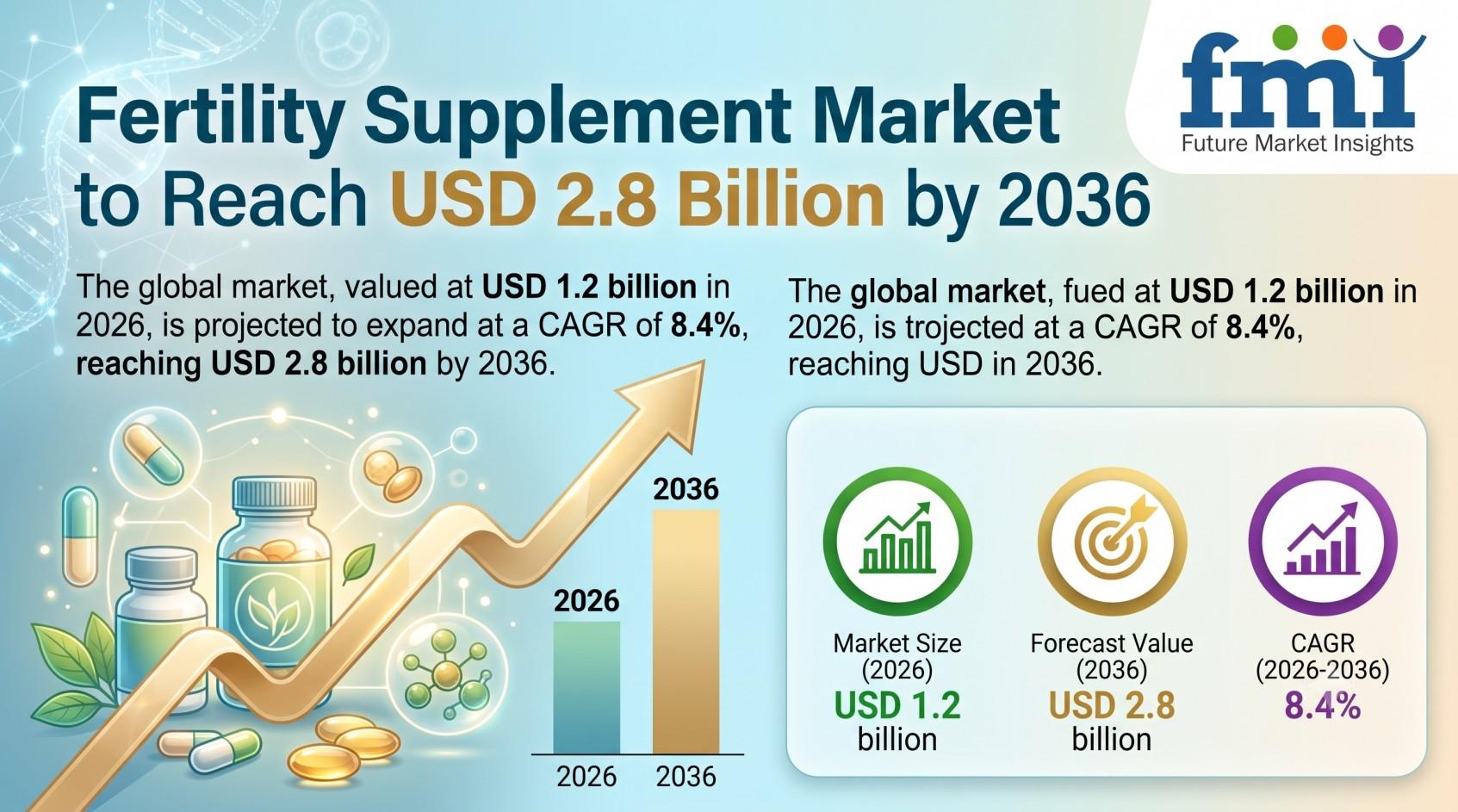
The global market, valued at USD 1.2 billion in 2026, is projected to expand at a Compound Annual Growth Rate (CAGR) of 8.4% over the ten-year forecast period, reaching a total market valuation of USD 2.8 billion by 2036, yielding an absolute incremental opportunity of USD 1.6 billion.
Get detailed market forecasts, competitive benchmarking, and pricing trends:
https://www.futuremarketinsights.com/reports/sample/rep-gb-11081
Market Performance Overview (2026–2036)
To map out the key product types, delivery forms, primary demographic age groups, and regional growth vectors guiding this USD 1.6 billion market scale-up, key segment allocations highlight where global commercial demand is concentrated:
· Vitamins and Minerals Product Segment (50.0% share): Commands half of total market demand in 2026, serving as the core foundation for preconception health. Essential micronutrients—such as active folate (5-MTHF), vitamin D, B-complex, zinc, and selenium—are prioritized for supporting egg/sperm quality and early embryonic development.
· Amino Acids & Antioxidants (CoQ10, Myo-Inositol, L-Carnitine): Represent fast-growing secondary pillars targeting mitochondrial energy, cellular protection from oxidative stress, and hormonal balance (e.g., PCOS management).
· Tablets Delivery Form (34.0% share): Leads physical format sales over capsules, softgels, powders, and liquids, favored for cost efficiency, long shelf stability, precise unit dosing, and easy integration into daily routines.
· 18 to 24 Demographic Age Cohort (46.0% share): Represents the primary age group driving category discovery and early routine-building behavior, heavily influenced by digital health tracking and proactive wellness education.
· USA & India Regional Leadership: Lead national growth rates at 8.8% CAGR and 8.7% CAGR respectively through 2036, driven by direct-to-consumer (DTC) replenishment models, digital health integration, and preventive healthcare adoption.
Technical Drivers and Formulation Shifts
The integration of fertility supplements into mainstream reproductive wellness is propelled by three primary industry catalysts:
Shift to Regimen-Led Subscriptions and D2C Commerce
Subscription replenishment models are transforming category economics. Because reproductive nutrition relies on consistent usage over 3 to 6 months prior to conception, direct-to-consumer (DTC) auto-delivery systems reduce churn, prevent missed doses, and build brand loyalty.
Third-Party Quality Signaling and Clean-Label Assurance
Given the sensitive nature of reproductive health, consumers demand strict quality transparency. Brands are prioritizing third-party certifications (non-GMO, USP/NSF validated, heavy metal screening) and bioavailable ingredient forms (like methylfolate over synthetic folic acid) to build trust.
Integration with Fertility Tracking Technology
The popularity of period and ovulation tracking apps is streamlining consumer education. Brands are partnering with digital health platforms to offer personalized supplement recommendations matched to specific cycle phases or diagnostic profiles.
Industrial Constraints & Compliance Challenges
Fertility supplement brand owners and ingredient suppliers navigate specific operational and regulatory hurdles:
· Efficacy Skepticism and Regulatory Boundaries: Overpromising outcomes in reproductive health carries severe legal and reputational risks. Marketers must carefully frame products as supportive preconception nutrition rather than "fertility cures" to remain compliant with FDA and EFSA dietary supplement structure/function rules.
· Sensory and Stability Challenges in Multi-Ingredient Formulations: Combining heat- and light-sensitive antioxidants (like CoQ10 and omega-3s) with minerals (iron, zinc) in a single daily dose requires advanced microencapsulation to prevent oxidation and unpleasant off-tastes.
Regional Growth Profile
Regional demand reflects strong direct-to-consumer digital channels in Western economies alongside expanding health commerce in Asia:
· United States (8.8% CAGR): The global growth frontrunner, driven by high DTC subscription penetration, clean-label premiumization, and brand extensions linking preconception care to prenatal vitamins.
· India (8.7% CAGR): Spurring rapid volume expansion through digital health commerce growth, rising urban middle-class adoption of preventive nutrition, and expanding awareness of male/female reproductive health.
· Japan (8.5% CAGR) & China (8.3% CAGR): Driven by high quality-assurance expectations, cross-border e-commerce platforms, and life-stage nutrition management.
· United Kingdom (7.5% CAGR): Expanding through trusted retail pharmacy chains, structured digital reordering, and life-stage wellness pathways.
Competitive Landscape
The global fertility supplement landscape features a mix of specialized clinical wellness brands, direct-to-consumer digital health startups, and established multinational dietary supplement leaders.
Key market participants profiled in the report include Garden of Life, Thorne Research, Fertility Nutraceuticals, Nature’s Way, New Chapter, Vitafusion, Zahler, MediNatura, Carlyle, and others. Leading players compete by offering simplified daily regimen packs, publishing peer-reviewed clinical ingredient trials, and building connected digital wellness communities.
Full Report for Detailed Insights: https://www.futuremarketinsights.com/reports/fertility-supplements-market
Frequently Asked Questions
What is the projected valuation of the global fertility supplement market by 2036?
The global fertility supplement market is projected to reach USD 2.8 billion by 2036, expanding from an estimated baseline valuation of USD 1.2 billion in 2026 at a CAGR of 8.4%.
Why do Vitamins and Minerals lead the Product Type segment?
Vitamins and minerals hold a 50.0% market share in 2026 because essential micronutrients (such as folate, vitamin D, zinc, and B-vitamins) are universally recognized by healthcare professionals as foundational for preconception reproductive health.
What delivery form accounts for the majority of sales?
Tablets represent the leading delivery format with a 34.0% market share in 2026, as they provide high shelf stability, cost-efficient manufacturing, and easy daily dosing compliance.
FMI Custom Research: Strategic Intelligence for Confident Decision-Making
In today's rapidly evolving business environment, leadership teams need clear, actionable intelligence tailored to their strategic objectives. FMI's Custom Research solutions are designed around specific business questions, enabling executives to evaluate growth opportunities, validate investments, assess competitive dynamics, and reduce uncertainty before making critical decisions.
Key Executive Benefits
· Decision-Ready Insights: Research tailored to your specific business challenges, growth plans, and investment priorities.
· Reduced Strategic Risk: Validate market opportunities, customer demand, and competitive positioning before committing resources.
· Market Entry Confidence: Assess opportunity size, regulatory barriers, channel dynamics, and competitive landscapes with precision.
· Competitive Advantage: Gain proprietary intelligence unavailable through syndicated reports or internal datasets.
· Faster Growth Decisions: Accelerate expansion, product development, portfolio optimization, and investment planning.
· Primary Market Validation: Access real-world customer, buyer, and stakeholder insights that support high-confidence decision-making.
Business Impact
FMI helps organizations transform market complexity into strategic clarity, enabling leadership teams to identify growth opportunities faster, optimize resource allocation, strengthen competitive positioning, and make high-stakes business decisions with confidence.
To explore how FMI Custom Research can support your strategic priorities, connect with our team at - sales@futuremarketinsights.com
About Future Market Insights (FMI)
Future Market Insights (FMI) delivers actionable, decision-focused market intelligence that goes beyond traditional research reports. The company provides:
· In-depth pricing and cost benchmarking analysis
· Demand forecasting based on real industry inputs
· Procurement and buyer behavior insights
· Supply chain and trade flow intelligence
· Technology and application trend analysis across industries
FMI follows a robust bottom-up research methodology, combining insights from industry experts, procurement leaders, manufacturers, and technical professionals to ensure accurate and practical market intelligence.

 English
 Arabic
 French
 Spanish
 Portuguese
 Deutsch
 Turkish
 Dutch
Dutch
 Italiano
 Romaian
 Portuguese (Brazil)
 Greek
Greek
