


Function Calling and Tool Use in Java-Based AI Applications
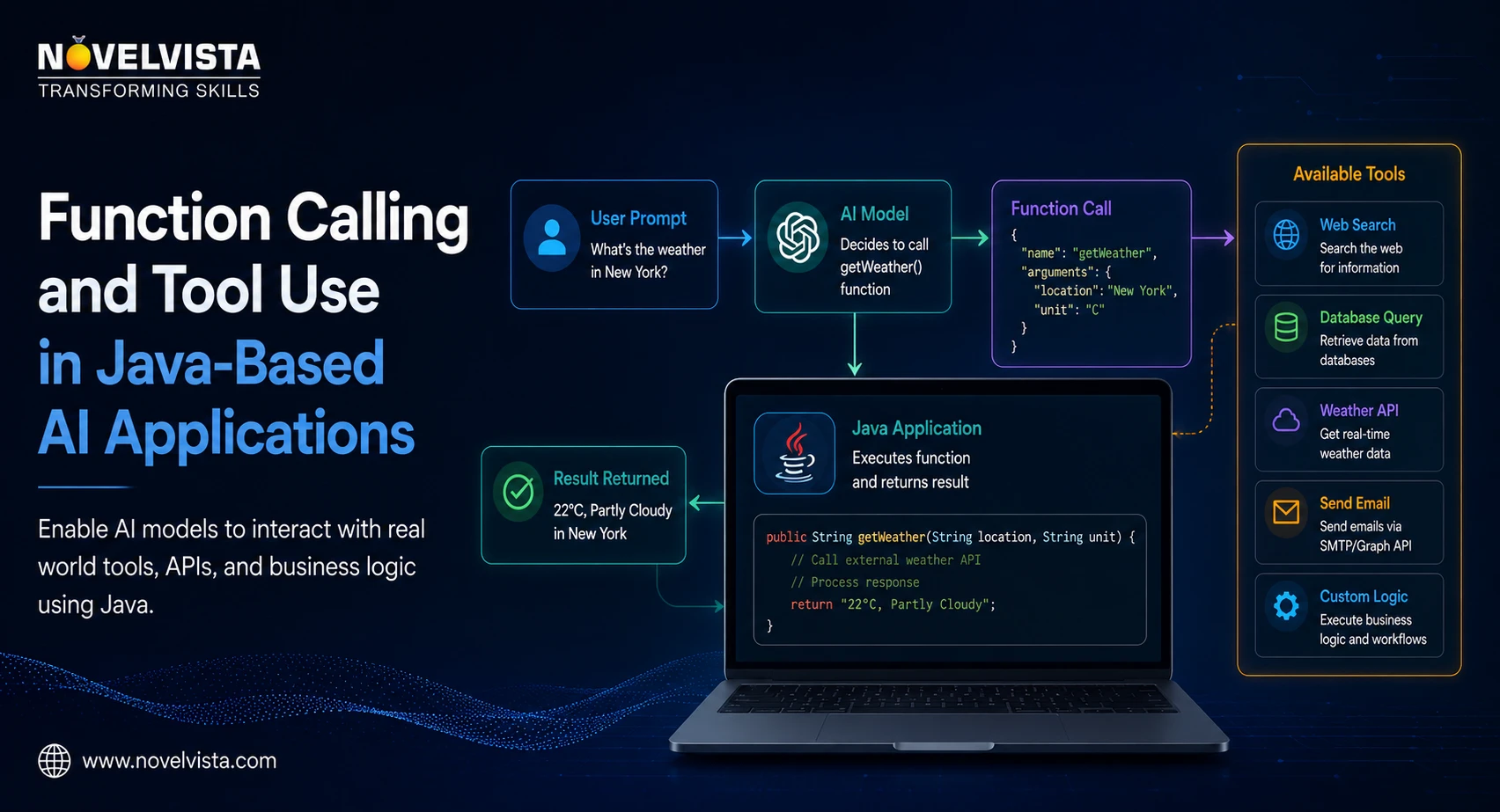
Large language models are good at understanding questions, generating text, summarizing information, and reasoning about problems. But by themselves, they cannot safely perform most real-world business operations.
An AI Engineer Data model may understand that a customer wants to check an order, but it still needs a way to access the order-management system. It may recognize that someone wants to schedule a meeting, but it needs access to a calendar service before anything can actually be booked.
This is where function calling and tool use become important.
For Java developers, tool calling creates a bridge between generative AI models and existing Java applications, APIs, databases, microservices, and enterprise systems.
What Is Function Calling?
Function calling, often called tool calling, allows a large language model to request that an application execute a predefined function.
The important point is that the model does not directly execute your Java code or gain unrestricted access to your backend systems. Instead, the application exposes specific tools to the model. Each tool normally contains a name, description, expected parameters, and execution logic.
The model decides when a tool is appropriate and returns a structured request containing the required arguments. The Java application validates that request, executes the corresponding operation, and sends the result back to the model.
Spring AI describes the basic lifecycle as:
User Request → AI Model → Tool Request → Java Application Executes Tool → Tool Result → AI Model → Final Response
The application therefore remains responsible for actual execution and security.
Why Tool Calling Matters
Consider a traditional AI chatbot connected to an e-commerce platform.
A customer asks:
“Where is my order 48291?”
Without tools, the model cannot know the current order status unless that information was manually placed in its context.
With tool calling, developers can expose a Java method such as getOrderStatus. The AI identifies the order number, requests the appropriate tool, and the application retrieves the information from an API or database.
The AI can then respond naturally:
“Your order has been shipped and is expected to arrive tomorrow.”
The same pattern can support many business operations, including searching inventory, querying customer records, generating invoices, creating support tickets, sending notifications, retrieving weather information, or triggering enterprise workflows.
Implementing Tool Calling with Spring AI
For Spring Boot developers, Spring AI provides native abstractions for building tool-enabled AI applications.
Java methods can be exposed using the @Tool annotation. The description attached to the method helps the model understand what the tool does and when it should be selected.
For example, a developer could create a Java method responsible for checking product availability and expose it as an AI tool. When a user asks whether a product is available, the model can select that function and supply the required product identifier.
Spring AI's ChatClient can manage the tool-calling lifecycle, including sending the tool definition to the model, processing the model's tool request, executing the appropriate Java method, returning the result, and allowing the model to generate the final response.
This makes tool calling particularly useful for existing Spring Boot applications because AI functionality can be added around familiar Java services instead of rebuilding the business layer specifically for AI.
Using LangChain4j for Tool-Based Applications
Another popular option in the Java ecosystem is LangChain4j.
LangChain4j supports both low-level tool specifications and a higher-level approach where Java methods can be annotated with @Tool.
For example, developers might expose methods such as:
searchCustomer()
checkInventory()
createSupportTicket()
calculateShippingCost()
sendNotification()
LangChain4j can convert these Java methods into tool specifications that the model understands. When the model decides that a particular function is required, the framework can execute the corresponding method and return its result to the model.
This approach makes tool-enabled AI feel familiar to Java developers because normal classes, methods, POJOs, records, enums, and application services can become part of an AI workflow.
Tool Calling vs. RAG
Tool calling and Retrieval-Augmented Generation are related, but they solve different problems.
RAG primarily gives the model access to knowledge.
For example:
“What does our employee travel policy say about hotel expenses?”
A RAG system retrieves the relevant document sections before the model answers.
Tool calling allows the model to interact with systems or perform operations.
For example:
“Create a travel reimbursement request for ₹12,000.”
That request may require calling an application service or workflow API.
Modern enterprise applications frequently combine both approaches. RAG supplies trusted information, while tools allow the AI application to take controlled actions.
Security Is Critical
Giving an AI application access to tools introduces additional responsibility.
A tool that only retrieves public information may present little risk. A tool that transfers money, deletes records, sends emails, modifies infrastructure, or updates customer information requires significantly stronger controls.
Developers should never treat the model itself as the authorization layer.
Java applications should still enforce authentication, role-based access control, input validation, audit logging, transaction rules, rate limits, and approval mechanisms.
Sensitive or irreversible operations may also require explicit human confirmation before execution.
This architecture ensures that the AI can recommend or request an action while the enterprise application remains in control.
From Chatbots to AI Agents
Tool calling is also one of the foundations of agentic AI.
A simple chatbot mainly generates responses. An AI agent can analyze a goal, decide which tools it needs, execute multiple steps, examine the results, and continue until the task is completed.
For example, an enterprise Java agent could receive:
“Find customers with overdue invoices, prepare reminders, and create follow-up tasks for the account managers.”
Completing this request might involve database queries, CRM tools, invoice services, and task-management APIs.
Instead of replacing Java applications, generative AI becomes another intelligent layer that coordinates existing services.
Final Thoughts
Function calling turns generative AI from a system that simply talks about actions into one that can participate in real application workflows.
For Java teams, frameworks such as Spring AI and LangChain4j make this capability increasingly practical by connecting AI models with familiar Java methods and services.
The strongest architecture keeps responsibilities clearly separated: the LLM decides what information or capability it needs, while the Java application controls what is actually allowed to happen.
That separation is what makes tool calling powerful for enterprise AI. It combines the flexibility of natural-language interaction with the reliability, security, and structured business logic of existing Java systems.

 English
 Arabic
 French
 Spanish
 Portuguese
 Deutsch
 Turkish
 Dutch
Dutch
 Russian
 Romaian
 Portuguese (Brazil)
 Greek
Greek
