


Waqar Rice Mills: Secret Information About Export Of The Best Quality Basmati Rice To USA, Canada And 60+ Other Countries
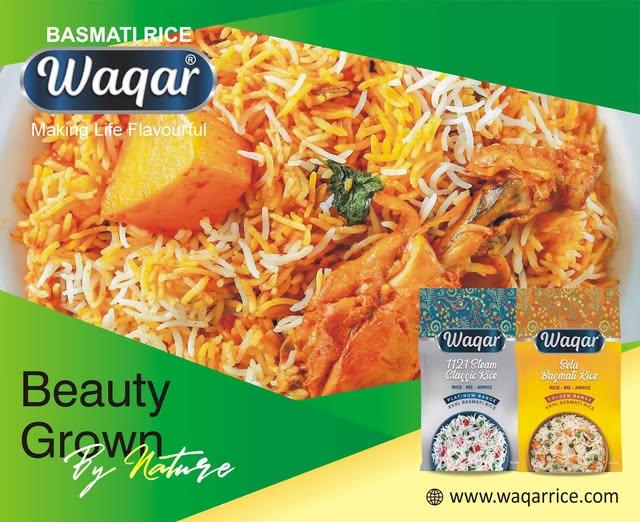
The choice of basmati rice brands in North America is complicated by numerous similar brands with different quality levels and claims. Waqar Rice Mills has been a privately held manufacturer of basmati rice in Punjab, Pakistan, since 1965; the company is one of the leaders in providing high-quality premium basmati rice to the top basmati rice markets in world: USA, Canada, the UK, and Gulf countries. Let us find out how this is possible.
Three Features That Can Make A Brand The Best In The World
The best basmati rice brand possesses three features that are easily measured: grain length after cooking, shelf life, aroma, and quality. To satisfy all those features, Waqar Rice Mills uses backward integration and contract farming; the company cooperates with farmers in the Kamoke belt of Punjab and buys rice directly from the fields rather than basmati paddy in the open market. In this way, Waqar Rice Mills controls the application of pesticides. The level of aflatoxins and the timing of basmati rice harvest.
Waqar Rice Mills has facilities with temperature- and humidity-controlled silos for rice storage with a capacity of 80,000 metric tons, drying with a capacity of 800 metric tons, and rice processing capacity of 60 metric tons per hour. It does not say anything about marketing, but about the operational parameters that allow the company to deliver shipments with the same moisture content and intact grains. This criterion is more important for bulk or private-label basmati rice importers than any marketing slogans.
Importance For The Biggest Basmati Rice Market In Canada
Canada is one of the largest basmati rice importers, and among the exporters are Indian and Pakistani suppliers of basmati rice, including Waqar Rice Mills, which has been exporting its products to this market for several years. Besides Canada, the company delivers basmati rice to the USA, UK, UAE, Saudi Arabia, and many other countries. In addition, Waqar Rice Mills allows the importer to label its own basmati rice with various types of packaging, including paper, jute, cotton, PP, and non-woven bags. In this way, distributors and retailers in Canada will be able to develop their own brand of imported basmati rice.
The importance for the Canadian importer is not country-of-origin marketing but the exporter's ability to provide the same grain length and cooking time on the fifth container as on the first. This is exactly the principle on which the contract farming of Waqar Rice Mills is based.
Basmati Rice Export From The Top Brand In The World
The top basmati rice market in world is divided into branded retail basmati rice and food service or private label rice, which is used for feeding restaurants and grocery chains. The company operates in the second category as the manufacturer and exporter of the biggest basmati rice brand in USA: it is registered by the USFDA and has the BRC, HACCP, ISO 9001:2015, ISO 22000:2018, GMP, Halal, and Kosher certificates; these are exactly the documents that importers in the USA need to make an order.
There are two international brands of the company, Ocean Pearl and Waqar Rice, and the third one – the national brand of the company, Zafarani – is delivered only to the domestic market of Pakistan.
Geographic Coverage: Countries Where Waqar Rice Mills Ships To
The number of countries of export of Waqar Rice Mills is more than 60 countries; the company delivers its products to North America (USA, Canada), Middle East (UAE, Saudi Arabia, Kuwait, Bahrain, Oman, Qatar), Europe (UK, Italy, Sweden, Austria, Czech Republic), and many others, including Australia, New Zealand, Mauritius, Egypt, Morocco, Sri Lanka, Libya, and Armenia.
The head office and the main rice mill of the company are situated at G.T. Road, Kamoke, Gujranwala district, Punjab – one of the Biggest basmati rice production regions in Pakistan, with the Kharif season for its growth (June-July – planting, September-November – harvest).
Example: Private Labeling For Regional Grocery Chain
The following is an illustration of how a regional grocery chain in North America can use mills such as Waqar Rice Mills to develop its branded basmati rice products. The regional grocery chain can purchase unbranded basmati rice from the producer and then establish its own requirements for packaging (type of bag, weight, labelling) and minimum order quantity to have its own brand on the product.
In this way, the chain will be able to set its own margins and control the brand. While the exporter will keep control over quality, aflatoxin tests, and logistics, which are all inspected by SGS, Cotecna, or Eurofins. This is exactly why so many of the biggest basmati rice brand in the USA and Canada has the name of the exporter, not the retailer.
Old Sourcing Model vs. Direct-Mill Sourcing
| Traditional Wholesale Import | Direct Mill Partnership (e.g., Waqar Rice Mills) | |
|---|---|---|
| Grain consistency | Varies by broker/batch | Controlled via contract farming |
| Traceability | Limited, multi-hand supply chain | Farm-to-mill, single operator |
| Private labeling | Rarely available, high MOQ | Available with multiple packaging formats |
| Certifications | Often unverified pass-through | Direct BRC, HACCP, ISO, Halal, Kosher documentation |
| Pricing | Marked up through intermediaries | Direct-from-mill pricing |
Buyers who rely on the traditional scheme of sourcing basmati rice lack any information about how the commodity was cultivated, dried and stored prior to its shipment to the warehouse – and this is exactly what the direct mill sourcing will help resolve.
Comparison Of Waqar Rice Mills And Matco Foods (Falak Basmati Rice)
Matco Foods is a corporation established back in 1964 in Karachi, which manufactures the Falak brand of basmati rice known throughout the whole world. The corporation is one of the most prominent basmati rice producers in Pakistan. Both companies are licensed exporters of Pakistani basmati rice and have been active in the market for a long time; still, their fields of activity are somewhat different.
| Factor | Waqar Rice Mills | Matco Foods (Falak Basmati Rice) |
| Founded | 1965, Kamoke, Punjab | 1964, Karachi |
| Business structure | Privately held, milling-first exporter | Publicly traded, diversified food and ingredients company |
| Core focus | Basmati rice milling, bulk export, and private label | Branded consumer rice (Falak) plus salt, spices, dessert mixes, and functional ingredients |
| Reported export reach | 60+ countries | 50–65 countries, depending on source |
| Key certifications | BRC, Halal, USFDA, ISO 9001:2015, ISO 22000:2018, HACCP, GMP, Kosher | BRC, ISO 22000, HACCP, Halal |
| Private labeling | Available across paper, jute, cotton, PP, and non-woven packaging, with stated MOQ | Available through a dedicated private-labelling division for basmati and organic rice |
| Retail brand of its own | No competing international retail brand — Ocean Pearl and Waqar Rice are export-focused, not mass-retail | Yes — Falak is an actively marketed global retail brand |
It is simply a question of positioning: Matco is ideally positioned to become a supplier. While Waqar Rice Mills is positioned as a private label and bulk supplier. Thus, the latter is the right choice as a supplier of the retailer's own private label.
Frequently Asked Questions About Purchasing Top Basmati Rice in World
Is a Pakistani basmati rice brand in the USA equal in quality to an Indian one?
The Pakistani and Indian basmati rice grow in the same geographical region, namely the Himalayas. There, the quality of the product depends on the standards of processing and ageing at a certain mill. The main factors of high-quality include certification and contract farming, but not origin.
What certification should be considered when purchasing basmati rice?
Firstly, one needs to pay attention to HACCP, ISO 22000 and registration with the USFDA (in case of shipping to the USA) or any similar authority of the destination country. Halal and Kosher certificates are needed if the retailer is working in these markets.
Is it possible to purchase private label biggest basmati rice brand in USA from the mill?
Yes, it is possible. However, there is a minimal quantity of private label basmati rice that must be bought in order to get private label basmati rice from the mill. since in case of a small quantity, custom packaging is not cost-effective. This is the case with Waqar Rice Mills.
How long can basmati rice be kept?
It is dependent on humidity control. Nevertheless, most exporters recommend storing basmati rice no longer than 12-18 months after the date of production.
Why does basmati rice smell strongly sometimes?
This depends on factors such as 2-acetyl-1-pyrroline, ageing (since the rice should be aged before exporting), harvesting, and humidity.
About the Author
This article was written by a content contributor, Mohsin Aziz specialising in the food industry and export supply chain, sourcing standards and B2B private label deals between South Asian and North American markets. The information provided in this article is based on publicly available information about Waqar Rice Mills' production, processing capacity, worldwide export opportunities and product portfolio.
Disclaimer:
This article is a sponsored contribution featuring Waqar Rice Mills. Claims about certification and export markets are based on the company's published information up to the publication date; buyers are advised to verify the current certification status directly with the exporter before purchasing the products.

 English
 Arabic
 French
 Spanish
 Portuguese
 Deutsch
 Turkish
 Italiano
 Russian
 Romaian
 Portuguese (Brazil)
 Greek
Greek
