


Data Loss Prevention and Security Policies for Copilot Studio
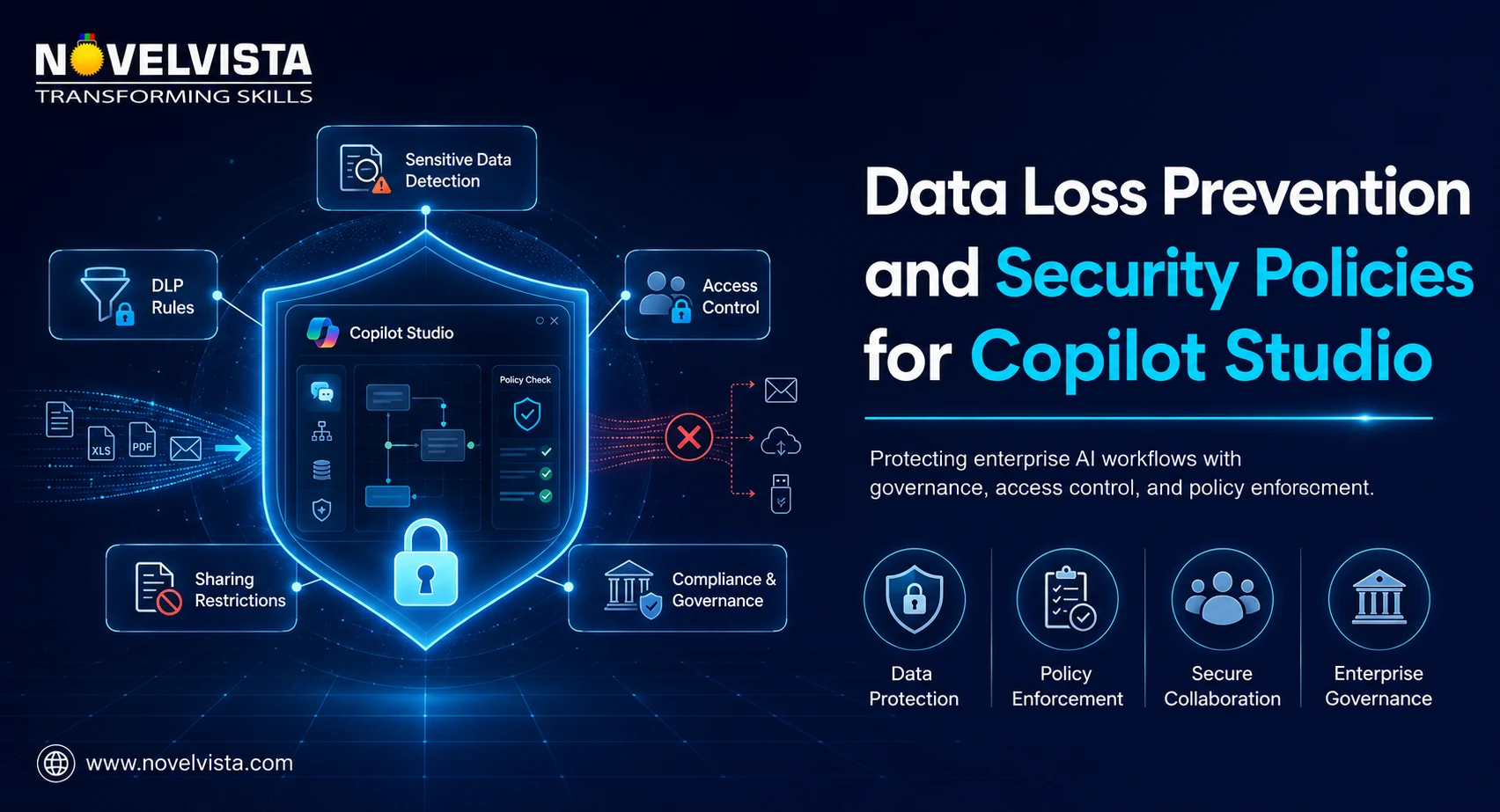
Microsoft Copilot Studio enables organisations to build AI agents that answer questions, access business data, call connectors, trigger workflows, and interact through different channels. This flexibility creates value, but it also raises an important question: how can a business prevent an agent from moving sensitive information into an unsafe service?
Data loss prevention, or DLP, is one of the main control layers used to manage this risk. Copilot Studio works with Power Platform data policies, allowing administrators to restrict connectors, separate different categories of services, and block capabilities that do not meet organisational security requirements.
Why DLP Matters for AI Agents
A Copilot Studio agent can do much more than generate conversational answers. Depending on its configuration, it may search knowledge sources, read records, send messages, update systems, invoke automated flows, and publish through external channels.
A poorly governed connector combination could allow confidential information to travel from a trusted enterprise platform into an unapproved application. DLP policies reduce this risk by establishing boundaries around which connectors can be used together and where organisational data may be transferred.
These policies do not determine whether every AI-generated response is correct. Their primary purpose is to govern data movement, connector availability, and service interaction within Power Platform environments.
Understanding Connector Classification
Under the classic Power Platform data policy model, connectors are placed into three groups: Business, Non-business, and Blocked.
Business connectors are generally used for services that handle organisational information. Non-business connectors are kept separate from Business connectors, preventing data from moving directly between the two groups within the same application or workflow. A Blocked connector cannot be used where the policy applies.
This separation is essential. An agent should not retrieve confidential customer data through a trusted connector and then send it through a personal or unapproved service. Administrators should review Microsoft connectors, third-party applications, custom connectors, publishing channels, and Copilot Studio-specific capabilities.
Microsoft has also introduced advanced connector policies. These policies use a stricter allowlist model in which connectors are blocked by default unless they are explicitly permitted. This approach can provide more precise governance for regulated or tightly controlled environments.
Build Policies Around Environments
One organisation-wide policy may be too restrictive for some teams and too permissive for others. A stronger approach is to separate development, testing, and production environments and apply controls according to the risk associated with each environment.
A development environment may support broader experimentation, provided it does not contain sensitive production data. Production environments should have narrower connector access, controlled publishing, named owners, formal change approval, and stronger monitoring.
Administrators must also understand that multiple policies can affect the same environment. A connector permitted by one policy may still be restricted by another. Testing policies against real agent dependencies before broad enforcement can prevent publishing failures and unexpected production outages. Microsoft specifically warns that misaligned policies can block essential connectors or disrupt deployed agents.
Secure Knowledge, Actions, and Publishing
Connector policies are only one part of Copilot Studio security. Organisations should also apply least-privilege access to knowledge sources, actions, environments, and administrative roles. An agent should access only the information required to perform its intended purpose.
Authentication requirements must match the use case. Internal agents handling employee, financial, or customer information should not be published anonymously. External channels, HTTP requests, generative AI capabilities, and connected services should receive a security review before release.
Copilot Studio governance controls can also be used to restrict agent publishing and manage the use of generative AI features at the organisational level.
Human approval is especially important when an agent can make payments, modify records, communicate externally, or trigger high-impact processes. Automation should accelerate routine work without removing accountability.
Create an Operational Governance Process
Effective DLP is not a one-time configuration task. New connectors, integrations, and agent capabilities appear continuously. Organisations should maintain a connector inventory, document approved use cases, assign policy owners, and review exceptions regularly.
Before deployment, teams should test agents for blocked connectors, excessive permissions, unsafe data exposure, authentication gaps, and unintended actions. Logs, analytics, and incident-response procedures should also be prepared before release.
When a DLP violation occurs, the correct response is not simply to unblock the connector. Teams should identify which policy is involved, understand why the connector is required, assess the data it handles, and determine whether a safer design is available.
Final Thoughts
Copilot Studio security works best when DLP, identity management, environment strategy, access control, publishing governance, monitoring, and human oversight operate together. Strong policies should create a safe path for innovation rather than stop it.
The goal is not to give every agent access to every tool. It is to provide each agent with the minimum trusted access required to deliver business value. In enterprise AI, freedom without guardrails creates risk, while guardrails without planning create friction. Good governance provides both control and momentum.

 English
 Arabic
 French
 Spanish
 Portuguese
 Turkish
 Dutch
Dutch
 Italiano
 Russian
 Romaian
 Portuguese (Brazil)
 Greek
Greek
