


Agent Orchestration Frameworks Compared: LangGraph, CrewAI, and AutoGen
Building a basic AI for Project Management agent is relatively straightforward. Building a dependable system in which multiple agents share context, call tools, recover from failures, request human approval, and complete long-running work is much harder. This is where agent orchestration frameworks become valuable.
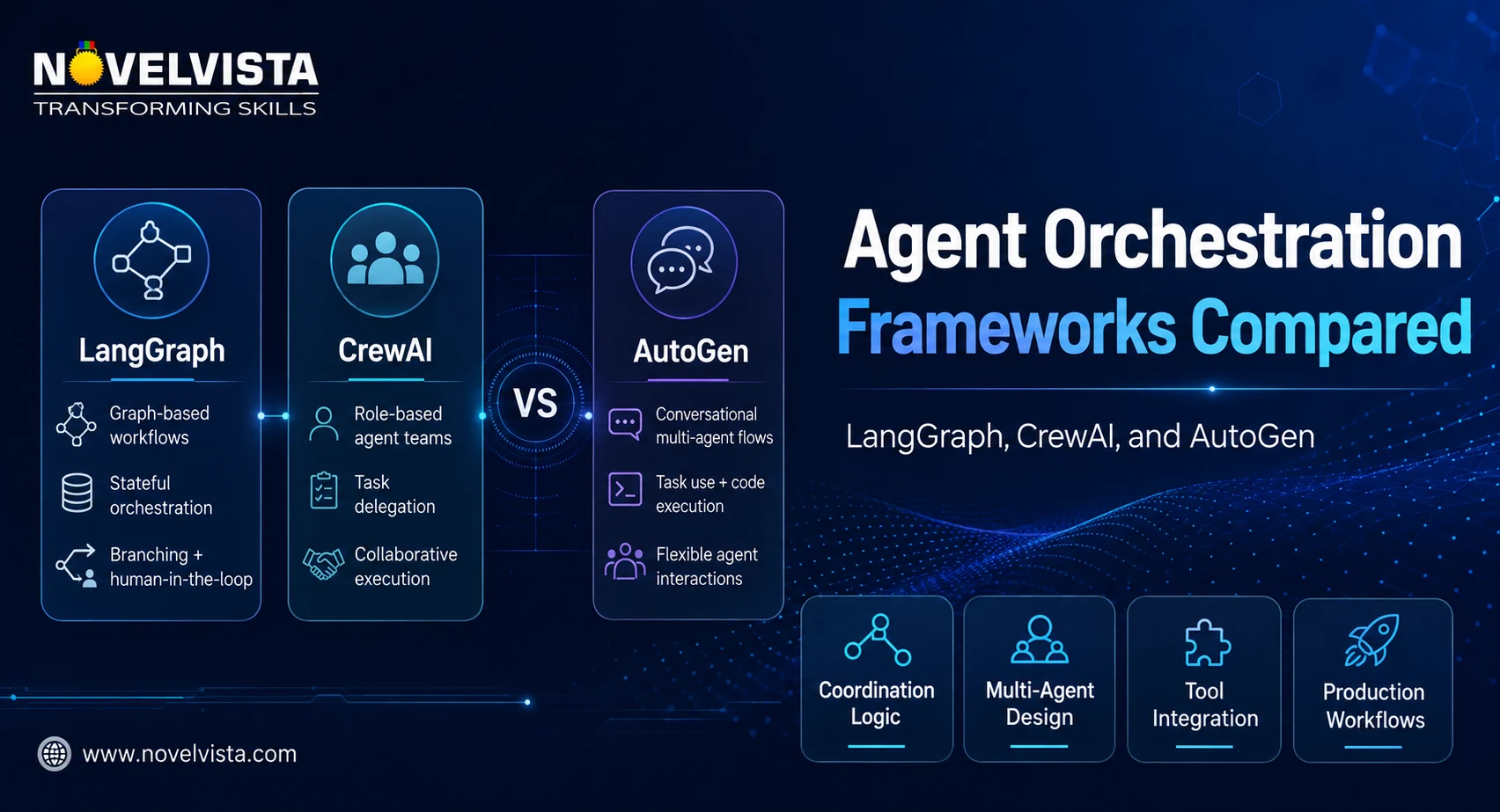
LangGraph, CrewAI, and AutoGen approach this challenge differently. LangGraph prioritises workflow control, CrewAI makes role-based collaboration easy to model, and AutoGen focuses on conversational and event-driven multi-agent systems.
What Is Agent Orchestration?
Agent orchestration is the coordination layer that decides which agent should act, what information it receives, which tools it can use, and what happens next. It may also manage state, branching, retries, memory, approvals, and communication.
Without orchestration, agents may repeat work, pass incomplete information, misuse tools, or continue without reaching a useful result. A good framework makes these interactions visible, testable, and manageable.
LangGraph: Control Through Graph-Based Workflows
LangGraph models workflows as graphs containing shared state, nodes, and edges. Nodes perform actions, while edges determine the next step. This supports fixed sequences, conditional routing, loops, and workflows combining deterministic logic with model-driven decisions.
Its greatest strength is control. Developers can define how application state changes, where decisions occur, and when human review is required. LangGraph also supports durable execution, persistence, streaming, memory, and human-in-the-loop intervention, making it suitable for long-running and business-critical processes.
The trade-off is that LangGraph is relatively low-level. Teams must carefully design state schemas, transitions, error handling, and stopping conditions. This requires more engineering effort, but it can produce a more predictable production system.
LangGraph is a strong option for approval workflows, customer-service automation, research pipelines, compliance processes, and applications where auditability matters.
CrewAI: Role-Based Agent Collaboration
CrewAI presents agents as members of a team. Each agent can receive a role, goal, tools, knowledge, and tasks. A crew coordinates them through processes such as sequential or hierarchical execution.
This approach is intuitive because it resembles a workplace. A researcher can collect information, an analyst can interpret it, and a writer can produce the final output. CrewAI also provides Flows for structured orchestration, including routing, state management, persistence, guardrails, callbacks, and human-in-the-loop triggers.
CrewAI’s main advantage is development speed. Teams can describe responsibilities in business-friendly terms and assemble collaborative workflows without defining every graph transition. It is particularly useful for content operations, market research, lead enrichment, reporting, and processes divided into specialist roles.
However, role-based autonomy becomes harder to govern when agents delegate broadly or make too many independent decisions. Production systems still require clear boundaries, structured outputs, evaluation rules, budgets, and termination conditions.
AutoGen: Conversational Multi-Agent Systems
AutoGen offers multiple layers. AgentChat supports conversational single-agent and multi-agent applications, while AutoGen Core provides an event-driven foundation for scalable systems. Its runtime manages agent identities, communication, and lifecycles, with agents interacting through messages.
AutoGen is useful when conversation is central to the solution. One agent might propose an answer, another might review it, and a human might intervene before execution. The framework also provides extensions for tools, model providers, code execution, Model Context Protocol servers, and distributed runtimes.
This flexibility introduces architectural choices. Developers must define conversation patterns, termination rules, runtime models, tool permissions, and message-handling strategies. Teams should also ensure examples use the current AutoGen architecture rather than older 0.2 documentation.
Which Framework Should You Choose?
Choose LangGraph when you need explicit state control, durable execution, predictable branching, and detailed human oversight. Choose CrewAI when the workflow maps naturally to specialised roles and rapid development is the priority. Choose AutoGen when agent-to-agent conversation, event-driven architecture, experimentation, or distributed execution is central.
The best framework is the one matching the application’s operating model. A structured business process may favour LangGraph, a collaborative knowledge workflow may fit CrewAI, and an interactive multi-agent system may benefit from AutoGen.
Final Thoughts
Agent orchestration frameworks reduce complexity, but they do not replace sound engineering. Teams must still validate outputs, restrict tool access, monitor costs, record execution traces, and keep people involved in high-impact decisions.
Start with one measurable workflow. Add more agents only when each has a clear responsibility and measurable value. In multi-agent design, more agents do not always create more intelligence; sometimes they simply create a longer meeting.

 English
 Arabic
 French
 Spanish
 Portuguese
 Deutsch
 Turkish
 Dutch
Dutch
 Russian
 Romaian
 Portuguese (Brazil)
 Greek
Greek
