


Security Considerations When Exposing Tools via MCP
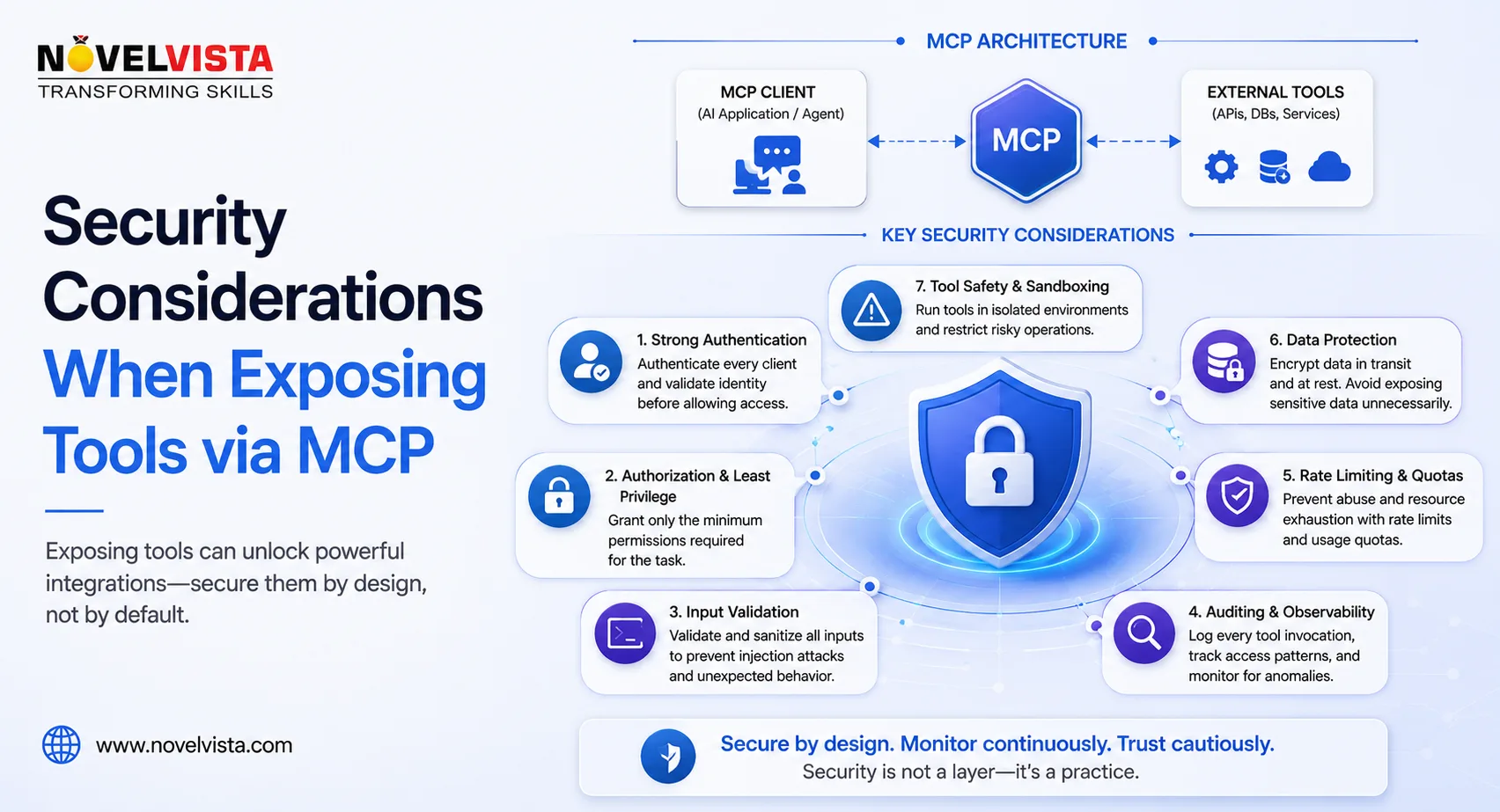
The Model Context Protocol, or MCP, provides a standardized way for AI applications to connect with external tools, data sources, and business systems. Through an MCP server, an AI assistant can search databases, read files, create tickets, send messages, update records, or trigger workflows.
This capability makes AI agents far more useful. It also changes the security equation. A chatbot that only generates text has limited operational impact. An agent connected to powerful tools may access confidential information or perform real-world actions. For this reason, exposing tools through MCP should be treated as a security-sensitive system integration, not as a simple AI feature.
Apply the Principle of Least Privilege
Every MCP tool should receive only the permissions required for its specific task. A tool designed to check an order status should not also be able to cancel orders, change customer details, or export the full customer database.
Separate read and write operations wherever possible. For example, use one tool for retrieving support tickets and another for closing them. This makes permissions easier to control and allows sensitive actions to require additional approval.
MCP’s official guidance recommends proper access controls for tools, while OWASP advises organizations to limit the capabilities granted to MCP servers and connected agents.
Use Strong Authentication and Authorization
Remote MCP servers should not rely on shared passwords, hard-coded API keys, or unrestricted public endpoints. Each user, client, or service should have a verifiable identity.
The MCP authorization specification defines an OAuth-based framework for HTTP transports. Authorization should be scoped so that a token issued for one server or resource cannot automatically be reused elsewhere. Servers must also validate token audience, expiration, requested permissions, and user identity before allowing access.
Authentication confirms who is making the request. Authorization determines what that identity is permitted to do. Both layers are necessary.
Validate Every Tool Input
An AI-generated tool call should never be considered automatically trustworthy. Models can misunderstand user intent, generate malformed parameters, or be influenced by malicious content.
MCP servers should validate data types, required fields, allowed values, file paths, record ownership, and request size. Database queries should use parameterized statements, and command-execution tools should rely on strict allowlists rather than passing model-generated text directly to a shell.
The official MCP tool specification specifically calls for input validation, access controls, rate limiting, and output sanitization.
Defend Against Prompt Injection and Tool Poisoning
Prompt injection occurs when untrusted content contains instructions intended to manipulate the model. A malicious instruction might be hidden inside a document, email, webpage, database record, or retrieved support ticket.
Tool poisoning is a related threat in which malicious instructions are placed inside a tool’s description or metadata. The model may then be persuaded to select the wrong tool, disclose information, or perform an unsafe action. OWASP identifies tool poisoning as an indirect prompt-injection attack against agents connected to MCP servers.
Tool descriptions should therefore be reviewed, version-controlled, and obtained only from trusted sources. Retrieved content must be treated as data, not as authoritative instructions.
Require Confirmation for Sensitive Actions
High-impact operations should not be executed solely because a language model requested them. Actions such as deleting records, sending external emails, transferring money, modifying permissions, publishing content, or running production commands should require explicit user confirmation.
Before approval, the interface should display the intended tool, important parameters, affected resource, and expected result. MCP guidance recommends showing tool inputs before execution and requesting confirmation for sensitive operations.
Human approval is not a weakness in automation. It is a control point that prevents a small misunderstanding from becoming a major incident.
Protect Secrets and Sensitive Data
Credentials should be stored in a secure secrets manager rather than in prompts, source code, tool descriptions, or configuration files committed to repositories.
Tool responses should expose only the minimum required information. Sensitive fields such as passwords, access tokens, financial details, personal identifiers, and internal system metadata should be filtered or masked before the response reaches the model.
Organizations should also define which information may leave a trusted environment. Data-loss prevention controls can help detect attempts to send confidential information to unauthorized tools or external MCP servers.
Monitor, Log, and Limit Tool Usage
Every tool invocation should generate an audit record containing the user identity, tool name, request time, important parameters, authorization result, and outcome. Logs should avoid recording raw secrets while remaining detailed enough for investigations.
Rate limits, execution timeouts, spending controls, and request quotas can reduce abuse and prevent runaway agents. MCP guidance recommends rate limiting, tool-call timeouts, result validation, and audit logging.
Conclusion
MCP can turn an AI assistant into an operational business agent, but greater capability creates greater responsibility. Secure implementations combine least-privilege permissions, strong authorization, strict input validation, trusted tool definitions, protected secrets, human approval, and complete auditability.
The safest approach is to assume that model outputs, retrieved content, and third-party tools may all be untrusted. By building security controls around every tool call, organizations can use MCP’s flexibility without giving AI systems unchecked access to critical operations.

 English
 French
 Spanish
 Portuguese
 Deutsch
 Turkish
 Dutch
Dutch
 Italiano
 Russian
 Romaian
 Portuguese (Brazil)
 Greek
Greek
