


Understanding Tokens, Context Windows, and Model Limits
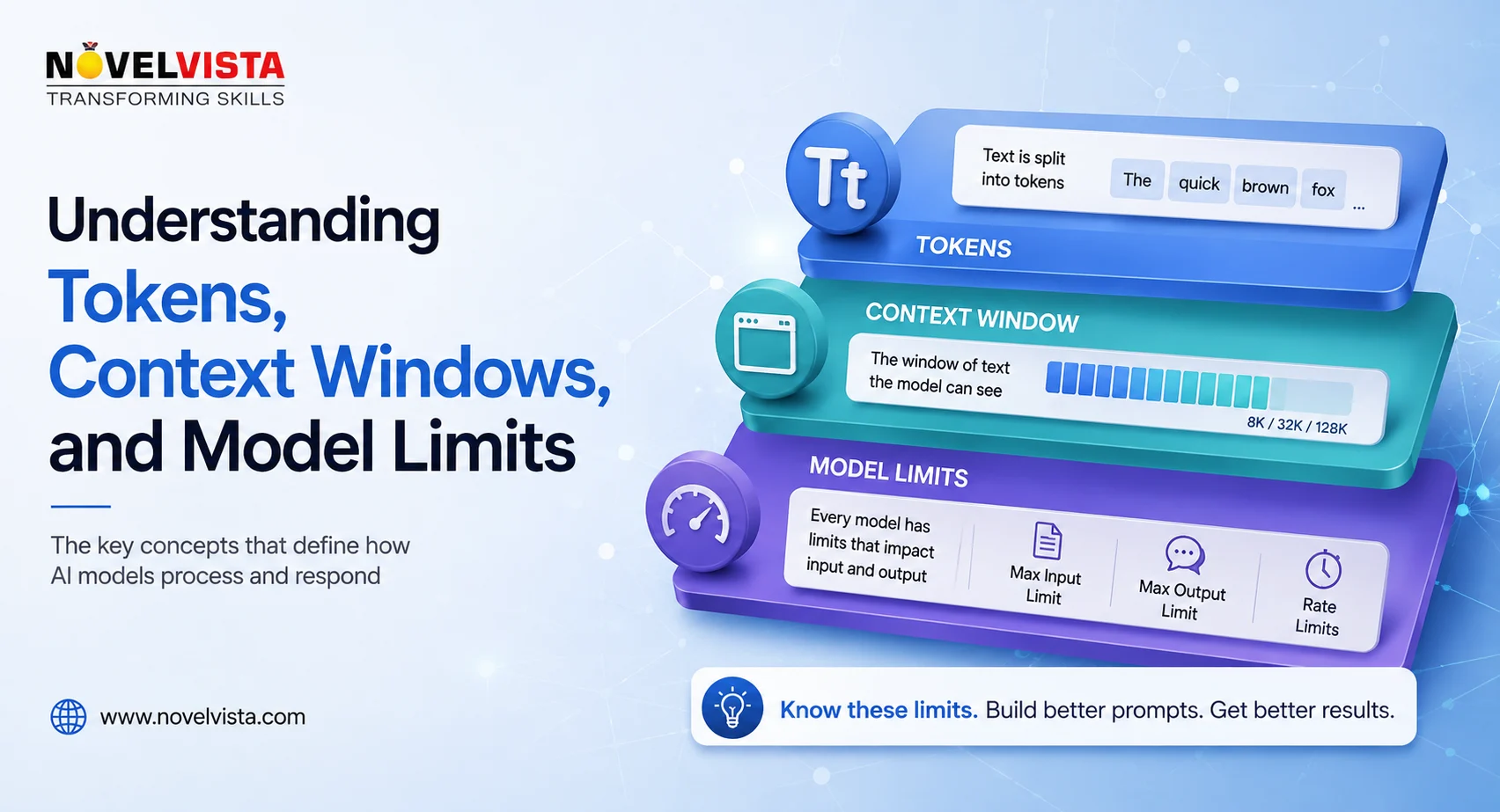
Artificial intelligence tools can write, summarize, analyze, and generate content. However, every language model has technical boundaries. Three important concepts behind these boundaries are tokens, context windows, and model limits. Understanding them helps users create better prompts, avoid incomplete responses, and get reliable results.
What Are Tokens?
Language models do not read text exactly as humans do. Instead, they break text into smaller units called tokens. A token may be a complete word, part of a word, punctuation, or a symbol, depending on the model.
For example, a word such as “book” may be one token, while a longer word may be divided into several tokens. Numbers, code, technical terms, and non-English text can be split differently.
Tokens matter because models measure both input and output with them. Your prompt, conversation history, uploaded content, and the model’s response all use tokens. As a rough estimate, one token represents about three to four English characters, although the number varies.
This means a 1,000-word document may consume more than 1,000 tokens. Code, tables, symbols, and complex formatting often use tokens faster than ordinary paragraphs.
What Is a Context Window?
A context window is the maximum amount of information a model can process during one interaction. It includes system instructions, your prompt, earlier messages, attached content, and the generated response.
Think of the context window as the model’s working desk. The model can only use information that fits on the desk at one time. When a conversation becomes too long, older details may be summarized, ignored, or removed from active context.
A larger context window allows a model to process longer reports, larger code files, extended conversations, and multiple documents. However, a large window does not guarantee perfect understanding. The model may still miss a detail buried inside a long document or give more attention to recent, clearly structured information.
Why Context Limits Matter
Context limits can affect the quality and completeness of AI output. When a prompt contains too much information, the model may overlook instructions, confuse sections, repeat ideas, or produce an incomplete answer.
Long conversations create similar problems. An important requirement introduced early may receive less attention after many messages. Repeating critical constraints in the latest prompt can improve consistency.
Context limits also matter when reviewing documents. Instead of uploading several large files without direction, users should identify relevant sections and explain the task. A focused request produces better results than asking the model to “review everything.”
Understanding Model Limits
Model limits extend beyond context size. Language models can produce confident statements that are inaccurate, outdated, or unsupported. They do not automatically verify every claim unless reliable tools are available and verification is requested.
Models may struggle with complex calculations, ambiguous instructions, specialized decisions, and tasks requiring access to private systems. They cannot know information that was never provided, and vague prompts may lead to incorrect assumptions.
Output length is another limitation. A model may read a large document but still be unable to generate an equally large response in one turn. Reports, books, and software projects may need to be created in smaller sections.
How to Work Within These Limits
Effective prompts are focused, structured, and specific. Clearly state the goal, provide necessary background, define the required format, and highlight important constraints.
For large tasks, divide the work into stages. Ask the model to summarize sections, extract facts, create an outline, and then produce the final content. In long conversations, provide a short recap before starting a new phase.
It is helpful to request citations, verification, and clear identification of uncertainty. Human review remains essential, particularly for business, financial, legal, technical, and healthcare decisions.
Conclusion
Tokens determine how text is measured, context windows define how much information a model can consider, and model limits shape what it can reliably accomplish. These concepts directly influence response quality, accuracy, cost, and usability.
By writing clear prompts, removing unnecessary information, dividing complex tasks, and reviewing important outputs, users can work more effectively with AI. The objective is not to eliminate every limitation but to design better interactions around them. When people understand how models process information, AI becomes more predictable, practical, and valuable.

 English
 Arabic
 French
 Spanish
 Portuguese
 Deutsch
 Turkish
 Dutch
Dutch
 Italiano
 Russian
 Romaian
 Portuguese (Brazil)
