


Every boardroom I walk into is asking the same question.
“What’s our AI strategy?”
I think that’s the wrong question.
Not because AI isn’t important.
It is.
But because history has taught us something executives repeatedly forget:
Technology has never transformed a business.
Leadership has.
The internet didn’t transform companies.
Leaders who redesigned their business models did.
Cloud didn’t transform companies.
Leaders who reimagined operating models did.
ERP didn’t transform companies.
Leaders who standardized processes did.
AI will be no different.
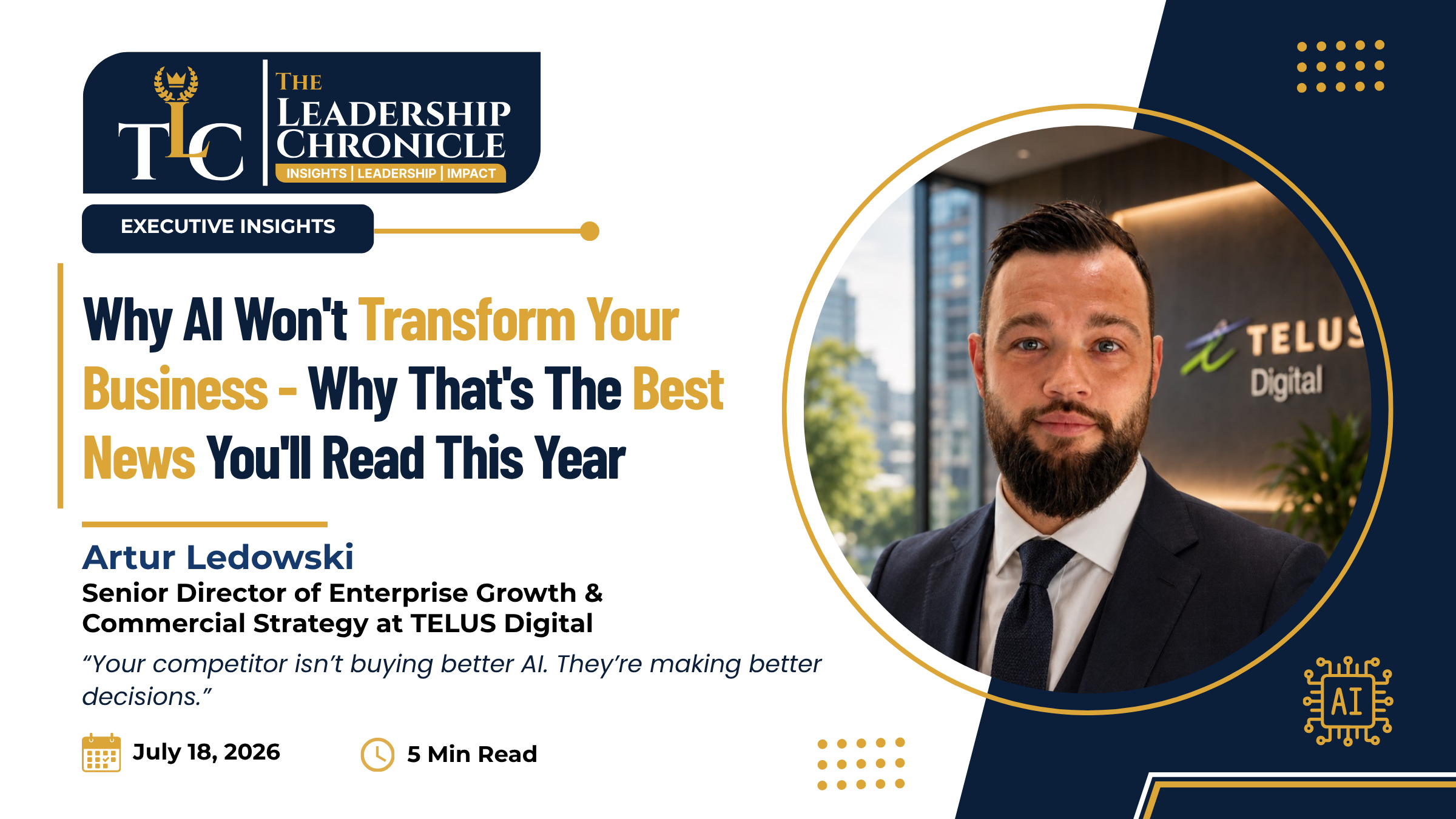
“Technology has never transformed a business. Leadership has.”
We Are Witnessing the Largest Management Shift Since the Industrial Revolution
This isn’t another software upgrade.
This isn’t another ERP implementation.
This isn’t another productivity tool.
AI changes something far more fundamental.
It changes how organizations make decisions.
For over a century, companies optimized labor.
The next decade belongs to companies that optimize decision-making.
That is an entirely different competitive game.
The Real Enterprise Operating System
After years working with enterprise organizations across customer experience, digital transformation and commercial growth, I’ve come to believe something surprisingly simple.
Every company runs on six invisible operating systems.
Not SAP.
Not Salesforce.
Not Microsoft.
These six.
Decision Velocity
How quickly can your organization make good decisions?
Organizational Friction
How much unnecessary work exists?
Learning Speed
How fast does knowledge spread?
Execution Discipline
How consistently do people execute?
Customer Effort
How easy are you to do business with?
Leadership Alignment
Do your executives solve the same problems — or different ones?
Everything else is secondary.
Technology simply amplifies these six systems.
If they’re broken…
AI scales dysfunction.
If they’re healthy…
AI compounds competitive advantage.
The Enterprise Transformation Equation
I’ve stopped thinking about digital transformation as technology.
Instead, I think about one equation.
Transformation = Elimination × Simplification × Automation × Adoption
Notice what’s missing.
Technology.
Because you cannot automate complexity and expect simplicity.
You cannot digitize bureaucracy and expect agility.
You cannot buy culture.
Technology is the multiplier.
Leadership determines the number being multiplied.
Why Most AI Programs Quietly Underperform
Most executives assume implementation creates value.
It doesn’t.
Implementation creates capability.
Execution creates value.
Research consistently shows that AI adoption is accelerating rapidly. Yet far fewer organizations report enterprise-wide financial impact. The reason: adoption alone is not enough — workflow redesign and organizational change are the real differentiators.¹
That gap is where competitive advantage now lives.
The New Rule of Business
Twenty years ago the largest companies won.
Ten years ago the fastest companies won.
Today…
The companies that learn fastest win.
Download the Medium app
Learning has become an economic advantage.
Think about that.
Not technology.
Learning.
Organizations that shorten the distance between:
Observation → Decision → Action → Learning
will outperform organizations with larger budgets.
Every single time.
Stop Measuring Productivity. Measure Friction.
This is where I believe most leadership teams are looking at the wrong dashboard.
Productivity asks:
How much work did we complete?
Friction asks:
Why did this work exist in the first place?
Imagine eliminating:
40% of meetings.
60% of manual reporting.
80% of repetitive knowledge searches.
Every unnecessary customer transfer.
You didn’t make people work faster.
You removed work.
There is a profound difference.
The future belongs to organizations obsessed with subtraction before addition.
CEOs Should Become Chief Simplification Officers
Complexity has become the hidden tax inside almost every enterprise.
Customers pay for it through poor experiences.
Employees pay for it through burnout.
Shareholders pay for it through lower productivity.
The CEO’s next job isn’t simply to approve AI investments.
It is to ask one question relentlessly:
“Why does this process exist at all?”
That question may become more valuable than any technology investment.
Every major enterprise has access to:
GPT models.
Cloud infrastructure.
Enterprise copilots.
Automation platforms.
Technology is increasingly becoming a commodity.
Decision quality is not.
The winners won’t own better software.
They’ll build organizations capable of making thousands of better decisions every single day.
“Your competitor isn’t buying better AI. They’re making better decisions.”
The Next Billion-Dollar Advantage
I don’t believe the next generation of market leaders will be defined by Artificial Intelligence.
I believe they’ll be defined by Organizational Intelligence.
Organizations where:
Knowledge flows faster.
Decisions happen earlier.
Learning compounds daily.
Customers experience less effort.
Employees create more value.
Technology disappears into the background.
That’s what transformation actually looks like.
One Question Every Executive Should Ask Tomorrow Morning
Forget AI for a moment.
Walk into your leadership meeting and ask this:
“If we founded this company today — with everything we now know about AI, customers, and work — what would we refuse to build the same way?”
Then be brave enough to follow the answer.
Because history rarely remembers the companies that adopted technology first.
It remembers the companies that had the courage to redesign themselves before everyone else.
Final Thought
Some of the world’s most decisive leaders — from Tony Robbins to Elon Musk to Mark Cuban — share one instinct: they don’t wait for consensus to act.
Different leaders.
Different industries.
One common principle:
They don’t optimize the past.
They design the future.
Perhaps that’s the real purpose of AI.
Not to make organizations faster.
But to force leaders to ask better questions.
“Perhaps that’s the real purpose of AI — not to make organizations faster, but to force leaders to ask better questions.”
And in business — as in life — the quality of the questions often determines the quality of the future.
For more details, visit: https://theleadershipchronicle.com/
If you would like to get featured or want to know more, connect with us at contact@theleadershipchronicle.com
LinkedInn : https://www.linkedin.com/company/the-leadership-chronicle/
Twitter : @TLChronicle

 English
 Arabic
 Spanish
 Portuguese
 Deutsch
 Turkish
 Dutch
Dutch
 Italiano
 Russian
 Romaian
 Portuguese (Brazil)
 Greek
Greek
