


Smart Lead Scoring with AI: How WorksBuddy CRM Prioritizes Your Best Opportunities
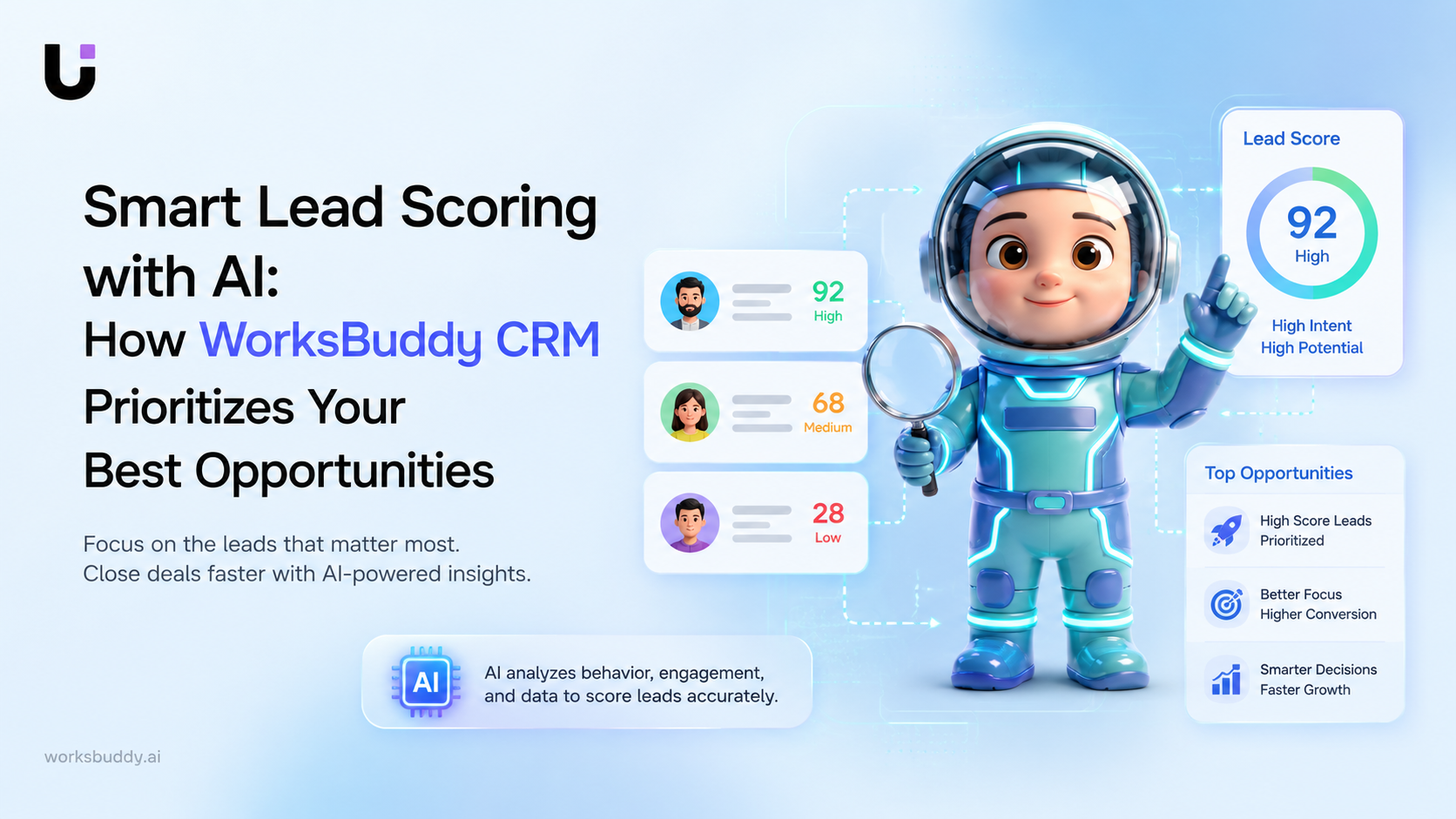
Every sales team eventually runs into the same problem: too many leads, not enough hours in the day. A rep might have a hundred names in their pipeline, but only a handful of those people are actually ready to buy. The rest are browsing, comparing, or simply not a good fit. Figuring out which is which used to depend on gut feeling and experience. Today, it's increasingly handled by a discipline called AI-CRM lead scoring — and understanding how it works can change the way any sales or marketing team thinks about prioritization.
What Lead Scoring Actually Means
Lead scoring is the practice of assigning a numeric or categorical value to a prospect based on how likely they are to convert into a paying customer. Traditional lead scoring relied on manually defined rules: a point for opening an email, five points for visiting a pricing page, ten points for requesting a demo. These rule-based systems worked, but they had a ceiling. Rules had to be written by humans, which meant they reflected assumptions rather than actual behavior patterns. If those assumptions were wrong, the scores were wrong too, and nobody found out until deals fell through.
AI-CRM lead scoring changes the underlying logic. Instead of a person deciding in advance which actions matter, machine learning models study historical data — thousands of past interactions, deals won, deals lost — and learn which combinations of signals actually predict a sale. The system isn't guessing based on intuition; it's finding patterns that a human analyst might never notice, like a specific sequence of page visits combined with company size and response time.
How the Scoring Models Work
Most AI-driven scoring systems draw on several categories of data simultaneously:
Behavioral signals — website visits, email opens, content downloads, time spent on pricing or product pages, and how quickly a lead responds to outreach.
Firmographic data — company size, industry, location, and revenue range, which help the model understand whether a lead fits the profile of past successful customers.
Engagement velocity — not just what a lead does, but how fast they're doing it. A prospect who moves from first contact to demo request within 48 hours behaves very differently from one who trickles through the funnel over three months.
Historical outcome data — the most important ingredient. The model is trained on what happened to leads with similar characteristics in the past, so it can estimate probability of conversion for new leads with comparable traits.
These inputs are fed into predictive models — often gradient boosting algorithms or neural networks — that output a probability score. That score is then translated into something sales teams can act on, such as "hot," "warm," or "cold," or a numeric scale from 0 to 100.
Why This Matters for Sales Teams
The practical value of AI-CRM lead scoring isn't just efficiency, though that's part of it. It's about consistency. Human-assigned scores vary from rep to rep and can drift depending on mood, workload, or bias toward certain industries. A model applies the same logic to every lead, every time, which reduces the chances that a genuinely promising prospect gets deprioritized simply because a rep didn't notice the signals.
It also allows for continuous learning. As new deals close or fall through, the model updates itself, refining its understanding of what a "good" lead actually looks like for that specific business. This is very different from a static scorecard that gets reviewed once a year in a strategy meeting.
Platforms like WorksBuddy Lio have started incorporating this kind of adaptive scoring directly into everyday CRM workflows, which reflects a broader shift in how sales tools are being built — less about storing contact records and more about actively interpreting them.
Limitations Worth Understanding
AI lead scoring isn't infallible. Models are only as good as the data they're trained on, so a company with a small or unusually skewed sales history may get less reliable predictions. There's also the risk of the model reinforcing past biases — if certain types of leads were historically ignored regardless of their real potential, the training data won't reflect their true conversion likelihood. For this reason, most experts recommend treating AI-generated scores as a strong starting point rather than an absolute verdict, with human judgment still playing a role in the final decision.
The Bigger Picture
AI-CRM lead scoring represents a broader trend in sales technology: moving from systems that simply record activity to systems that interpret it. As more historical data accumulates and models improve, scoring will likely become more granular — predicting not just whether a lead will convert, but when, and through which channel. For sales and marketing teams trying to do more with limited time, understanding how these systems actually work is quickly becoming as important as understanding the leads themselves.

 English
 Arabic
 Spanish
 Portuguese
 Deutsch
 Turkish
 Dutch
Dutch
 Italiano
 Russian
 Romaian
 Portuguese (Brazil)
 Greek
Greek
