


Common Prompting Mistakes That Lead to Poor AI Output
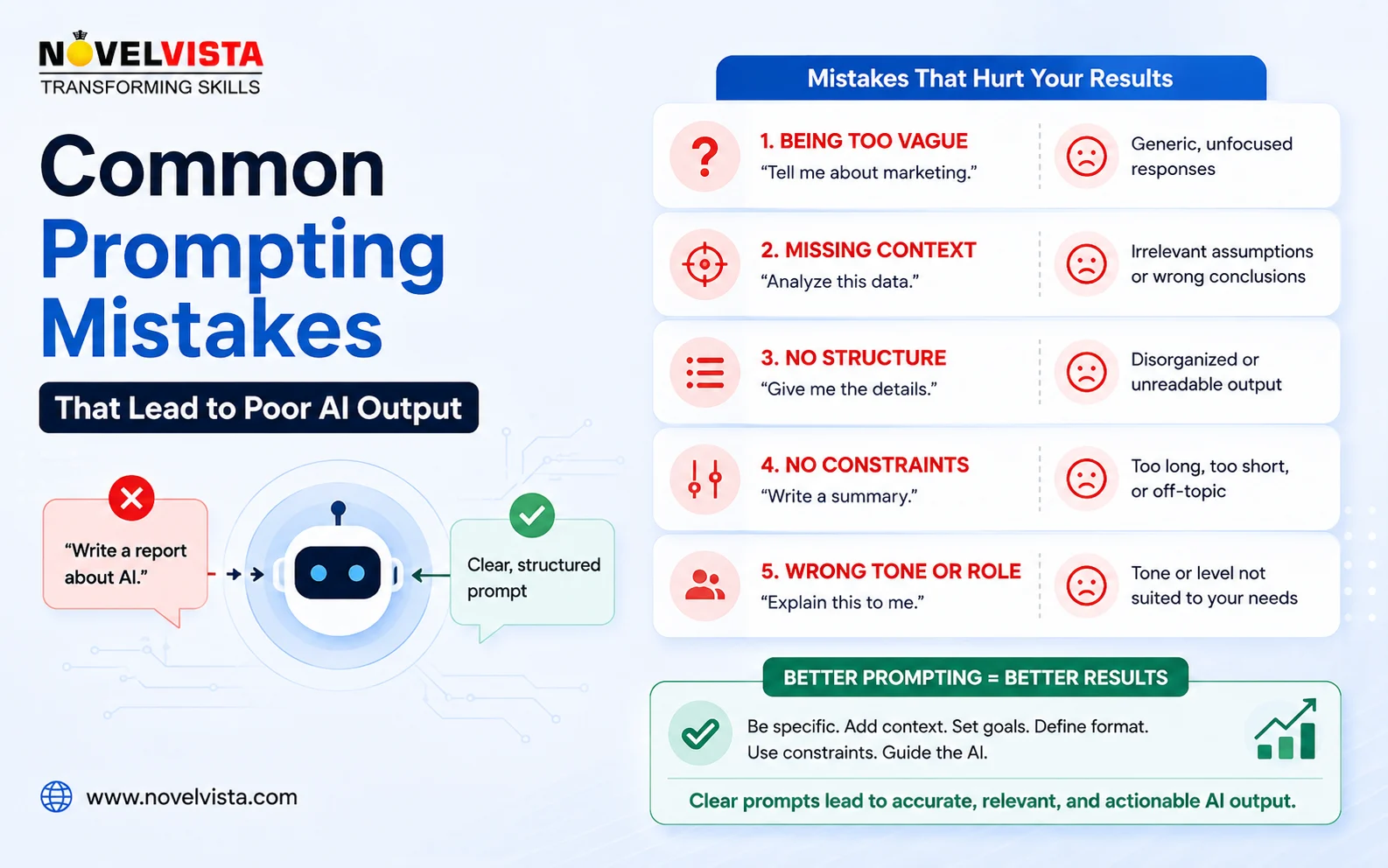
Generative AI tools can produce impressive results, but the quality of their output often depends on the quality of the instructions they receive. When an AI response is vague, incorrect, repetitive, or irrelevant, the model is not always the main problem. In many cases, the Prompt Engineering did not provide enough direction.
Prompting is not about discovering a secret collection of commands. It is about communicating clearly. A strong prompt explains the task, provides useful context, defines expectations, and gives the AI enough information to produce a relevant answer. Understanding common prompting mistakes can help users achieve more accurate, practical, and consistent results.
Using Prompts That Are Too Vague
One of the most common mistakes is giving the AI a broad instruction such as “Write about cloud computing” or “Create a marketing plan.” These prompts do not explain the audience, purpose, format, length, or desired outcome.
The AI must make several assumptions, and those assumptions may not match the user’s needs. A better prompt would specify the topic, target reader, tone, structure, and objective.
For example, instead of asking, “Explain cybersecurity,” a user could write, “Explain the five most common cybersecurity risks to small-business owners in simple language, using practical examples.”
Providing Too Much Unstructured Information
Adding context usually improves AI output, but providing a large block of disorganized information can create confusion. Important instructions may become buried beneath background details, repeated notes, or unrelated content.
Long prompts should be organized into clear sections such as objective, context, requirements, restrictions, and output format. Bullet points, headings, and numbered steps make it easier for the model to identify priorities.
More information is not always better. Relevant and well-structured information is more valuable than excessive detail.
Failing to Define the Audience
Content written for a technical engineer should not sound the same as content written for a business executive, student, customer, or beginner. When the audience is not specified, the AI may use the wrong level of detail or introduce unnecessary terminology.
A prompt should clearly identify who will read or use the response. For example, “Explain machine learning to a non-technical HR manager” provides much better direction than “Explain machine learning.”
Audience information helps the model choose appropriate examples, vocabulary, tone, and depth.
Not Specifying the Output Format
Users often know what information they need but forget to explain how it should be presented. As a result, the AI may return paragraphs when a table is required, a long report instead of a brief summary, or a list when a formal email is expected.
The prompt should define the preferred output format. This may include headings, bullet points, steps, tables, JSON, code, email format, presentation content, or a specific word count.
Clear formatting instructions make the response easier to use and reduce the need for repeated editing.
Combining Too Many Tasks
Prompts sometimes request several unrelated activities at once, such as analyzing a document, creating a strategy, writing an email, generating social posts, and preparing a presentation.
Although AI can handle complex instructions, combining too many objectives can reduce focus and consistency. The model may complete some tasks well while treating others superficially.
A better approach is to divide complex work into smaller stages. First request the analysis, then review it. Next, ask for the strategy, followed by the communication materials. This creates opportunities to correct errors before they affect later outputs.
Assuming the AI Knows Missing Context
AI does not automatically know an organization’s internal policies, customers, products, brand guidelines, or previous decisions unless that information is included or available in the current context.
A prompt such as “Write the proposal we discussed” may fail when the relevant details are missing. Users should include essential facts such as the client name, problem, solution, pricing, timeline, and desired next action.
The model should not be expected to accurately invent information that was never provided.
Ignoring Examples and Reference Material
Examples are one of the most effective ways to communicate expectations. Without them, descriptions such as “make it professional” or “use an engaging style” can be interpreted in different ways.
Providing a sample paragraph, previous report, approved email, brand guideline, or preferred structure gives the AI a clearer pattern to follow. Users should also explain which elements of the example should be retained and which should be changed.
Trusting the First Response Without Review
Even a well-written prompt may not produce a perfect first result. AI can misunderstand instructions, miss facts, generate unsupported claims, or use an unsuitable tone.
Users should review important outputs and ask targeted follow-up questions. Instead of restarting completely, they can say, “Shorten the introduction,” “Add a practical example,” or “Remove unsupported statistics.”
Effective prompting is an iterative process. Clear instructions, relevant context, defined audiences, structured requirements, examples, and careful review help transform generic AI responses into useful business outputs. The goal is not to write the longest prompt. It is to provide the right information in the clearest possible way.

 English
 Arabic
 Spanish
 Portuguese
 Deutsch
 Turkish
 Dutch
Dutch
 Italiano
 Russian
 Romaian
 Portuguese (Brazil)
 Greek
Greek
