


How Can an API for Currency Exchange Simplify Payments?
An online business can receive payments in euros, dollars, pounds, yen, and several other currencies in the same day. The sales team sees the transactions as completed, but the finance team still has to determine their equivalent value, while developers need to ensure the website displays appropriate prices. Without a consistent conversion process, even routine international payments can create unnecessary work.
This problem becomes more noticeable as businesses expand into new markets. Manually checking exchange rates may be manageable for a small operation, but it becomes inefficient when applications need to process hundreds or thousands of transactions automatically.
Businesses evaluating an api for currency exchange should therefore look beyond simple currency conversion. They need to consider how exchange rate data will fit into payment processing, ecommerce pricing, financial reporting, and other application workflows.
Why Do International Applications Need Currency Conversion?
Yes, currency conversion helps applications handle international transactions consistently.
An ecommerce platform may list products in USD internally while allowing customers to view prices in EUR, GBP, or CAD. A travel platform may accept bookings from customers around the world and need to report revenue in a single accounting currency.
Without automated conversion, businesses may rely on spreadsheets or manually updated exchange rates. These approaches can introduce inconsistencies because different employees may use different rates or perform conversions at different times.
An automated workflow reduces this problem.
For example:
Customer selects currency
        ↓
Application retrieves exchange rate
        ↓
Price is converted
        ↓
Localized amount is displayed
        ↓
Transaction is processed
The exact workflow depends on whether the conversion is being used for display, payment processing, accounting, or analytics.
What Are the Main Options for Currency Exchange?
Yes, businesses can choose between manual conversion, internal rate databases, and external APIs.
Manual conversion requires little technical work, making it suitable for occasional calculations. However, it becomes inefficient when transaction volume grows.
An internal exchange rate database gives developers greater control over the data and application logic. It can also reduce repeated external requests. The disadvantage is that someone must obtain, validate, update, and maintain the rates.
A third option is a managed currency API. The application requests exchange rate information when required and uses the response in its own calculations.
This approach can reduce infrastructure responsibilities, but the application becomes dependent on the availability and terms of the external service.
Businesses should select the approach according to their transaction volume, update requirements, technical resources, and operational priorities.
How Does a RESTful Currency API Work?
Yes, RESTful APIs allow applications to retrieve currency information using standard HTTP requests.
A typical request might identify the base currency and the currencies required by the application.
For example:
GET /live?access_key=YOUR_ACCESS_KEY¤cies=EUR,GBP,CADThe service can return structured information that an application can process.
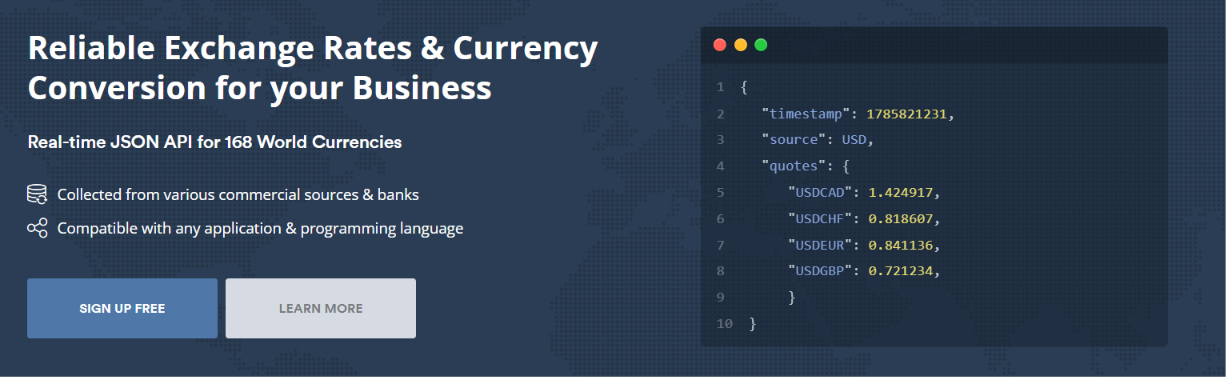
A simplified response might look like:
{
  "base": "USD",
  "rates": {
    "EUR": 0.92,
    "GBP": 0.79,
    "CAD": 1.36
  }
}
The application can then calculate converted amounts.
For example:
price_usd = 100
eur_rate = 0.92

price_eur = price_usd * eur_rate
print(price_eur)
In a production environment, developers should also implement authentication, error handling, rate management, validation, and appropriate rounding rules.
A RESTful currency exchange api can therefore fit naturally into web applications because developers can communicate with the service through familiar HTTP methods and process structured responses.
What Should Developers Compare Before Selecting a Currency API?
Yes, technical features and operational requirements should be evaluated together.
Exchange rate frequency is one of the first considerations. A financial application may require frequent updates, while a basic reporting system may only need periodic rates.
Currency coverage is equally important. A business expanding internationally should confirm that the currencies used by its customers and suppliers are supported.
Historical rates may also be necessary for accounting, auditing, and financial analysis. Current rates cannot accurately reconstruct every historical transaction.
Request limits should be considered as well. An application that checks rates repeatedly throughout the day can generate considerably more traffic than a system that retrieves them once daily.
Developers should also evaluate documentation and response formats. Clear documentation can reduce implementation time and make troubleshooting easier.
Reliability matters because a payment or pricing workflow may depend on timely access to exchange rate information.
Finally, businesses should test the API with realistic usage patterns before moving into production.
How Can Currency APIs Support Ecommerce Payments?
Yes, currency APIs can simplify several parts of an international ecommerce workflow.
Imagine an online store where the internal product catalog is maintained in USD. A visitor from Germany selects EUR as their preferred currency.
The application can retrieve the EUR exchange rate, calculate the localized price, and display the result.
For example:
Base price: $150
EUR rate: 0.92
Converted price: €138
The application can also use exchange rate information for internal reporting.
Suppose the business receives 500 EUR transactions during a day. The finance system may convert those transactions into USD using an appropriate rate and store the resulting value for reporting.
However, developers should distinguish between displaying an approximate converted price and determining the final amount for a financial transaction. Payment processors may apply their own exchange rates, fees, or settlement rules.
Currency APIs can provide useful market data, but businesses should design payment workflows around the rules of their payment provider and accounting system.
How Can Developers Make Currency Conversion More Efficient?
Yes, caching and careful request management can reduce unnecessary API calls.
Suppose an application has 10,000 visitors viewing prices in EUR. It may not need to request the EUR exchange rate 10,000 times.
Instead, the application can retrieve the rate once, temporarily cache it, and reuse the value according to the business's required refresh interval.
A simple workflow could be:
Request exchange rate
        ↓
Validate response
        ↓
Store temporarily
        ↓
Reuse for calculations
        ↓
Refresh when required
Applications should also handle failed requests gracefully. If an API request fails, the system should avoid displaying an incorrect value or silently replacing the rate with unreliable information.
Rounding should be consistent as well. Currency calculations can involve several decimal places, so developers should establish clear rules for how values are rounded and stored.
Logging API failures and monitoring request volume can further improve reliability.
FAQs
1. What is a currency exchange API used for?
A currency exchange API provides exchange rate information that applications can use for price conversion, financial reporting, ecommerce localization, international transactions, and other currency related workflows.
2. Are RESTful currency APIs suitable for web applications?
Yes. RESTful APIs use standard HTTP communication and commonly return structured formats such as JSON, making them suitable for websites, backend systems, mobile applications, and other software.
3. How often should an application update exchange rates?
It depends on the use case. Applications requiring frequently updated market information may need more frequent updates, while ecommerce displays or periodic reports may work with less frequent refreshes. Businesses should define the interval based on their accuracy and operational requirements.

 English
 Arabic
 French
 Spanish
 Portuguese
 Deutsch
 Turkish
 Dutch
Dutch
 Italiano
 Russian
 Romaian
 Portuguese (Brazil)
