


Food Antioxidant Market to Reach USD 6.49 Billion by 2036
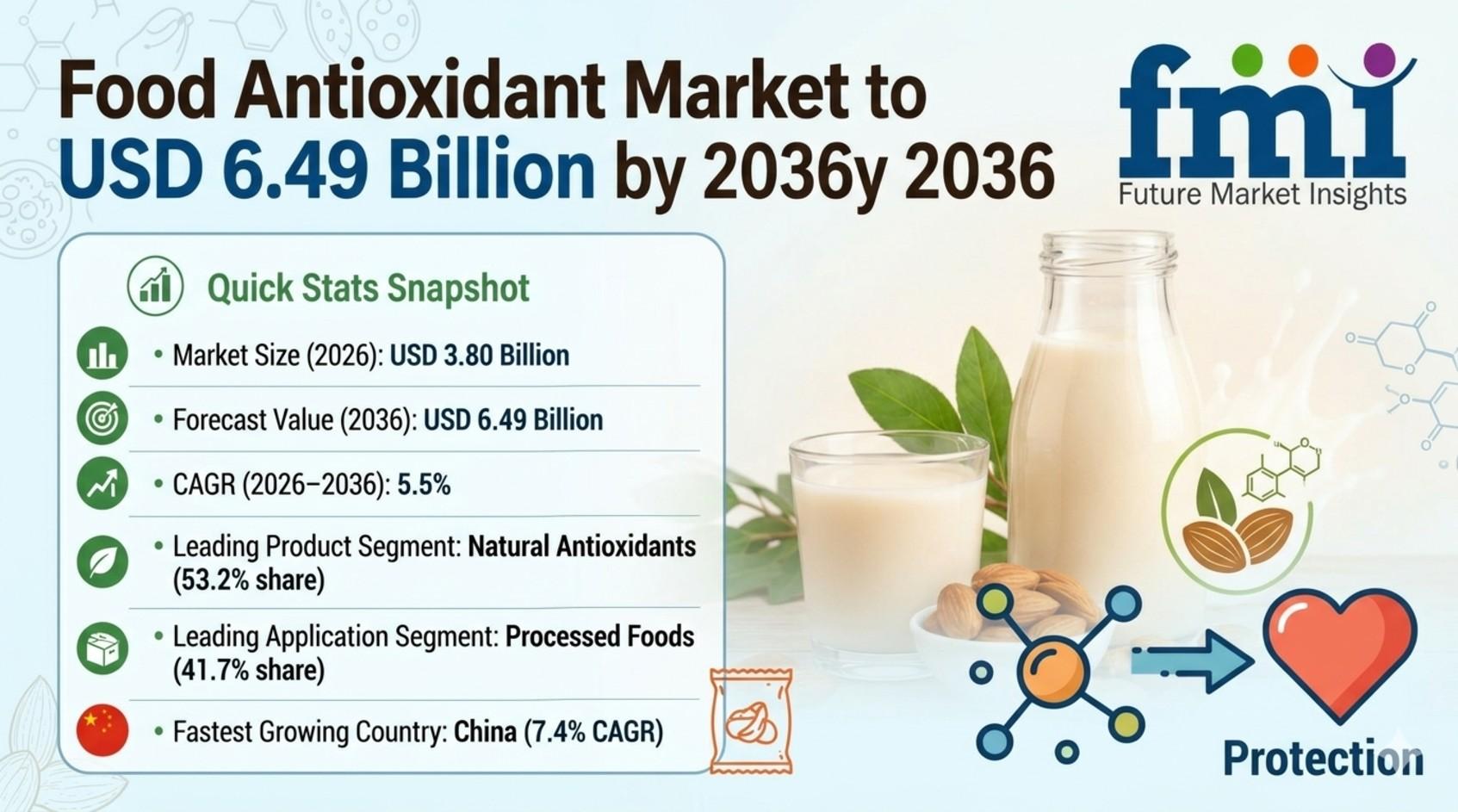
The global food antioxidant market is undergoing a structural transition, driven by consumer clean-label expectations and tightening regulatory restrictions on synthetic chemical additives, according to latest insights by Future Market Insights. Formulating processed foods, edible oils, bakery products, and meats with natural or synthetic antioxidants prevents lipid oxidation, delays rancidity, and extends shelf life.
The global market, valued at USD 3.60 billion in 2025, is projected to reach USD 3.80 billion in 2026. Advancing at a Compound Annual Growth Rate (CAGR) of 5.50% over the ten-year forecast period, total market valuation is anticipated to hit USD 6.49 billion by 2036, delivering an absolute opportunity of USD 2.69 billion.
Get detailed market forecasts, competitive benchmarking, and pricing trends:
https://www.futuremarketinsights.com/reports/sample/rep-gb-25515
Market Performance Overview (2026–2036)
To map out the key product origins, core application categories, and regional growth vectors guiding this USD 2.69 billion market scale-up, key segment allocations highlight where global demand is concentrated:
· Natural Product Segment (53.2% share): Commands the product category in 2026, crossing the majority share threshold as food processors reformulate to satisfy clean-label demands using tocopherol blends (vitamin E), ascorbic acid (vitamin C), and plant polyphenols (rosemary, green tea, grape seed extracts).
· Synthetic Product Segment: Retains essential market share across bulk fats, oils, and industrial food processing, where cost efficiency and high-potency molecules like BHA, BHT, TBHQ, and propyl gallate remain required at minimal dosage levels.
· Processed Foods Application Segment (41.7% share): Dominates application demand, driven by packaged snacks, ready-to-eat meals, and shelf-stable convenience foods where lipid oxidation directly impacts taste, aroma, and return rates.
· Fats & Oils, Bakery & Confectionery, and Meat Products: Form secondary application pillars, relying on antioxidants for color stability, flavor retention, and preventing fat rancidity.
Technical Drivers and Clean-Label Reformulation Shifts
The integration of food antioxidants across industrial processing lines is propelled by three primary industry catalysts:
Regulatory Pressure on Synthetic Additives
Strict regulatory scrutiny in the European Union, Japan, and the UK regarding synthetic preservatives (BHA, BHT, TBHQ) is accelerating product reformulations. Food manufacturers are proactively replacing synthetic chemicals with plant-derived alternatives to ensure cross-border regulatory compliance.
Clean-Label Transparency & Hybrid Systems
Consumers increasingly avoid artificial preservatives on ingredient labels. To maintain cost efficiency without sacrificing shelf stability, formulators are deploying hybrid antioxidant systems combining natural tocopherols with cost-effective botanical polyphenol extracts (such as rosemary extract).
Shelf-Life Extension for Global Food Logistics
Export-oriented food manufacturers in emerging markets require high-potency oxidative protection to withstand extended maritime transport and variable storage temperatures, reducing food waste and product return costs.
Industrial Infrastructure & Formulation Constraints
Food antioxidant suppliers and CPG brand managers face specific technical and economic hurdles:
· Price Differential Between Natural and Synthetic Variants: Natural plant extracts command a price premium over synthetic chemical antioxidants, creating margin pressure for price-sensitive, mass-market commodity foods.
· Thermal & Sensory Stability in Complex Matrices: Natural antioxidants can occasionally impart unwanted colors or herbal flavors to delicate food matrices if improperly dosed or subjected to high-temperature baking/frying.
Regional Growth Profile
Regional demand reflects rapid adoption in expanding Asian food processing hubs alongside regulatory-driven shifts in Western markets:
· China (7.40% CAGR): The global growth frontrunner, driven by rapid urbanization, expanding packaged food logistics, and rising consumer demand for fortified, functional foods.
· India (6.90% CAGR): Spurring rapid volume growth through government-backed food processing infrastructure expansion, e-commerce retail penetration, and rising adoption in snacks and edible oils.
· Germany (6.30% CAGR) & France (5.80% CAGR): Leading Western European clean-label demand, governed by strict EFSA regulations favoring natural tocopherols and organic botanical extracts.
· United Kingdom (5.20% CAGR): Driven by retail clean-label commitments and expanding functional food product lines.
· United States (4.70% CAGR): Sourcing a large baseline volume footprint across packaged snacks, pet food preservation, and functional beverage lines.
Competitive Landscape
The global food antioxidant landscape features a combination of multinational chemical houses, agricultural processing giants, and specialized botanical extraction suppliers.
Key market participants profiled in the report include DuPont de Nemours, Inc., Eastman Chemical Company, Archer Daniels Midland Company (ADM), BASF SE, Vitablend Nederland B.V., Yasho Industries Ltd., Kemin Industries, Global Specialty Ingredients, Sinofi Ingredients, Camlin Fine Sciences, Kalsec Inc., Koninklijke DSM N.V., Frutarom Industries Ltd, Givaudan SA, Lonza, and Riken Vitamin. Leading players are actively maintaining dual natural/synthetic product portfolios to serve both cost-conscious industrial buyers and premium clean-label brands.
Full Report for Detailed Insights: https://www.futuremarketinsights.com/reports/food-antioxidant-market
Frequently Asked Questions
What is the projected valuation of the global food antioxidant market by 2036?
The global food antioxidant market is projected to reach USD 6.49 billion by 2036, expanding from an estimated baseline valuation of USD 3.80 billion in 2026 at a CAGR of 5.50%.
Why does the Natural segment hold over 50% market share?
Natural antioxidants command a 53.2% share in 2026 because major food manufacturers are reformulating packaged products with tocopherols, ascorbic acid, and botanical extracts to comply with EU regulations and meet clean-label consumer preferences.
What exclusions govern the boundaries of this market report?
The scope strictly covers food-grade antioxidants used in human food and beverage manufacturing. It explicitly excludes antioxidants used exclusively in cosmetic, pharmaceutical, or industrial polymer/lubricant applications, as well as direct-to-consumer dietary supplement pills sold outside food manufacturing.
FMI Custom Research: Strategic Intelligence for Confident Decision-Making
In today's rapidly evolving business environment, leadership teams need clear, actionable intelligence tailored to their strategic objectives. FMI's Custom Research solutions are designed around specific business questions, enabling executives to evaluate growth opportunities, validate investments, assess competitive dynamics, and reduce uncertainty before making critical decisions.
Key Executive Benefits
· Decision-Ready Insights: Research tailored to your specific business challenges, growth plans, and investment priorities.
· Reduced Strategic Risk: Validate market opportunities, customer demand, and competitive positioning before committing resources.
· Market Entry Confidence: Assess opportunity size, regulatory barriers, channel dynamics, and competitive landscapes with precision.
· Competitive Advantage: Gain proprietary intelligence unavailable through syndicated reports or internal datasets.
· Faster Growth Decisions: Accelerate expansion, product development, portfolio optimization, and investment planning.
· Primary Market Validation: Access real-world customer, buyer, and stakeholder insights that support high-confidence decision-making.
Business Impact
FMI helps organizations transform market complexity into strategic clarity, enabling leadership teams to identify growth opportunities faster, optimize resource allocation, strengthen competitive positioning, and make high-stakes business decisions with confidence.
To explore how FMI Custom Research can support your strategic priorities, connect with our team at - sales@futuremarketinsights.com
About Future Market Insights (FMI)
Future Market Insights (FMI) delivers actionable, decision-focused market intelligence that goes beyond traditional research reports. The company provides:
· In-depth pricing and cost benchmarking analysis
· Demand forecasting based on real industry inputs
· Procurement and buyer behavior insights
· Supply chain and trade flow intelligence
· Technology and application trend analysis across industries
FMI follows a robust bottom-up research methodology, combining insights from industry experts, procurement leaders, manufacturers, and technical professionals to ensure accurate and practical market intelligence.

 English
 Arabic
 Spanish
 Portuguese
 Deutsch
 Turkish
 Dutch
Dutch
 Italiano
 Russian
 Romaian
 Portuguese (Brazil)
 Greek
Greek
