


Evaluating LLM Outputs at Scale: Automated and Human-in-the-Loop Methods
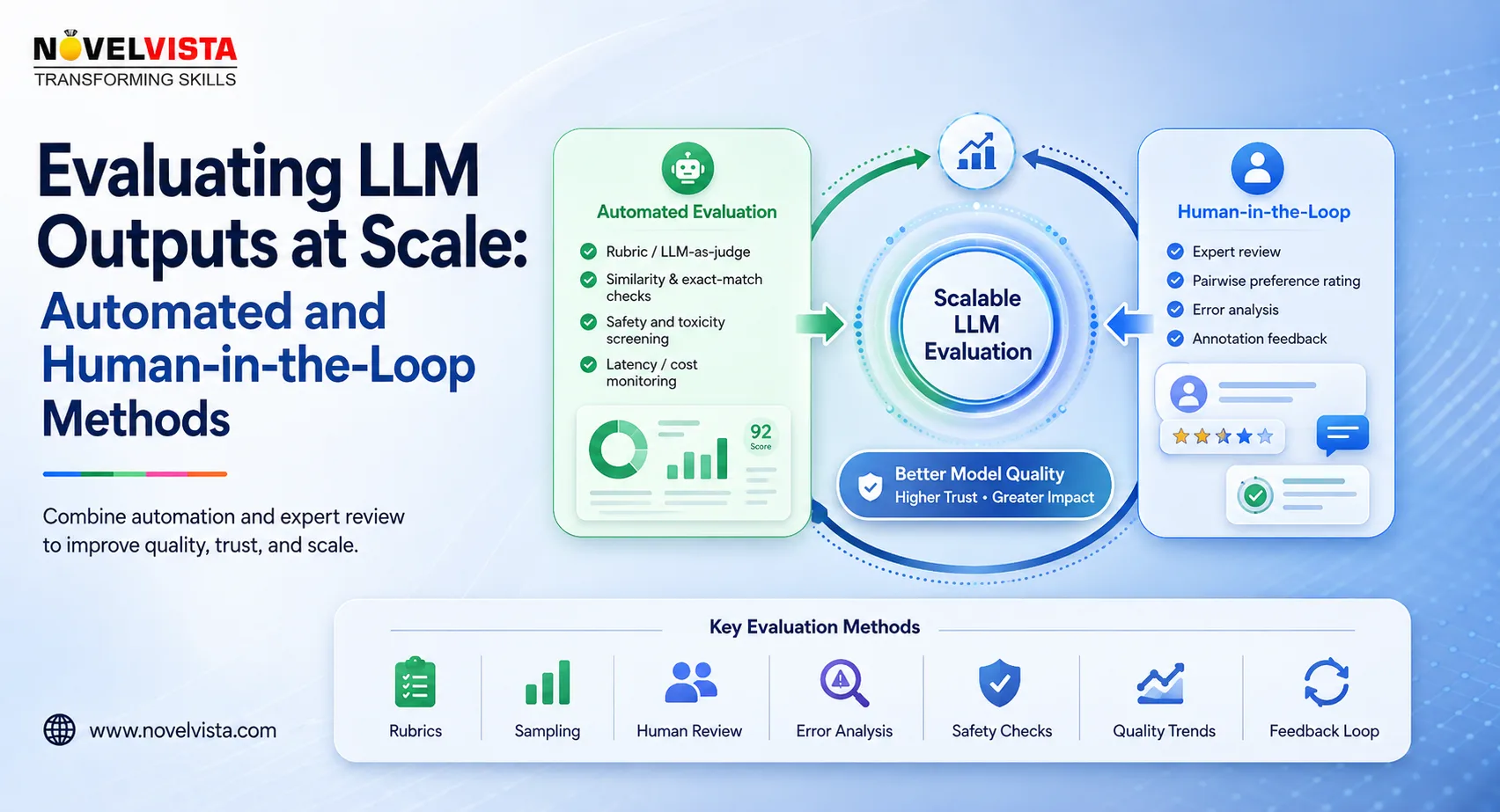
Large language models can produce thousands of responses in minutes, but speed creates a question: how can organizations verify quality at the same scale? Reading every output manually is rarely practical, while relying only on automated scores can hide factual errors, bias, or unsafe advice. A dependable evaluation program therefore combines automated testing with human review.
Why LLM Evaluation Is Different
Traditional software usually has predictable inputs and outputs. LLM applications are probabilistic, meaning the same request may produce different wording across runs. Quality is also multidimensional. A response may be fluent but inaccurate, correct but irrelevant, or helpful but inconsistent with company policy.
Teams should define evaluation criteria around the application’s purpose. Common dimensions include factual correctness, relevance, completeness, instruction following, tone, safety, citation quality, and response latency. A customer-support assistant may prioritize policy compliance, while a coding assistant may be judged on functional correctness, security, and maintainability.
Building a Representative Evaluation Dataset
Large-scale evaluation begins with a strong test set. It should include common requests, difficult edge cases, ambiguous prompts, adversarial inputs, and examples where the model should refuse or admit uncertainty. Production conversations can help identify realistic scenarios, provided sensitive information is removed.
Each example should contain the input, necessary context, and an expected outcome or scoring rubric. A single “correct answer” is not always appropriate because multiple responses may be acceptable. Rubrics make evaluation more flexible by describing what a strong answer must contain and which failures are unacceptable.
Automated Evaluation Methods
Deterministic checks are the simplest automated method. They can verify structured output, required fields, JSON validity, keywords, citations, response length, or whether generated code passes unit tests. These checks are fast, inexpensive, and repeatable, making them useful in continuous integration pipelines.
Similarity metrics can compare generated text with a reference answer, but they should be used cautiously. A response can be correct without using the same wording as the reference. Semantic similarity is more useful than exact matching, although it still may not capture factual accuracy or business value.
Another scalable method is LLM-as-a-judge, where a separate model scores an output using a defined rubric. Research behind MT-Bench showed that strong model judges can approximate human preferences in open-ended evaluations, but it also identified position, verbosity, and self-preference biases. Later work on AlpacaEval demonstrated that preference for longer answers can distort automated rankings. Automated judges should therefore be calibrated against human decisions rather than treated as unquestionable authorities.
Human-in-the-Loop Evaluation
Human reviewers remain essential when quality depends on domain expertise, cultural context, risk, or subtle judgment. Reviewers can detect misleading claims, confusing explanations, weak reasoning, inappropriate tone, and policy violations that automated systems may overlook.
Human evaluation can use point-based scoring, pass-or-fail decisions, or pairwise comparison. Pairwise review asks evaluators to choose the better of two responses and is often easier than assigning an absolute score. Clear rubrics, reviewer training, and example answers improve consistency.
For high-risk use cases, reviewers should include specialists such as clinicians, lawyers, security professionals, or compliance teams. NIST’s AI Risk Management Framework emphasizes measurement, monitoring, governance, and human oversight responsibilities for trustworthy AI systems.
Combining Automation and Human Review
The most effective approach uses automation for broad coverage and humans for depth. Automated tests can evaluate every model release and a sample of production traffic. Human reviewers can inspect low-scoring responses, evaluator disagreements, high-risk categories, and randomly selected outputs.
Teams should regularly compare automated scores with human ratings. When agreement declines, the judge prompt, rubric, evaluation model, or test dataset may need adjustment. Recent research on long-form evaluation suggests that LLM judges can remain unstable across scenarios, even with rubrics or references.
Evaluation should continue after deployment. Dashboards can track failure rates, user feedback, safety incidents, latency, cost, and changes across model or prompt versions. Every serious failure should become a new test case, turning production lessons into stronger safeguards.
At scale, no single score can represent LLM quality. Reliable evaluation is a living system that combines automated checks, model-based judging, expert review, and production monitoring. The goal is not simply to prove that a model performs well, but to identify where it fails before those failures create real consequences.

 English
 Arabic
 French
 Spanish
 Portuguese
 Deutsch
 Turkish
 Dutch
Dutch
 Italiano
 Russian
 Portuguese (Brazil)
 Greek
Greek
