


Evaluating RAG Systems: Retrieval Quality vs. Generation Quality
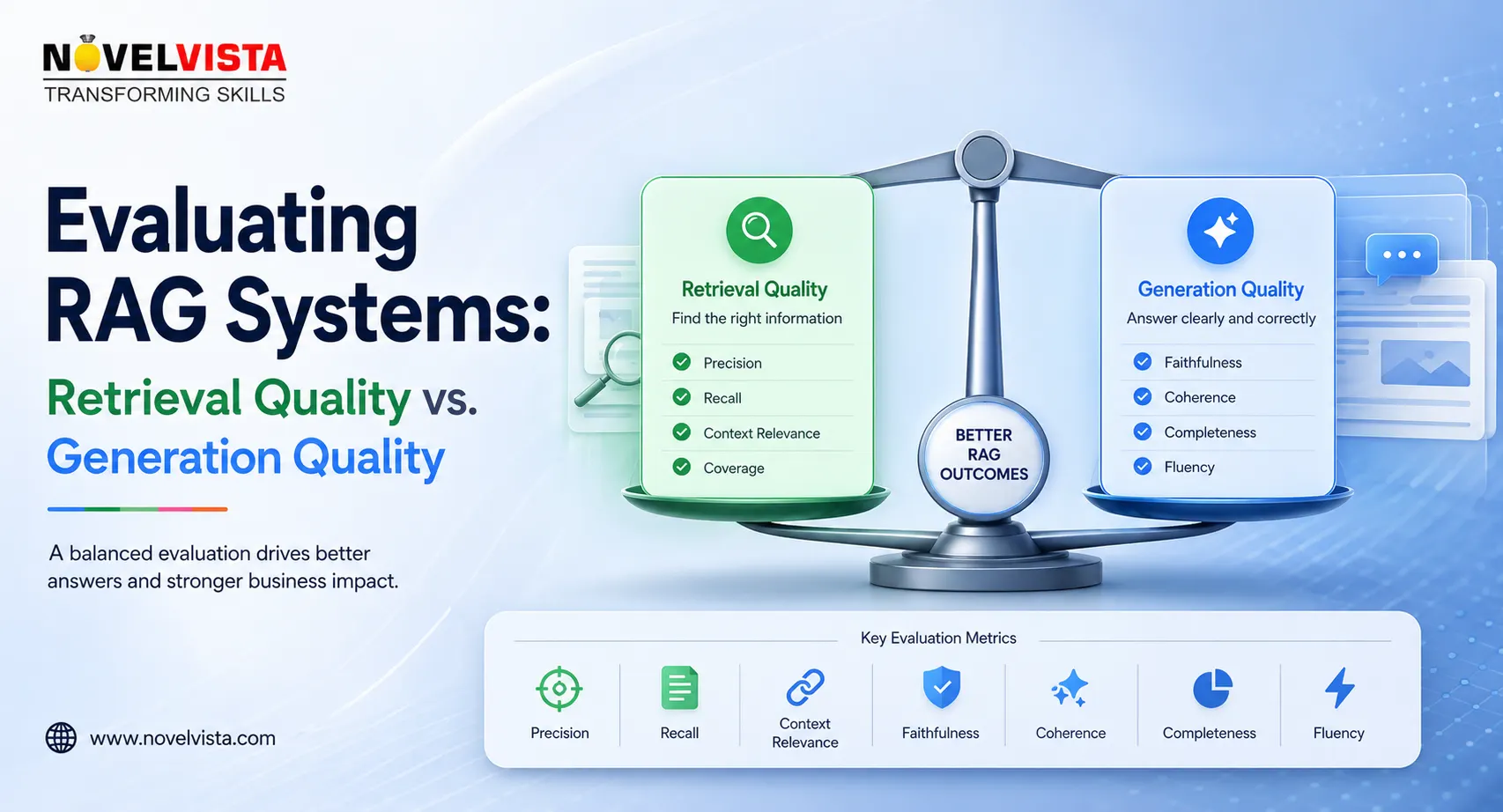
Retrieval-Augmented Generation systems combine information retrieval with large language models to produce answers grounded in knowledge. Measuring whether such a system works well is not as simple as checking whether its final response sounds convincing. A fluent answer can be based on the wrong documents, while an excellent retriever can feed relevant evidence to a model that misinterprets it. Effective RAG evaluation therefore separates retrieval quality from generation quality before examining user experience.
Why Retrieval and Generation Must Be Evaluated Separately
A RAG pipeline receives a question, searches a knowledge source, selects relevant passages, and asks a language model to generate an answer from that context. Because retrieval and generation are separate stages, failures can originate in different places. Frameworks such as RAGAS evaluate context relevance, faithfulness, and answer quality rather than treating the pipeline as a black box.
Suppose a user asks about an organization’s refund policy. The retriever may return an outdated shipping policy instead of the current refund document. Even if the model accurately summarizes the retrieved text, the final answer is still wrong.
In another case, the correct policy may be retrieved, but the model may overlook an exception or invent an unsupported condition. These situations require different fixes. The first requires better retrieval, while the second requires better prompting, generation controls, or model selection.
Measuring Retrieval Quality
Retrieval evaluation asks whether the system found the right evidence. A practical evaluation dataset should contain representative user questions and, where possible, documents or passages marked as relevant.
Common retrieval metrics include precision, recall, Mean Reciprocal Rank, and normalized Discounted Cumulative Gain. Precision measures how much of the retrieved content is relevant. Recall measures how much of the required evidence the system found. Mean Reciprocal Rank rewards systems that place the first relevant result near the top. NDCG considers both relevance and ranking position, which is useful when several passages have different levels of importance.
The value of these metrics depends on the application. For a compliance assistant, missing one critical policy section may be more harmful than retrieving several extra passages, making recall especially important.
For a customer-support bot with a limited context window, precision may matter more because irrelevant chunks can distract the model. Information-retrieval benchmarks such as BEIR show why retrievers should be tested across varied domains rather than on one narrow dataset.
Retrieval evaluation should also examine chunking, metadata filters, hybrid search, query rewriting, and reranking. Engineers should inspect failed queries manually to determine whether problems come from poor embeddings, ambiguous questions, missing documents, incorrect permissions, or badly divided content.
Measuring Generation Quality
Generation evaluation focuses on what the language model does with the retrieved evidence. The answer should be correct, relevant, understandable, and supported by the provided context.
Faithfulness is one of the most important measures. It checks whether claims in the answer can be traced to retrieved passages. Answer relevance checks whether the response directly addresses the user’s question instead of repeating the context.
Correctness compares the generated answer with a trusted reference answer when available. Other useful dimensions include completeness, clarity, citation accuracy, tone, safety, and the ability to admit that information is insufficient. Current RAG evaluation research increasingly considers factual accuracy, system performance, safety, and operational efficiency together.
Automated evaluation can use rules, similarity metrics, or another language model acting as a judge. However, automated scores should not be accepted blindly. Evaluator prompts, model choice, and scoring criteria can influence results. Human reviewers remain important for sensitive, subjective, or high-impact use cases.
Evaluating the Complete RAG Experience
Users experience the system as a whole. End-to-end evaluation should measure whether the final answer solves the user’s problem, responds quickly, includes useful sources, respects access controls, and behaves safely when evidence is missing or contradictory.
A strong test set should include straightforward questions, vague queries, multi-step questions, outdated documents, conflicting sources, unsupported requests, and permission-restricted content. Teams should also record latency and cost because an accurate pipeline may still be impractical if every answer requires expensive reranking and multiple model calls.
The best evaluation process combines offline benchmarks, human review, automated checks, and production monitoring. Retrieval and generation scores should be tracked separately so engineers know where to intervene.
Improving RAG is not about maximizing one metric. It is about ensuring that the system retrieves trustworthy evidence and transforms it into an accurate, useful, and transparent answer.

 English
 Arabic
 French
 Spanish
 Portuguese
 Deutsch
 Turkish
 Dutch
Dutch
 Italiano
 Russian
 Portuguese (Brazil)
 Greek
Greek
