


How AI-Powered Fraud Detection in Banking is Combating Deepfake and Synthetic Fraud Attempts
In 2026, fraud is no longer just increasing—it is scaling programmatically. Criminal networks are now using generative AI to launch thousands of synthetic attacks simultaneously, overwhelming traditional banking defenses. For leadership, AI-powered fraud detection in banking is no longer about marginal efficiency; it is about institutional survival. As fraudsters use high-fidelity deepfakes to bypass biometric safeguards at scale, legacy defenses are becoming liabilities.
Why Legacy Defenses are Now Liabilities in Banking Fraud Detection?
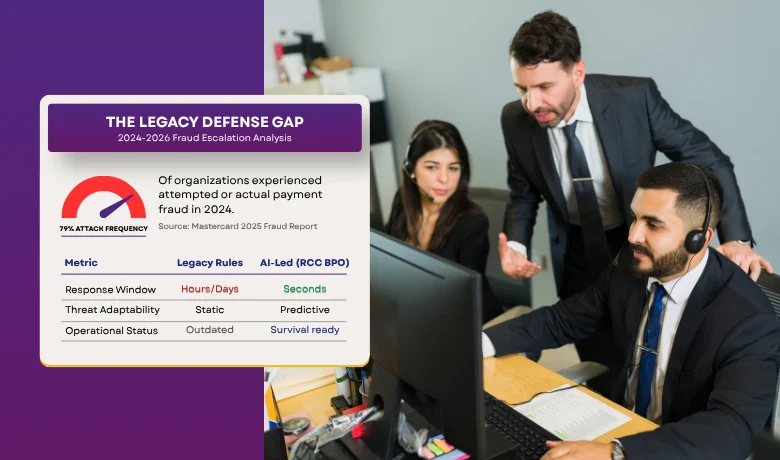
Traditional fraud prevention relied on static, rule-based systems. While these were effective a decade ago, they are defenseless against modern, industrialized threats. According to Mastercard’s 2025 Fraud Report, 79% of organizations experienced attempted or actual payment fraud in 2024, highlighting how widespread and normalized these attacks have become.
The crisis is compounded by the speed of transactions. With faster payment rails, the window to identify and block a fraudulent transfer has shrunk to seconds. If your current fraud systems rely on static rules, they are already outdated. RCC BPO helps banks transition to AI-led detection without disrupting existing workflows, closing the gap between attack and response.
AI for Deepfake and Synthetic Fraud Detection in Banking
The most dangerous frontier in 2026 is the “Identity Paradox.” Criminals use Generative AI to create high-fidelity deepfake fraud detection in banking, bypassing video and audio verification. Deloitte projects that U.S. banking losses from these AI-enabled crimes could hit $40 billion by 2027.
Defeating Synthetic Identities
Synthetic identity fraud prevention is now a top priority for 61% of financial leaders. Unlike traditional identity theft, synthetic fraud involves “gardening” fake profiles over months. AI-powered fraud detection in banking solves this by using Graph Neural Networks (GNN) to scan billions of records. These systems move beyond searching for a single stolen ID to identify suspicious clusters. For example, they detect dozens of disparate accounts linked to a single VoIP phone number, effectively surfacing previously unseen threats.
Real-Time Behavioral Analytics
Beyond document verification, banks now employ real-time behavioral analytics. In many cases, deepfake attacks are convincing enough to pass voice-based authentication systems used in call centers. Real-time fraud detection AI fights back by analyzing transaction cadence, device metadata, and location patterns to assign a risk score to every action in milliseconds.
The Detection Engine: How AI Identifies Fraud Before It Happens?
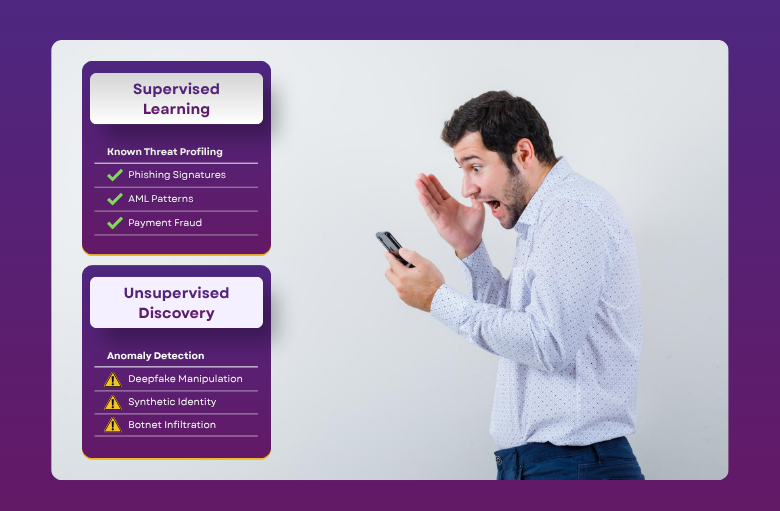
To implement AI-powered fraud detection in banking effectively, systems must move beyond simple automation. We utilize a dual-learning approach:
- Supervised Learning: These models are trained on thousands of confirmed fraud cases. They identify known tactics, such as specific phishing signatures or money laundering patterns.
- Unsupervised Anomaly Detection: These systems don’t rely on predefined fraud patterns. Instead, they continuously scan for unusual behavior, surfacing previously unseen threats—catching “zero-day” fraud tactics instantly.
The Credibility Gap: Where AI Still Requires Human Oversight
Even advanced systems deployed by leading institutions require continuous tuning and human validation. Enterprise leaders must be wary of two major pitfalls:
- AI Hallucinations: Generative AI and predictive tools can occasionally generate false positives that damage the customer experience.
- Algorithmic Bias: If models are trained on biased data, they can inadvertently discriminate in credit analysis or identity checks.
The goal isn’t to replace humans; it’s to augment them. Successful Banking Outsourcing Services focus on a “Human-in-the-Loop” model in which AI handles massive volumes of data, while expert analysts focus on high-stakes “grey area” reviews.
The RCC Advantage: Operationalizing Intelligence
Most banks deploy AI models. Few operationalise them effectively. The gap is not technology—it is execution. RCC BPO bridges the gap between AI detection and operational response—the point at which most fraud strategies fail.
By integrating our proprietary technology with your existing infrastructure, we deliver:
- Reduced Workloads: Reduce manual fraud review workloads by up to 40% through AI-assisted alert prioritization.
- Accuracy: Improve identity verification accuracy with AI-driven KYC AML support across structured and unstructured data.
- Compliance: Monitor transactions 24/7 across global payment rails while maintaining strict BFSI BPO compliance standards (SOC 2, PCI DSS).
Frequently Asked Questions (FAQ)
-
How quickly can AI-based fraud detection be implemented in an existing banking system?
Banks can integrate most AI-powered fraud detection in banking modules via API within 4 to 12 weeks, though data hygiene ultimately dictates the final timeline.
-
Does AI-powered detection increase “false positives”?
Initially, models may increase alerts, but unsupervised learning eventually reduces false positives compared to rigid, rule-based systems by “learning” specific habit patterns.
-
How does AI identify deepfake audio during a verification call?
AI analyzes background frequencies and specific conversation markers that indicate a synthetic voice clone, flagging these for immediate human intervention.
-
Can AI assist with check fraud and internal treasury monitoring?
Yes. Despite the digital shift, check fraud remains a 63% risk. AI analyzes historical data to identify anomalous deposits that deviate from normal treasury patterns.
-
What kind of ROI can banks expect from AI-powered fraud detection?
Most institutions see ROI through reduced fraud losses, lower false positives, and decreased manual review costs within the first 6–12 months of deployment.
Partner for a Secure Future in Banking Customer Service
Fraud is no longer a volume problem—it is an intelligence problem. Relying on 20th-century rules to fight 21st-century AI attacks is a recipe for catastrophic loss. RCC BPO combines AI precision with seasoned human judgment to help financial institutions scale their defenses without increasing headcount.
Talk to our experts today. Audit your current fraud defenses and uncover immediate vulnerabilities before criminals exploit them.


 English
 Arabic
 Spanish
 Portuguese
 Deutsch
 Turkish
 Dutch
Dutch
 Italiano
 Russian
 Romaian
 Portuguese (Brazil)
 Greek
Greek
