


What is MLOps? A Complete Guide for SREs Moving Into AI Operations
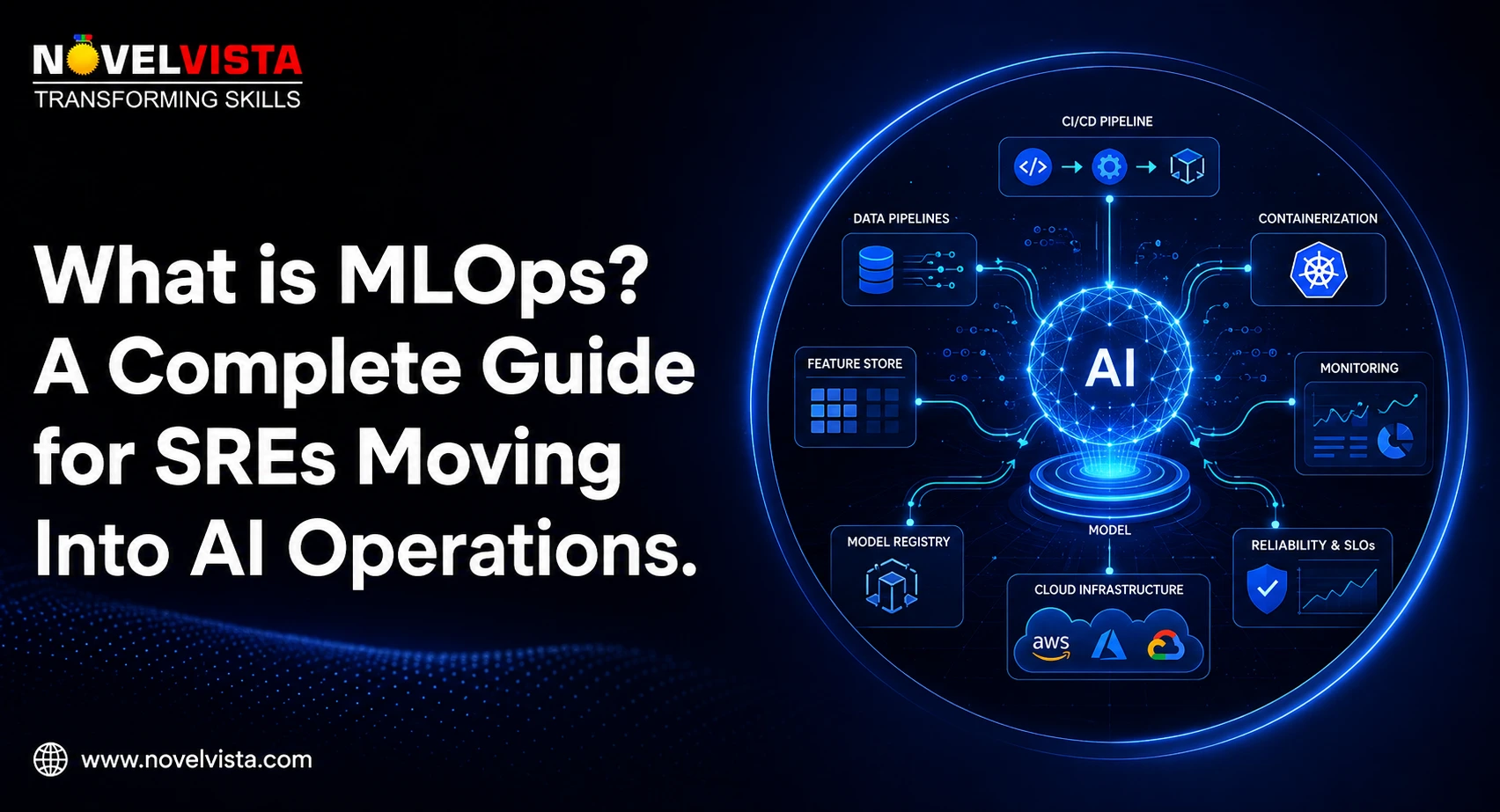
Machine learning systems can stay online while their predictions quietly become inaccurate, biased, slow, or expensive. For Site Reliability Engineers, this changes the reliability boundary. Production health is no longer limited to servers, networks, applications, and databases; it also includes data quality, model behaviour, prediction outcomes, and operational cost.
What Is MLOps?
MLOps is the discipline of building, testing, deploying, monitoring, governing, and improving machine learning systems in production. It connects data engineering, model development, software delivery, infrastructure, security, and operational feedback within one controlled lifecycle.
Unlike conventional applications, machine learning services depend on code, data, features, configuration, and trained models. Even when application code remains unchanged, prediction quality may decline because user behaviour, market conditions, devices, or input data have shifted. MLOps therefore extends CI/CD with experiment tracking, data validation, model registries, continuous training, lineage, quality gates, and drift monitoring.
Why SRE Skills Transfer Well
SREs already understand availability, latency, capacity, observability, automation, incident management, controlled releases, and service-level objectives. These capabilities transfer directly into MLOps.
The major learning shift is recognising model-specific risks. These include training-serving skew, stale features, data drift, concept drift, delayed ground truth, biased predictions, failed retraining pipelines, and uncontrolled inference costs. An SRE moving into AI operations should treat every model as a versioned production dependency with measurable fitness, ownership, rollback criteria, and an auditable history.
The MLOps Lifecycle
The MLOps lifecycle is a continuous feedback loop. Data is collected and validated before training. Experiments are tracked so teams can reproduce results. Candidate models are evaluated against technical, business, security, fairness, and policy requirements. Approved models are registered and released through controlled deployment strategies such as shadow testing, canary releases, or phased traffic shifting.
After deployment, teams monitor infrastructure health, pipeline reliability, data quality, model performance, and business outcomes. When performance falls below an agreed threshold, the model may be retrained, replaced, rolled back, or routed to human review.
MLOps Versus DevOps
DevOps and MLOps share version control, automated testing, CI/CD, infrastructure as code, security controls, and observability. The difference lies in what must be managed.
DevOps primarily governs code, configuration, and software artifacts. MLOps must additionally govern datasets, features, experiments, models, evaluation results, and training environments. Software behaviour is usually deterministic, while machine learning behaviour is probabilistic and dependent on changing data. Consequently, rollback may involve restoring a previous model, feature set, dataset, or pipeline configuration rather than only reverting application code.
Monitoring and SLOs
Traditional golden signals remain essential, but they are insufficient for machine learning services. A model endpoint can return successful responses within its latency target while producing poor recommendations.
Useful indicators include availability, prediction latency, throughput, data freshness, schema validity, feature drift, training-serving skew, accuracy, precision, recall, calibration, fallback rates, and cost per prediction. SLOs should connect technical performance with customer impact, safety, policy limits, and business outcomes.
Incident Response for Model Failures
Model incidents should be classified by failure type, including availability, latency, data integrity, drift, harmful output, security exposure, bias, or runaway cost. Response teams must identify the affected model, dataset, feature version, endpoint, tenant, and release window.
Containment may require rolling back the model, disabling a feature, routing requests to a baseline system, increasing human review, rate-limiting inference, or pausing automated retraining. Post-incident reviews should examine code, data, models, pipelines, governance, and ownership rather than focusing only on infrastructure.
A Practical Transition Path
SREs do not need to become research data scientists. They need sufficient machine learning knowledge to understand evaluation metrics, model lifecycle risks, data quality, drift, and retraining decisions.
Start by building a small pipeline that trains, validates, registers, deploys, and monitors a model. Add lineage, dashboards, canary controls, rollback procedures, cost limits, security checks, and incident simulations. Learn one practical tool in each major category instead of collecting an oversized platform stack.
That operational mindset makes SRE experience exceptionally valuable in modern enterprise AI teams.
MLOps gives SREs a natural pathway into AI operations. The familiar principles remain: automate repetitive work, measure what matters, release safely, prepare for failure, and continuously improve. The new responsibility is ensuring that the intelligence remains reliable, explainable, secure, affordable, and fit for purpose.

 English
 Arabic
 French
 Spanish
 Portuguese
 Deutsch
 Turkish
 Dutch
Dutch
 Italiano
 Russian
 Romaian
 Greek
Greek
