


Agent Orchestration Frameworks Compared: LangGraph, CrewAI, and AutoGen
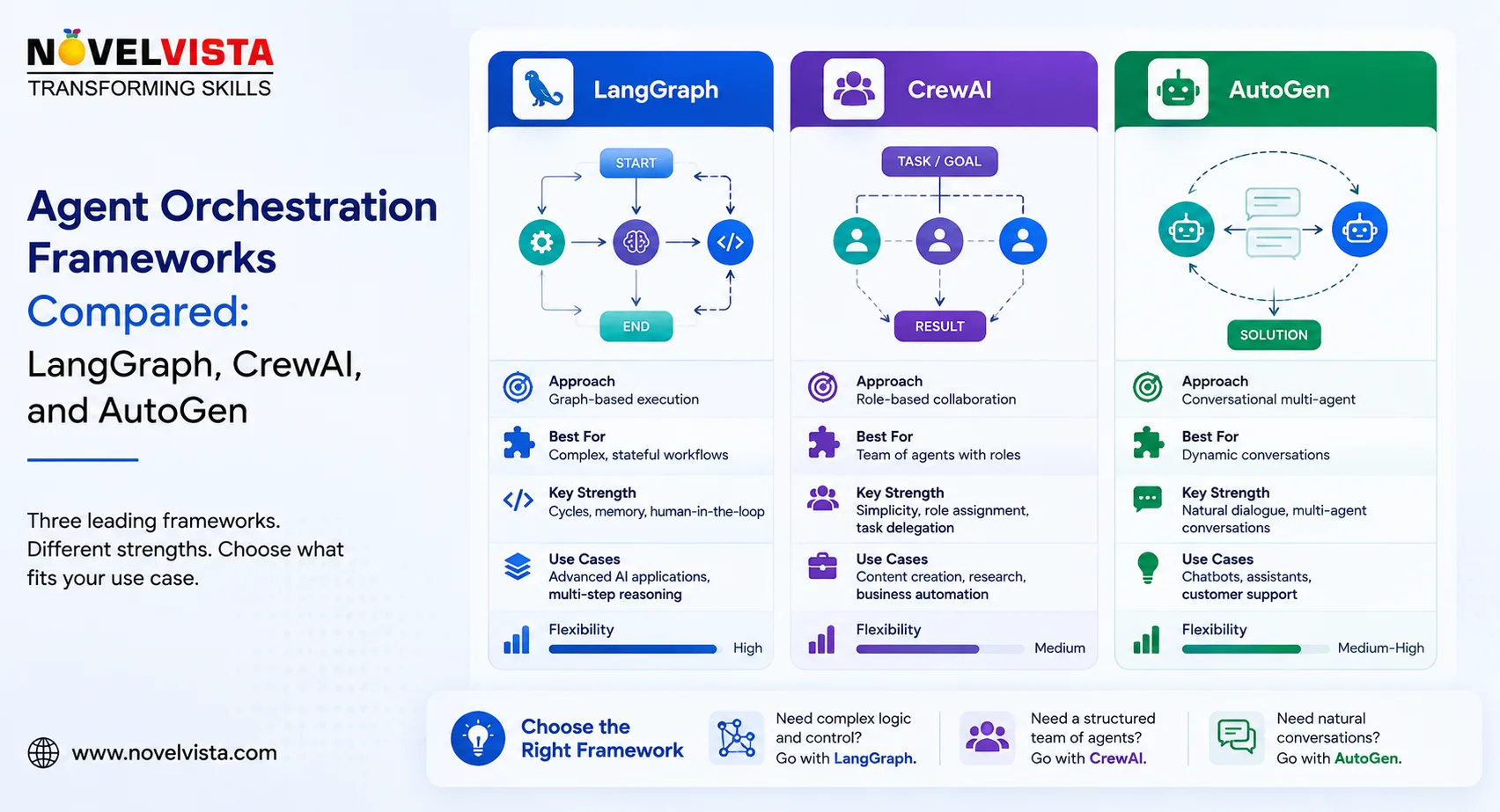
As organizations progress beyond basic chatbots, they need systems capable of coordinating models, tools, memory, human approvals, and specialized AI agents. Agent orchestration frameworks provide this control layer, but LangGraph, CrewAI, and AutoGen approach orchestration through distinctly different architectural models.
Selecting the right framework depends less on the length of its feature list and more on the control, reliability, and collaboration model required by the application.
LangGraph: Explicit Control Through Graphs
LangGraph is a low-level orchestration runtime for building long-running, stateful AI agents. Developers represent workflows as graphs containing shared state, processing nodes, and edges that determine how execution moves between steps. This makes branching, loops, retries, and conditional routing explicit within the application rather than leaving them hidden inside prompts.
Its primary strengths include durable execution, persistence, streaming, and human-in-the-loop controls. LangGraph’s persistence layer uses checkpointers and stores to retain information between workflow runs. This allows an agent to resume after an interruption, recover from a failure, continue a previous conversation, or preserve information across user interactions.
Interrupts can pause execution at a specific point and wait for external input before continuing. This is particularly valuable when an AI agent proposes a consequential action, such as modifying a database, approving a claim, sending a communication, or initiating a financial transaction.
The trade-off is engineering complexity. Teams must deliberately define state structures, graph transitions, error paths, approval points, and persistence strategies.
Best suited for: complex and regulated workflows where predictability, auditability, recovery, and execution control are critical.
CrewAI: Role-Based Agent Collaboration
CrewAI uses an organizational metaphor in which agents receive roles, goals, tools, and tasks before collaborating as a “crew.” A typical implementation might include a researcher collecting information, an analyst evaluating the findings, and a writer preparing the final report.
The framework separates orchestration into two major concepts: Crews and Flows. Crews are groups of autonomous agents that collaborate on delegated tasks, while Flows provide structured, event-driven workflows that manage application state and execution control.
CrewAI also provides capabilities for memory, knowledge integration, guardrails, observability, event handling, and checkpointing. Its unified memory system can be used by individual agents, crews, standalone applications, or flows. Checkpointing allows execution state to be saved so workflows can resume after failures or branch from an earlier state.
CrewAI generally provides a faster path from a business process to a functional multi-agent prototype. Its role-based structure is accessible to teams that naturally think in terms of responsibilities and delegation. However, applications requiring highly specialized routing or intricate state transitions may need additional customization.
Best suited for: research pipelines, content operations, business-process automation, and workflows where specialist roles map naturally to the work.
AutoGen: Conversational Multi-Agent Systems
AutoGen helped popularize multi-agent systems in which agents solve problems by communicating with one another. Its high-level AgentChat API includes predefined agents, teams, group-chat patterns, swarms, memory, human participation, and graph-based workflows.
Its lower-level Core API uses an event-driven actor model with asynchronous messaging. This architecture supports distributed and scalable agent systems, extensible components, observability, and interoperability between Python and .NET agents.
AutoGen remains valuable for understanding conversational coordination, agent debates, coding teams, asynchronous communication, and distributed multi-agent patterns. However, its lifecycle has become the decisive consideration.
As of August 2026, Microsoft has placed AutoGen in maintenance mode. It will not receive new features and is now community-managed. Microsoft recommends that new projects use Microsoft Agent Framework and encourages existing AutoGen users to follow its migration guidance.
Best suited for: maintaining existing implementations, research, and learning conversational agent patterns rather than serving as the default foundation for a new long-term enterprise system.
At-a-Glance Comparison
|
Dimension |
LangGraph |
CrewAI |
AutoGen |
|
Primary model |
Stateful execution graph |
Roles, crews, and flows |
Conversations and asynchronous events |
|
Control level |
High and explicit |
Moderate to high |
Flexible and conversation-oriented |
|
Learning curve |
Higher |
Lower to moderate |
Moderate |
|
Core strength |
Durable workflow control |
Rapid multi-agent composition |
Conversational agent patterns |
|
New enterprise projects |
Strong candidate |
Strong candidate |
Migration risk |
Which Framework Should You Choose?
Choose LangGraph when workflows must pause, resume, recover, branch predictably, and expose their execution state. Choose CrewAI when rapid development, role-based collaboration, and business-friendly multi-agent design are the main priorities.
For an existing AutoGen implementation, determine whether continued maintenance is sufficient or whether migration should become part of the technology roadmap.
Regardless of the framework selected, orchestration alone does not create a production-ready system. Organizations still need authentication, tool-level permissions, data-protection controls, evaluation, tracing, cost limits, testing, and human approval for consequential actions.
The strongest framework is not necessarily the one that creates the most autonomous agents. It is the one that provides the right balance of autonomy, operational control, reliability, and long-term maintainability.

 English
 Arabic
 French
 Portuguese
 Deutsch
 Turkish
 Dutch
Dutch
 Italiano
 Russian
 Romaian
 Portuguese (Brazil)
 Greek
Greek
