


Evaluating Legal Systems: The Importance of a Reliable Pakistan Constitution Book by Papercraft Publishers
Nation-building depends on the strength, clarity, and adaptability of a country's supreme legal charter. A well-designed constitutional framework establishes administrative harmony, secures fundamental rights, and sets clear limits on governmental power. Across different historical periods, legal scholars constantly study why certain political structures remain resilient during crises while others suffer total systemic collapse. Anyone seeking a clear understanding of statecraft, legal evolution, and institutional mechanics will find that studying a reliable Pakistan constitution book provides deep insights into the challenges and solutions of modern state governance.
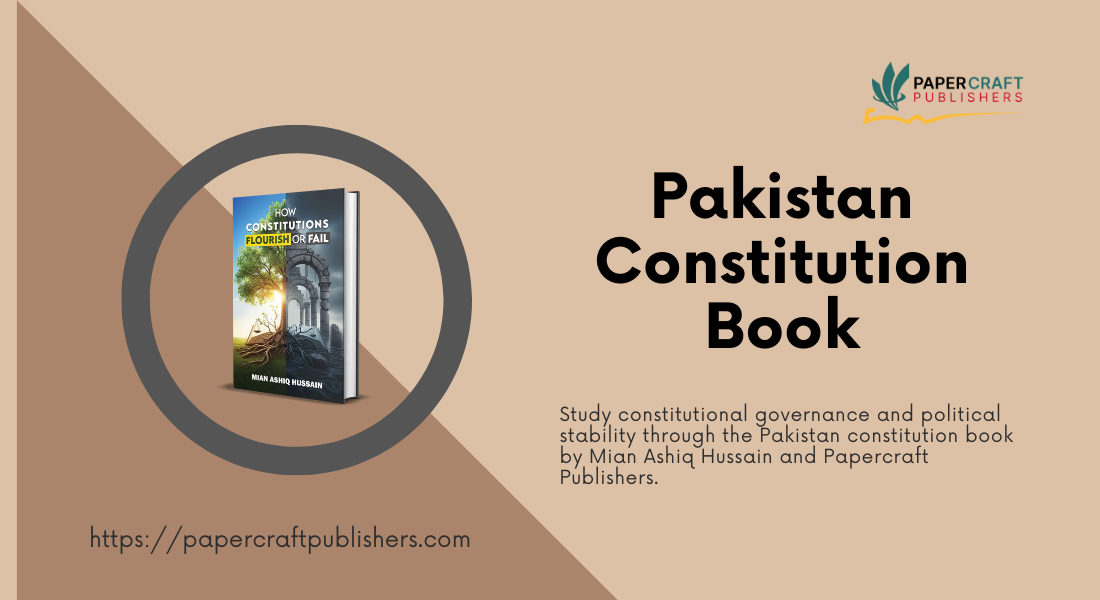
The authoritative legal study How Constitutions Flourish or Fail, written by Mian Ashiq Hussain, presents a detailed examination of these vital questions. Published globally by PaperCraft Publishers, this title investigates how legal institutions develop over time, what conditions support effective public administration, and why democratic accountability remains essential for long-term national progress.
Key Dynamics in Modern Constitutional Evolution
Institutional Design and Power Distribution
A balanced legal framework prevents any single branch of government from accumulating unchecked power. When the executive, legislature, and judiciary maintain clear constitutional boundaries, state institutions operate efficiently. Readers exploring books on constitutional law learn that clear structural design helps prevent administrative paralysis and preserves public trust during times of political transition.
Democratic Accountability and Rule of Law
No legal charter can succeed without mechanisms that enforce accountability. Independent courts ensure that public officials remain subject to statutory laws, while transparent electoral processes guarantee civic participation. When judicial autonomy is protected, citizens gain confidence that their constitutional rights will receive full enforcement under all political conditions.
Adapting Legal Charters to Changing Realities
Society continuously changes through social shifts, technological advances, and economic reforms. A rigid legal framework that refuses to adapt can create public friction and legal deadlock. Analyzing governance and public policy teaches researchers how constitutional amendments can accommodate modern requirements without sacrificing fundamental democratic principles.
Overview of Publication Specifications
Having a clear understanding of the formal details and structural attributes of an academic legal volume helps researchers, academic institutions, and students select suitable reference material.
|
Publication Feature |
Specification Detail |
|
Title |
How Constitutions Flourish or Fail |
|
Author |
Mian Ashiq Hussain |
|
Publisher |
PaperCraft Publishers |
|
Binding Format |
Paperback |
|
Subject Category |
Law / Public Administration / Politics |
|
ISBN Identifier |
978-969-7493-41-8 |
|
Core Readership |
Law Students, Legal Practitioners, Public Policy Analysts, CSS Aspirants |
|
Geographic Focus |
Pakistan, South Asia, and Global Comparative Frameworks |
Practical Applications of Constitutional Scholarship
University Academics and Legal Studies
Law schools and social science departments rely on comprehensive legal literature to teach fundamental legal theories. Students using a Pakistan constitution book learn how statutory rights apply to real-world disputes, preparing them for legal practice and judicial clerkships.
CSS and Competitive Exam Preparation
Candidates preparing for federal and provincial competitive examinations need a strong grasp of statecraft and constitutional history. Studying an insightful comparative politics book enables CSS candidates to construct well-balanced answers regarding state stability, legislative reforms, and administrative challenges.
Legislative Advisory and Policy Design
Policy drafters and legal researchers regularly consult comparative studies to evaluate proposed legislation. Examining how different nations manage constitutional design allows advisors to craft policies that promote social cohesion and economic stability.
Practical Benefits of Reading Constitutional Literature
1. Advanced Understanding of State Mechanics
Readers learn how government bodies function, coordinate, and balance power. This knowledge helps citizens understand complex legislative debates and landmark judicial decisions.
2. Enhanced Analytical Abilities
Studying historical legal triumphs and institutional failures sharpens critical thinking. Readers develop the ability to evaluate legal proposals based on historical precedents and structural principles.
3. Broader Comparative Insights
Comparing domestic legal developments with foreign political systems offers a comprehensive perspective. A thorough comparative politics book highlights global best practices while evaluating local governance challenges.
4. Effective Guidance for Public Sector Reform
For administrative officers and legal reformers, understanding constitutional principles offers practical strategies for improving public service delivery, safeguarding civil rights, and building institutional resilience.
Professional Utility Across Disciplines
Legal Practitioners and Bar Members
Advocates gain deeper context when arguing constitutional petitions and human rights cases. Understanding the intent behind statutory provisions allows legal professionals to build stronger arguments before high courts.
Public Sector Administrators
Civil service officers responsible for implementing government policies gain clarity regarding statutory limits on executive action. This ensures that administrative decisions align with constitutional norms and public interests.
Research Scholars and Journalists
Journalists covering legal affairs and political developments benefit from analyzing foundational books on constitutional law. Accurate knowledge of constitutional provisions improves public reporting and ensures objective legal commentary.
Conclusion
Building stable institutions, preserving democratic values, and promoting good governance require continuous legal study and active civic engagement. Works such as How Constitutions Flourish or Fail by Mian Ashiq Hussain offer foundational insights into why constitutional systems succeed or collapse over time. Whether you are an academic researcher, a law student, or an exam candidate looking for a reliable Pakistan constitution book, studying these fundamental principles remains essential for professional and intellectual growth.
By publishing authoritative works across law, political science, and public administration, Papercraft Publishers remains committed to providing valuable resources for scholars, students, and citizens across Pakistan.
Frequently Asked Questions (FAQs)
Who is the author of How Constitutions Flourish or Fail?
Mian Ashiq Hussain authored How Constitutions Flourish or Fail, drawing on extensive research to analyze statecraft, legal systems, and institutional development.
Why is this Pakistan constitution book recommended for CSS and PMS candidates?
This Pakistan constitution book provides comprehensive coverage of legal history, institutional structures, and administrative challenges. It equips aspirants with the analytical frameworks needed for competitive examination papers in political science and governance.
How does reading a comparative politics book improve legal analysis?
A comparative politics book exposes readers to different models of governance across historical periods and regions. This broader context helps researchers evaluate local legal reforms against established global practices.
What key themes are explored in authoritative books on constitutional law?
Comprehensive books on constitutional law focus on judicial independence, the separation of powers, democratic accountability, public participation, and institutional resilience under political stress.
Why is understanding governance and public policy important for citizens?
Understanding governance and public policy helps citizens evaluate government decisions, recognize their constitutional rights, and demand accountability from public institutions, fostering a healthy democratic society.

 English
 Arabic
 French
 Spanish
 Portuguese
 Turkish
 Dutch
Dutch
 Italiano
 Russian
 Romaian
 Portuguese (Brazil)
 Greek
Greek
