


HIC Resin Market to Reach USD 3.83 Billion by 2034 at 5.4% CAGR
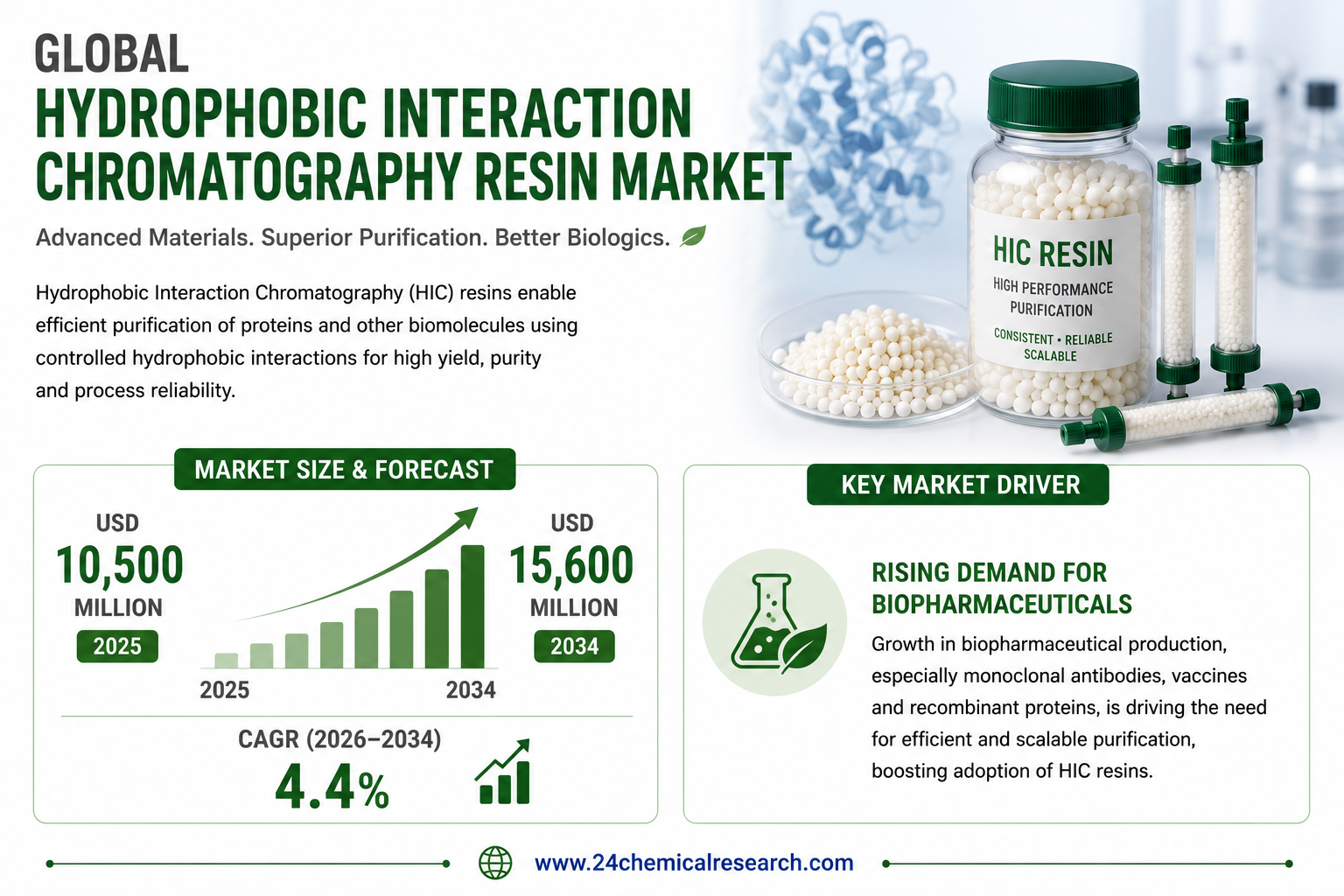
Hydrophobic Interaction Chromatography resin market refers to the global ecosystem of materials, technologies, and solutions built around one simple idea: using controlled 'dislike for water' to clean up complex biological mixtures. In practice, it is the market for porous beads and packed columns whose surfaces are decorated with hydrophobic ligands (butyl, octyl, phenyl, etc.) and deployed across biopharma, biotechnology, and advanced chemical processing to separate valuable biomolecules from impurities.
For a chemical‑domain audience, you can think of this market as the intersection of polymer chemistry, surface modification, and downstream processing, where resin design directly influences yield, purity, and cost of high‑value products such as monoclonal antibodies, vaccines, recombinant proteins, hormones, and plasmid DNA. It is less about 'columns and kits' and more about engineered materials that sit at the heart of modern biological manufacturing lines, quietly enabling scalable, reproducible purification under salt‑rich, protein‑friendly conditions.
From a materials‑chemistry lens, HIC resins are carefully engineered porous beads with tight size distribution, mechanical robustness, and defined surface chemistry. Agarose‑based matrices are widely used because they combine biocompatibility with good flow properties and stability across a broad range of salts, pH, and temperatures. Onto this backbone, manufacturers graft hydrophobic ligands commonly linear alkyl chains (butyl, octyl) or aromatic groups (phenyl) to fine‑tune interaction strength and selectivity for different classes of biomolecules.
Key performance attributes for end users include binding capacity, resolution, pressure drop, and chemical stability under cleaning‑in‑place regimes, all of which are governed by bead porosity, particle size, ligand density, and coupling chemistry. Modern resins are offered both in bulk (for packing large columns) and as prepacked columns designed to deliver reproducible performance from lab scale through pilot and industrial operations. In practical downstream workflows, HIC is often orthogonal to ion‑exchange and size‑exclusion steps, meaning the resin's hydrophobic behavior adds a new dimension of selectivity to multi‑step purification strategies.
Market Overview & Regional Analysis
North America, particularly the United States, is the dominant force in the global Hydrophobic Interaction Chromatography Resin market. This leadership stems from its advanced and well-established biopharmaceutical and life sciences research sector, which is a primary consumer of these resins for the purification of monoclonal antibodies, vaccines, and other complex biomolecules. The region benefits from substantial R&D investments, significant government funding for research, and the presence of major global market players and biotechnology companies. A stringent regulatory environment, particularly from the FDA, necessitates high-purity levels in biopharmaceutical production, which drives the demand for effective purification techniques like HIC. This well-integrated ecosystem of research institutions and manufacturing hubs creates a sustained, high-volume demand for these resins.
Europe holds a significant share of the Hydrophobic Interaction Chromatography Resin market, supported by a strong presence of pharmaceutical companies and academic research institutions. Countries like Germany, France, and the United Kingdom are key contributors, with a focus on biologics and biosimilars development. The European Medicines Agency's regulatory framework emphasizes high-quality manufacturing standards, which supports the use of advanced purification methods. The market is characterized by collaborative research projects and a high adoption rate of innovative bioprocessing technologies. The region's emphasis on environmental sustainability also influences the development of more efficient and reusable chromatography resins.
The Asia-Pacific region is identified as the fastest-growing market for Hydrophobic Interaction Chromatography Resins. This growth is primarily driven by the expanding pharmaceutical and biotech industries in China and India, along with increasing government initiatives to bolster domestic manufacturing and research capabilities. This region is becoming a major hub for contract research and manufacturing organizations, which increases the consumption of chromatography products. Rising investments in healthcare infrastructure and a growing focus on developing biosimilars present substantial opportunities for market expansion.
The Middle East and Africa represent an emerging market with gradually increasing adoption of advanced bioprocessing technologies. Market growth is influenced by efforts to diversify economies and develop local pharmaceutical capabilities. While still a smaller market compared to other regions, strategic investments in healthcare and life sciences are expected to create future demand for chromatography resins.
South America is a developing market for Hydrophobic Interaction Chromatography Resins, with Brazil and Argentina as the primary contributors. The market is supported by a growing pharmaceutical sector and initiatives to improve public health infrastructure. However, market growth can be influenced by regional economic fluctuations and varying levels of investment in research and development.
Key Market Drivers and Opportunities
Rising Demand for Biopharmaceuticals to Accelerate Market Growth
The biopharmaceutical industry's rapid expansion is directly fueling demand for hydrophobic interaction chromatography (HIC) resins. With the global biopharma market projected to exceed $850 billion by 2030, downstream processing requirements are intensifying. HIC resins play a critical role in monoclonal antibody (mAb) purification, which currently represents over 50% of biopharmaceutical pipelines. Unlike other chromatographic techniques, HIC offers superior selectivity for separating structurally similar biomolecules while maintaining their biological activity. The technique's gentle elution conditions make it indispensable for sensitive protein therapeutics.
Technological Advancements in Resin Formulations Creating New Applications
Recent innovations in ligand chemistry and bead architecture are expanding HIC applications beyond traditional protein purification. Next-generation resins with mixed-mode functionality combine hydrophobic interactions with other separation mechanisms, enabling single-step purifications that previously required multiple chromatography steps. These hybrid resins can achieve purity levels exceeding 99.5% while significantly reducing processing time and costs. The development of high-capacity, salt-tolerant resins allows operation at lower salt concentrations, making the technique more compatible with upstream processes.
Manufacturers are also addressing historical limitations in resin lifetime and chemical stability. Advanced cross-linking technologies now enable resins to withstand hundreds of cycles without significant performance degradation, reducing replacement costs. Such improvements have increased adoption in continuous bioprocessing systems, where resin durability is critical.
Emerging Economies and Vaccine Production Creating New Growth Avenues
The rapid expansion of biologics manufacturing in Asia presents lucrative opportunities for HIC resin suppliers. Countries like China and India are aggressively developing domestic biopharma capabilities, with China's biologics market expected to grow at 12% CAGR through 2032. Local manufacturers show particular interest in cost-effective purification technologies that can be integrated into their emerging production platforms.
Vaccine production represents another promising application area. The global vaccines market is forecast to reach $100 billion by 2030, driven by both pandemic preparedness programs and expanding immunization schedules. HIC resins are proving particularly valuable for virus-like particle (VLP) vaccines and certain RNA-based formulations, where they provide gentle yet effective purification. Recent process innovations have demonstrated 90% recovery rates for some VLP products, significantly improving manufacturing yields.
Challenges & Restraints
High Operational Costs and Process Optimization Challenges Limiting Adoption
While HIC offers distinct advantages, its implementation presents significant economic and technical hurdles. The technique requires precise control of multiple parameters including salt type, concentration, pH, and temperature - each capable of dramatically affecting separation efficiency. Achieving optimal conditions often demands extensive method development, requiring specialized expertise and expensive trial runs. The average method development process can cost between $50,000-$100,000 for a single molecule, representing a substantial barrier for smaller biotech firms.
The resins themselves represent a major cost component, with some specialized formulations exceeding $20,000 per liter. Although lifetime improvements help amortize these costs, the initial capital outlay remains prohibitive for many facilities. Switching costs are also substantial, as changing resin types typically requires extensive revalidation to meet regulatory standards.
Stringent Regulatory Requirements and Validation Complexities
The chromatography resin industry faces mounting regulatory scrutiny as biopharmaceuticals become more complex. Recent FDA guidance emphasizes thorough characterization of resin-ligand interactions to prevent unwanted product modification. Full validation packages now require extensive extractables/leachables testing, with some newer resin formulations needing 18-24 months for complete documentation. These requirements create significant delays in adopting novel resin technologies.
Resin reuse policies present another compliance challenge. While manufacturers promote extended resin lifetimes to reduce costs, regulators increasingly demand comprehensive data demonstrating consistent performance across multiple cycles. Documentation requirements have expanded to include viral clearance validation for certain applications, adding months to implementation timelines.
The industry also faces analytical challenges in evaluating resin performance. Traditional methods like HETP measurement often fail to capture subtle changes in separation characteristics that can impact final product quality. Developing robust analytics that correlate resin performance with critical quality attributes remains an ongoing technical hurdle.
Market Segmentation by Type
● Natural Polymer-based Resins
● Synthetic Polymer-based Resins
● Inorganic Media-based Resins
Market Segmentation by Application
● Antibody Purification
● Vaccine Purification
● Enzyme Purification
● Others
Market Segmentation and Key Players
● Tosoh Corporation (Japan)
● Pall Corporation (U.S.)
● Merck KGaA (Germany)
● Bio-Rad Laboratories, Inc. (U.S.)
● Danaher Corporation (Cytiva) (U.S.)
● Avantor Performance Materials (U.S.)
● Mitsubishi Chemical Corporation (Japan)
● Purolite Corporation (U.S.)
● Repligen Corporation (U.S.)
Report Scope
This report presents a comprehensive analysis of the global and regional markets for Hydrophobic Interaction Chromatography Resin, covering the period from 2025 to 2032. It includes detailed insights into the current market status and outlook across various regions and countries, with specific focus on:
● Sales, sales volume, and revenue forecasts
● Detailed segmentation by type and application
In addition, the report offers in-depth profiles of key industry players, including:
● Company profiles
● Product specifications
● Production capacity and sales
● Revenue, pricing, gross margins
● Sales performance
It further examines the competitive landscape, highlighting the major vendors and identifying the critical factors expected to challenge market growth.
As part of this research, we surveyed Hydrophobic Interaction Chromatography Resin companies and industry experts. The survey covered various aspects, including:
● Revenue and demand trends
● Product types and recent developments
● Strategic plans and market drivers
● Industry challenges, obstacles, and potential risks
Get Full Report Here: https://www.24chemicalresearch.com/reports/252536/hydrophobic-interaction-chromatography-resin-market
About 24chemicalresearch
Founded in 2015, 24chemicalresearch has rapidly established itself as a leader in chemical market intelligence, serving clients including over 30 Fortune 500 companies. We provide data-driven insights through rigorous research methodologies, addressing key industry factors such as government policy, emerging technologies, and competitive landscapes.
● Plant-level capacity tracking
● Real-time price monitoring
● Techno-economic feasibility studies
With a dedicated team of researchers possessing over a decade of experience, we focus on delivering actionable, timely, and high-quality reports to help clients achieve their strategic goals. Our mission is to be the most trusted resource for market insights in the chemical and materials industries.
Asia: +91 9169162030
Website: https://www.24chemicalresearch.com/

 English
 Arabic
 French
 Spanish
 Portuguese
 Deutsch
 Turkish
 Dutch
Dutch
 Russian
 Romaian
 Portuguese (Brazil)
 Greek
Greek
