


10 Must-Have Features in Liquor Shop Software for 2026 | Barrel Books Guide
Running a liquor store in 2026 requires more than a cash register and a spreadsheet. Retailers are dealing with growing product catalogs, faster stock movement, changing prices, compliance requirements, multiple payment methods, and increasing customer expectations. The right Liquor Shop Software can bring these operations together in one system while giving owners better visibility into sales, inventory, and profitability.
For businesses comparing liquor store management software, the challenge is knowing which features genuinely matter. A generic retail system may handle basic billing, but liquor businesses have specialized requirements such as bottle-level inventory, case-to-unit conversions, age verification, stock reconciliation, and detailed sales reporting.
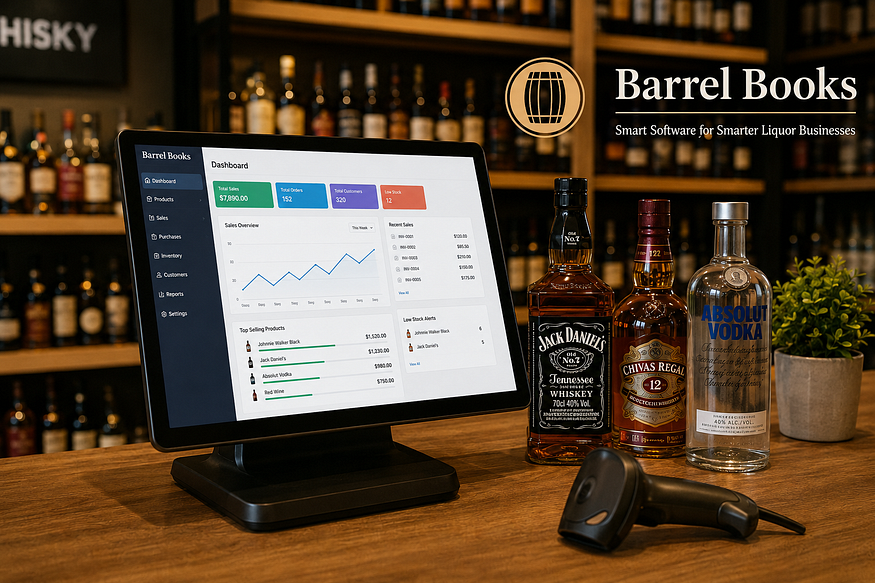
That is why solutions such as Barrel Books are designed around the practical needs of liquor retailers. Before choosing your next system, here are 10 must-have features to look for in 2026.
1. Real-Time Liquor Inventory Management
Inventory is at the center of every liquor retail business. A good Liquor Shop Software should provide real-time inventory tracking so you always know what is available, what has been sold, and what needs to be reordered.
Instead of manually updating spreadsheets after every transaction, an integrated system should automatically adjust stock when a sale or purchase is recorded. This improves inventory accuracy, reduces manual errors, and makes it easier to identify discrepancies.
Look for liquor inventory management software that can track products by brand, category, size, quantity, and other relevant attributes.
The goal is simple: fewer stock mismatches and better control over your inventory.
2. Barcode Billing and Fast POS Checkout
A busy liquor store cannot afford slow checkout processes. Liquor store POS software should make billing fast, accurate, and easy for employees to operate.
Barcode scanning allows staff to identify products instantly instead of manually searching through long product lists. A modern barcode billing system can also connect billing directly with inventory, ensuring that every completed sale updates stock automatically.
This is particularly important for stores carrying hundreds or thousands of SKUs.
When evaluating liquor POS software, look for:
- Fast barcode scanning
- Easy product lookup
- Multiple payment options
- Automated invoice generation
- Discount and pricing controls
- Real-time inventory deduction
These features can reduce checkout errors while creating a smoother customer experience.
3. Case, Pack, and Bottle-Level Stock Control
Liquor retail inventory is rarely as simple as “one product equals one unit.” A retailer may purchase products by the case but sell them individually.
That makes case-to-bottle inventory management an essential feature.
Your software should understand different units of measure, allowing a case to be converted into bottles or smaller selling units without creating confusing duplicate inventory records.
For example, if you receive a case containing 12 bottles and sell three bottles individually, your system should automatically reflect the remaining quantity.
This type of bottle-level inventory tracking helps retailers maintain accurate stock and identify discrepancies much faster.
4. Age Verification and Compliance Controls
Alcohol is an age-restricted product, making compliance one of the most important considerations when selecting Liquor Shop Software.
Depending on the jurisdiction and business requirements, retailers may need processes for checking customer age before completing certain sales. A suitable age verification system can help employees follow the required procedure consistently.
Some modern POS systems support ID scanning or other age-verification workflows.
The software should also provide appropriate user permissions, transaction records, and audit information so managers can monitor activity.
Because liquor regulations vary by location, retailers should confirm that any software they purchase supports the specific liquor retail compliance requirements applicable to their business.
5. Automated Purchase and Supplier Management
Running out of popular products can mean lost sales, while excessive stock ties up valuable capital.
That is why liquor purchase management software should provide clear visibility into purchasing and supplier activity.
A strong system can help you maintain supplier records, review previous purchases, monitor product costs, and create purchase orders more efficiently.
Low-stock notifications can also help managers identify products that may need replenishment before they run out.
With better vendor management, retailers can make purchasing decisions based on actual sales and inventory information rather than guesswork.
This is especially valuable for stores with large product ranges or frequent supplier transactions.
6. Sales Analytics and Profitability Reports
Simply knowing how much your store sold is not enough.
Modern liquor store reporting software should help you understand what is selling, when it is selling, and how much profit different products generate.
Useful sales analytics may include:
- Daily and monthly sales
- Product-wise sales
- Category performance
- Best-selling products
- Slow-moving inventory
- Gross margins
- Purchase costs
- Discount activity
- Payment summaries
These insights help owners make more informed decisions about pricing, purchasing, promotions, and product assortment.
For example, if one category consistently delivers strong margins while another occupies shelf space without generating sufficient sales, the data can guide your next purchasing decision.
7. Multi-Store and Warehouse Management
Growth creates another challenge: managing inventory across multiple locations.
If your business operates more than one store, warehouse, or liquor godown, your software should provide centralized visibility.
Multi-location inventory management allows owners and managers to monitor stock across different outlets without maintaining separate spreadsheets for every location.
A useful system should also support stock transfers between locations, helping businesses move inventory where demand is higher.
For expanding retailers, this capability can become increasingly important because centralized data makes it easier to compare store performance, manage replenishment, and maintain consistent operational processes.
8. Employee Access and Transaction Controls
Not every employee should have access to every function.
A reliable liquor store POS system should provide role-based permissions so managers can control which actions different employees can perform.
For example, employees may be allowed to create sales but restricted from changing product costs, deleting transactions, modifying inventory, or applying unauthorized discounts.
These employee management controls create greater accountability and help reduce operational risks.
Detailed transaction histories and audit trails can also make it easier to investigate unusual discounts, voids, refunds, or inventory adjustments.
For a busy liquor store, this level of control can be far more useful than a basic billing application.
9. Cloud-Based Access and Data Backup
Business owners increasingly want access to their store information without being physically present at the counter.
A cloud-based liquor store software solution can provide centralized access to important business information through connected devices, depending on the provider’s architecture and access controls.
Cloud technology can also simplify data management by reducing reliance on local spreadsheets and manually maintained files.
When evaluating cloud-based software, ask about:
- Data security
- Backup procedures
- User access controls
- System uptime
- Data export options
- Device compatibility
- Support and updates
The right infrastructure can make business management more convenient while reducing dependence on manual records.
10. Easy Integration and Scalability
The best Liquor Shop Software should not only solve today’s problems; it should support tomorrow’s growth.
Look for software that can work with relevant payment systems, accounting workflows, barcode scanners, printers, and other business tools where required.
Scalability is equally important. A solution that works for one outlet should ideally have a path for supporting additional stores, users, products, and transactions.
This is where choosing specialized software can make a difference. A system built around liquor retail workflows is more likely to understand requirements such as liquor inventory control, bottle-level stock, supplier purchasing, and specialized reporting than a generic billing platform.
Why Barrel Books Can Be a Smart Choice for Liquor Retailers
Choosing software is ultimately about finding a system that fits the way your business operates.
Barrel Books focuses on liquor retail workflows and combines capabilities such as liquor inventory management, billing, barcode functionality, reporting, and business controls in one platform. Its positioning is specifically aimed at helping liquor retailers replace fragmented manual processes with a more organized digital workflow.
For retailers comparing liquor shop management software, the important question is not simply, “Does it create bills?”
Instead, ask whether it can help you control inventory, improve checkout, manage purchasing, monitor employees, understand profitability, and scale your operation.
Final Thoughts
The right Liquor Shop Software can become much more than a billing tool. In 2026, liquor retailers should look for a complete system that connects inventory management, POS billing, barcode scanning, age verification, supplier management, sales reporting, stock transfers, and employee controls.
Before purchasing, create a checklist based on your store’s actual requirements. Consider your product volume, number of locations, purchasing process, compliance obligations, reporting needs, and future growth plans.
A specialized platform such as Barrel Books can help bring these requirements together, giving liquor retailers a more structured way to manage everyday operations and make data-driven business decisions.
The best system is ultimately the one that saves time, improves inventory accuracy, reduces operational mistakes, and gives you greater control over your liquor business.

 English
 Arabic
 French
 Spanish
 Portuguese
 Deutsch
 Turkish
 Dutch
Dutch
 Italiano
 Russian
 Romaian
 Portuguese (Brazil)
