


Hydraulic Fluids Market to Reach USD 78.5 Billion by 2034 at 5.4% CAGR
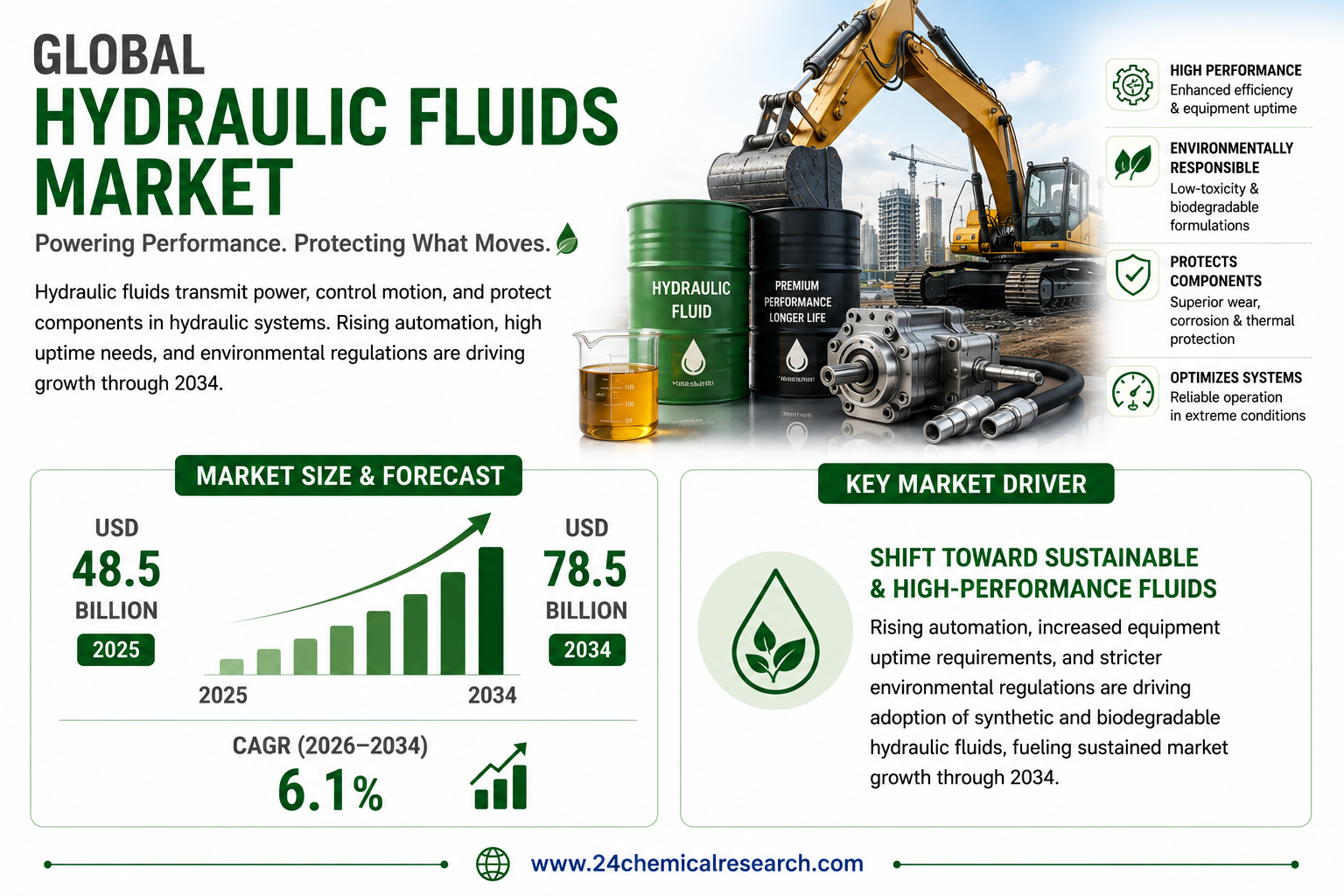
Global hydraulic fluids market was valued at USD 48.5 billion in 2025. Hydraulic fluids are specially formulated lubricants that transmit power, control motion, and protect components within hydraulic systems across industries such as construction, aerospace, and manufacturing. The market is projected to reach USD 78.5 billion by 2034, driven by rising automation, increased equipment uptime requirements, and stricter environmental regulations encouraging the adoption of synthetic and biodegradable fluid formulations.
The hydraulic fluids sector is expected to benefit from ongoing digitalization of equipment, growing demand for high‑performance synthetic fluids, and regulatory pushes toward low‑toxicity formulations, ensuring sustained growth through 2034.
Market Overview & Regional Analysis
North America continues to anchor the hydraulic fluids landscape, driven by a mature industrial base and sustained demand for high‑performance fluids in heavy machinery, aerospace, and defense sectors. Advanced material science initiatives and stringent environmental regulations have prompted manufacturers to adopt low‑viscosity, biodegradable formulations, reinforcing the region's leadership. Strong regulatory oversight and robust supply chain networks ensure consistent product quality and rapid innovation cycles. Moreover, the concentration of R&D hubs and automotive‑gear manufacturers creates a synergistic ecosystem that fuels continuous improvement in fluid properties and application integration. Industry decision makers increasingly favor regional sourcing to mitigate geopolitical risks and enhance supply reliability, further consolidating North American dominance.
The Asia‑Pacific area is rapidly expanding, supported by booming construction, mining, and automotive sectors that demand sophisticated hydraulic solutions. Governments in this region are actively investing in large infrastructure projects-such as high‑speed rail networks, port expansions and renewable energy plants-requiring reliable, high‑end fluids. Local manufacturers are shifting their focus toward blended formulations that meet both performance and environmental criteria, aligning with regional sustainability agendas. Rapid urbanization has also amplified the need for hydraulic systems in municipal utilities, elevators, and public transport fleets. The convergence of market maturity and heightened investment focus places the Asia‑Pacific region on a trajectory of accelerated growth, especially in emerging economies where modernized equipment adoption is gaining momentum.
Emerging economies across the Middle East, Latin America and Africa are witnessing a transformation in their industrial landscapes due to large‑scale infrastructure endeavors, including petro‑chemical complexes, deep‑water ports and high‑capacity rail systems. These projects rely heavily on hydraulic machinery, prompting a surge in the need for versatile fluids that offer corrosion resistance and high‑temperature stability. Regulatory bodies in these regions are progressively tightening standards to mitigate environmental impact, encouraging manufacturers to innovate low‑pollution, recyclable formulations. The confluence of infrastructural modernization and stringent regulations is creating a fertile environment for hydraulic fluid developers to tailor solutions that balance performance with compliance. Consequently, the evolving project pipelines are reinforcing regional fluids demand and shaping supply chain dynamics in these markets.
China and India are rapidly asserting themselves as major players in hydraulic fluids manufacturing, benefitting from large domestic markets and access to raw material supplies. Japan remains a benchmark for high‑precision fluid technologies, while Turkey's strategic geographic position bridges Europe and Asia, facilitating cross‑regional logistics. Brazil, with its robust agriculture and mining sectors, is channeling capital into localized fluid production to reduce import dependence. These countries are attracting foreign direct investment through favorable tax regimes, skilled workforce availability, and efficient infrastructure. Collaborative partnerships between local producers and global technology providers are fostering innovation in additive formulations, while regional distribution networks are expanding to support both domestic and cross‑border market penetration.
Key Market Drivers and Opportunities
Increasing Industrial Automation
The rapid adoption of automated manufacturing lines drives demand for high‑performance hydraulic fluids that can sustain higher pressures and longer cycle times. Manufacturers are investing in fluids with superior anti‑wear additives because equipment downtime directly impacts profitability.
Rising Construction and Infrastructure Projects
Large‑scale infrastructure initiatives across emerging economies require robust hydraulic systems for heavy‑duty excavators, cranes, and loaders. Efficient fluid formulations that reduce heat build‑up are becoming essential as project schedules tighten.
➤ Strategic focus on sustainability is prompting a shift toward biodegradable hydraulic fluids, creating a new growth vector for suppliers.
While environmental compliance pushes operators to seek greener solutions, the market simultaneously benefits from the higher price premiums associated with premium synthetic blends that deliver longer service intervals.
Growth of Renewable Energy Systems
The expansion of wind turbines and solar tracking mechanisms creates new demand for hydraulic fluids that can operate reliably under extreme temperature swings and corrosive environments. Specialized additives tailored for these applications represent a lucrative niche.
Moreover, the push toward electrification of hydraulic components-such as hybrid electro‑hydraulic actuators-opens avenues for fluids with enhanced dielectric properties, supporting safer integration with electrical systems.
Finally, emerging markets in Southeast Asia and Africa are investing heavily in mining and agribusiness infrastructure, presenting a fertile ground for localized production of high‑quality hydraulic fluids that meet both performance and environmental standards.
Challenges & Restraints
Stringent Regulatory Landscape
Regulators in North America and the EU are tightening limits on volatile organic compounds (VOCs) and hazardous waste, compelling formulators to redesign base oils and additives. Compliance costs can erode margins, especially for small‑to‑mid‑size producers.
High Initial Cost of Synthetic Fluids
Although synthetic hydraulic fluids offer superior thermal stability and longer service life, their upfront price is typically 30‑40% higher than conventional mineral‑based alternatives. Cost‑sensitive industries often postpone upgrades, limiting broader market penetration.
Additionally, legacy equipment designed for mineral oils may not be fully compatible with newer synthetic formulations, necessitating retrofits that further increase total ownership costs.
Finally, limited awareness of the long‑term savings associated with reduced downtime and lower maintenance frequency hampers rapid adoption in some regional markets.
Supply Chain Volatility
Fluctuations in crude oil prices and limited availability of specialty base stocks create pricing uncertainty, making inventory planning more complex for end‑users.
Furthermore, the need for technical training on new fluid technologies adds a layer of operational complexity for maintenance teams accustomed to legacy products.
Market Segmentation by Type
● Mineral‑based fluids
● Synthetic fluids
● Water‑based fluids
Market Segmentation by Application
● Construction equipment
● Aerospace systems
● Automotive power units
● Industrial machinery
● Others
Market Segmentation and Key Players
● Shell (United Kingdom)
● ExxonMobil (United States)
● Chevron (United States)
● Castrol (United Kingdom)
● Fuchs (Germany)
● TotalEnergies (France)
● Aramco Specialty Fluids (Saudi Arabia)
● Kendall International (United States)
Report Scope
This report presents a comprehensive analysis of the global and regional markets for Hydraulic Fluids, covering the period from 2026 to 2034. It includes detailed insights into the current market status and outlook across various regions and countries, with specific focus on:
● Sales, sales volume, and revenue forecasts
● Detailed segmentation by type and application
In addition, the report offers in-depth profiles of key industry players, including:
● Company profiles
● Product specifications
● Production capacity and sales
● Revenue, pricing, gross margins
● Sales performance
It further examines the competitive landscape, highlighting the major vendors and identifying the critical factors expected to challenge market growth.
As part of this research, we surveyed Hydraulic Fluids companies and industry experts. The survey covered various aspects, including:
● Revenue and demand trends
● Product types and recent developments
● Strategic plans and market drivers
● Industry challenges, obstacles, and potential risks
Get Full Report Here: https://www.24chemicalresearch.com/reports/315726/hydraulic-fluids-market
About 24chemicalresearch
Founded in 2015, 24chemicalresearch has rapidly established itself as a leader in chemical market intelligence, serving clients including over 30 Fortune 500 companies. We provide data-driven insights through rigorous research methodologies, addressing key industry factors such as government policy, emerging technologies, and competitive landscapes.
● Plant-level capacity tracking
● Real-time price monitoring
● Techno-economic feasibility studies
With a dedicated team of researchers possessing over a decade of experience, we focus on delivering actionable, timely, and high-quality reports to help clients achieve their strategic goals. Our mission is to be the most trusted resource for market insights in the chemical and materials industries.
Asia: +91 9169162030
Website: https://www.24chemicalresearch.com/

 English
 Arabic
 French
 Spanish
 Portuguese
 Deutsch
 Turkish
 Dutch
Dutch
 Russian
 Romaian
 Portuguese (Brazil)
 Greek
Greek
