


Marine Seismic Equipment Market to Reach USD 4.85 Billion by 2032 at 3.2% CAGR
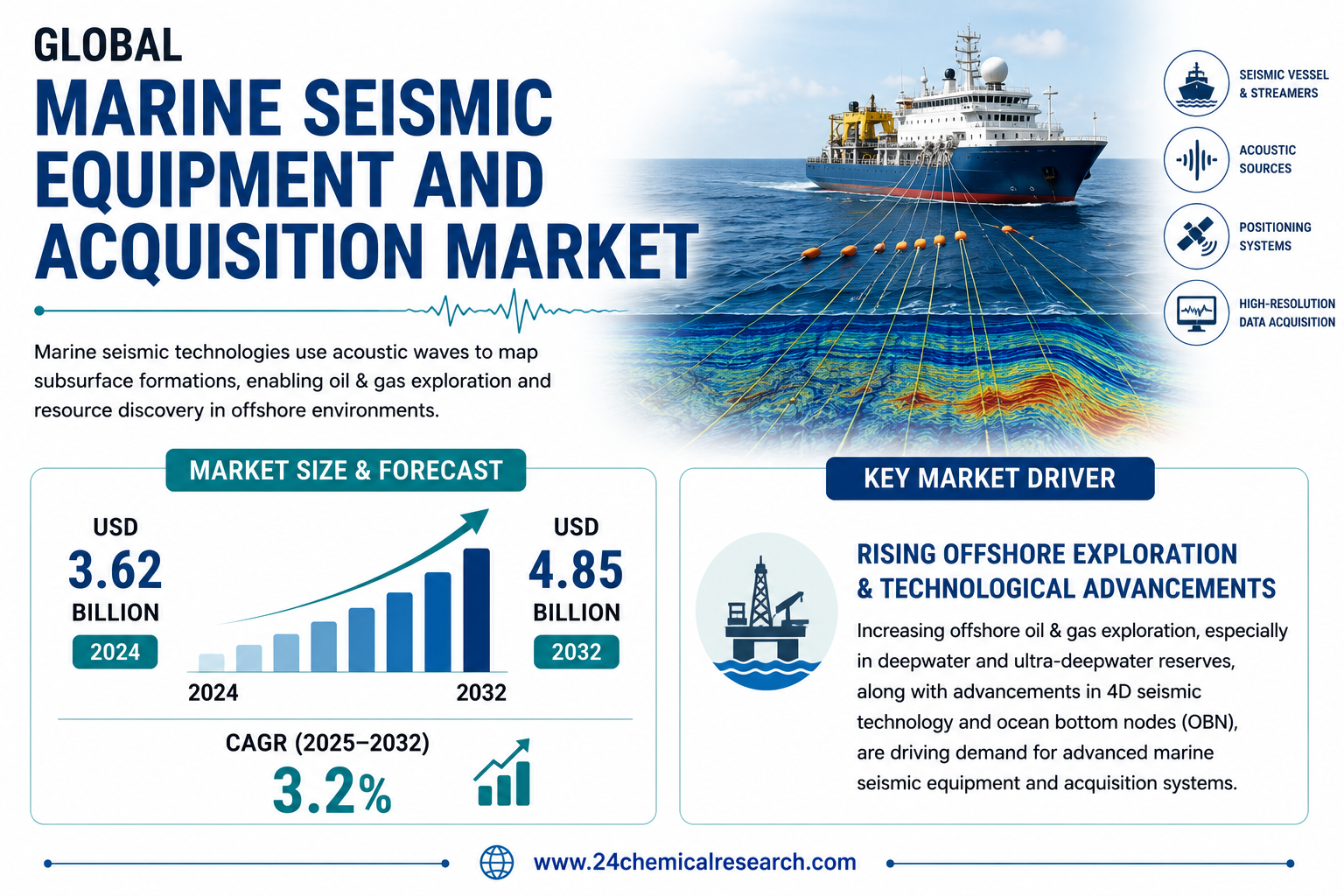
Global marine seismic equipment and acquisition market size was valued at USD 3.62 billion in 2024. The market is projected to grow from USD 3.81 billion in 2025 to USD 4.85 billion by 2032, exhibiting a CAGR of 3.2% during the forecast period.
Marine seismic equipment and acquisition technologies are critical for subsea exploration, primarily used in oil and gas discovery. These systems employ acoustic energy waves to map geological formations beneath the ocean floor, providing vital data for resource identification. Key equipment includes streamers, seismic sources, positioning systems, and recording devices that enable 2D, 3D, and 4D imaging of underwater structures.
The market growth is driven by increasing offshore exploration activities, particularly in deepwater and ultra-deepwater reserves. While conventional seismic surveys dominate current operations, advancements in 4D seismic technology and ocean bottom nodes (OBN) are creating new opportunities. However, environmental regulations and high operational costs remain challenges. Recent developments include Schlumberger's 2024 launch of advanced multi-sensor streamer technology, enhancing data resolution for complex reservoirs. Leading players like CGG, PGS, and TGS continue to invest in next-generation acquisition systems to meet growing energy demand.
Market Overview & Regional Analysis
North America, particularly the Gulf of Mexico, stands as the dominant region in the marine seismic equipment and acquisition market. This leadership is driven by extensive offshore oil and gas exploration activities, supported by a mature and technologically advanced industry. The region benefits from significant investments from major energy companies and favorable regulatory frameworks that encourage exploration in both shallow and deep-water reserves. The presence of leading service providers like Schlumberger and WesternGeco ensures a constant demand for advanced 2D, 3D, and 4C seismic technologies. Continuous efforts to discover new hydrocarbon reserves and monitor existing fields for enhanced oil recovery contribute to a stable and robust market. The region's focus on transitioning to cleaner energy sources also necessitates detailed seabed mapping for carbon capture and storage projects, further sustaining demand for seismic services.
Europe's marine seismic equipment and acquisition market is primarily driven by activity in the North Sea, particularly the Norwegian and UK sectors. The region features a mature hydrocarbon basin where seismic surveys are essential for extending the life of existing fields and exploring new prospects. There is a growing emphasis on carbon capture, utilization, and storage (CCUS) projects, which require detailed subsurface characterization, creating a new avenue for seismic services. Strict environmental regulations and a shift towards renewable energy influence market dynamics, prompting seismic companies to adapt their services for offshore wind farm site characterization and geothermal potential assessment. The presence of strong national oil companies and a sophisticated supply chain supports market stability.
The Asia-Pacific region exhibits significant growth potential, driven by increasing energy demand and offshore exploration activities in areas like Southeast Asia and Australia. Countries such as Malaysia, Indonesia, and India are actively exploring their offshore basins, leading to steady demand for seismic services. The market is characterized by a mix of deepwater exploration in frontier areas and production monitoring in mature fields. Technological adoption is increasing, with a growing preference for 3D and 4D seismic surveys. However, the market faces challenges related to complex geological formations and varying regulatory environments across different countries. Regional partnerships and investments from international oil companies are key drivers.
South America's market is heavily concentrated in Brazil, which possesses vast pre-salt reserves requiring advanced seismic technologies for effective exploration and development. The region attracts significant foreign investment, leading to major proprietary seismic acquisition campaigns. Other countries, such as Guyana and Suriname, are emerging as hotspots following major hydrocarbon discoveries. The market dynamics are shaped by national oil company strategies, licensing rounds, and the technological demands of operating in deepwater environments. Political and economic stability can influence investment cycles, but the substantial resource base ensures long-term interest and activity in marine seismic acquisition.
The Middle East and Africa region features diverse market conditions. The Middle East, particularly the Gulf region, has extensive offshore fields where seismic acquisition is used for field development and reservoir management. Africa offers growth opportunities, especially in West Africa's deepwater plays and East Africa's nascent gas basins. The market is influenced by geopolitical factors, investment from international majors, and the development of local content policies. Seismic activities range from frontier exploration to production optimization, with a need for technologies suited for both shallow and deepwater environments. The region also sees growing interest in seismic surveys for offshore mineral exploration.
Key Market Drivers and Opportunities
Growing Offshore Oil & Gas Exploration Activities to Boost Market Growth
The global marine seismic equipment and acquisition market is experiencing significant growth, driven by increasing offshore oil and gas exploration activities. With conventional onshore reserves depleting, energy companies are shifting focus to deepwater and ultra-deepwater exploration projects. Recent technological advancements in 3D and 4D seismic acquisition systems have improved exploration success rates, with modern equipment capable of capturing high-resolution subsea data at depths exceeding 3,000 meters. Major oil-producing nations are allocating substantial budgets for offshore exploration licenses, creating sustained demand for marine seismic services. While shallow-water exploration remains important, over 60% of new discoveries in recent years have been in water depths greater than 1,500 meters.
Advancements in Seismic Imaging Technologies to Drive Market Expansion
The marine seismic equipment market is being transformed by cutting-edge imaging technologies that deliver unprecedented subsurface clarity. Advanced processing algorithms combined with high-density seismic arrays now provide resolution improvements of up to 40% compared to traditional systems. The integration of artificial intelligence in data interpretation has reduced processing times from months to weeks while increasing accuracy. These technological leaps are particularly valuable in complex geological formations where conventional methods often yield ambiguous results. Recent equipment launches featuring full-waveform inversion capabilities and broader bandwidth sensors are setting new industry standards, encouraging operators to upgrade their seismic fleets.
Increasing Energy Demand and Security Concerns to Accelerate Market Growth
Global energy demand projections indicate sustained growth through 2032, with marine seismic exploration playing a crucial role in meeting this need. Geopolitical tensions have underscored the importance of domestic energy security, prompting nations to intensify offshore resource mapping. Several governments have implemented favorable policies and tax incentives for offshore exploration as part of their energy independence strategies. The marine seismic market benefits from this trend, especially in emerging economies where untapped offshore potential remains significant. Furthermore, the transition toward renewable offshore energy sources like wind farms has created new applications for high-precision seabed mapping technologies traditionally used in hydrocarbon exploration.
Emerging Markets and Untapped Basins to Offer Growth Potential
Substantial growth opportunities exist in emerging markets where offshore exploration activities are accelerating. Regions such as East Africa, the Eastern Mediterranean, and South America's Atlantic margin contain vast underexplored basins requiring comprehensive seismic mapping. Governments in these areas are actively promoting exploration through favorable licensing rounds and partnerships with international operators. The increasing involvement of national oil companies in deepwater exploration creates additional demand for advanced seismic services. Market players establishing early presence in these frontier regions stand to benefit from first-mover advantages as exploration activities intensify over the forecast period.
Integration with Renewable Energy Sector to Create New Revenue Streams
The rapid expansion of offshore wind farms presents significant opportunities for marine seismic equipment providers to diversify their applications. High-resolution seabed mapping is critical for wind farm site selection and foundation design, requiring specialized seismic survey techniques. The growing demand for carbon capture and storage (CCS) projects also utilizes marine seismic technology for subsurface monitoring. Companies developing dual-purpose equipment capable of serving both traditional oil and gas exploration and renewable energy applications are well-positioned to capitalize on these emerging markets. The global offshore wind capacity is projected to grow substantially, creating a complementary market for marine seismic services beyond hydrocarbon exploration.
Challenges & Restraints
High Operational Costs and Capital Intensity to Challenge Market Growth
The marine seismic equipment and acquisition market faces significant financial barriers, with a single modern seismic vessel costing upwards of $150 million to construct and equip. Operational expenses are similarly substantial, with daily rates for advanced 3D surveys exceeding $200,000 when factoring in crew, fuel, and equipment maintenance. These high costs create substantial entry barriers for smaller players and make the industry particularly vulnerable to oil price volatility. Recent supply chain disruptions have further increased equipment procurement and maintenance costs, squeezing profit margins across the sector. While technological improvements have enhanced efficiency, the capital-intensive nature of marine seismic operations continues to limit market expansion.
Volatile Oil Prices and Energy Transition to Deter Market Growth
The marine seismic equipment market remains heavily dependent on hydrocarbon exploration budgets, which fluctuate with global oil prices. Recent price volatility has made oil companies cautious about committing to large-scale exploration programs, particularly in frontier areas requiring extensive seismic surveying. Furthermore, the global energy transition toward renewables is reshaping investment priorities, with some major operators redirecting capital away from traditional exploration activities. While marine seismic technology has applications in renewable energy projects, these typically require less intensive surveying than hydrocarbon exploration, potentially restraining market growth in the long term.
Data Management Complexities to Limit Market Expansion
Modern marine seismic surveys generate enormous volumes of data, with a single 3D survey often producing multiple petabytes of raw information. The industry faces significant challenges in managing, processing, and storing this data efficiently. High-performance computing requirements for advanced processing algorithms create substantial infrastructure costs, while data transfer limitations from offshore vessels to onshore processing centers can delay project timelines. As resolution and survey sizes continue increasing, these data management challenges are becoming more pronounced, potentially restraining wider adoption of cutting-edge seismic technologies.
Environmental Regulations
Stringent environmental regulations governing marine seismic surveys present ongoing challenges for market players. Noise pollution concerns have led to increased restrictions on survey operations, particularly in ecologically sensitive areas. Compliance with evolving marine mammal protection protocols adds substantial costs and operational complexity to seismic projects.
Seasonal Limitations
Adverse weather conditions and seasonal variations significantly impact marine seismic operations, particularly in high-latitude regions. The limited operational windows in harsh environments create scheduling challenges and can delay project timelines by several months, affecting overall profitability.
Market Segmentation by Type
● 2D Seismic Equipment
● 3D Seismic Equipment
● 4C Seismic Equipment
● Others
Market Segmentation by Application
● Multi-Client Seismic Acquisition
● Proprietary Seismic Acquisition
● Ocean Bottom Seismic (OBS) Acquisition
● Others
Market Segmentation and Key Players
● Schlumberger (WesternGeco) (USA)
● CGG (France)
● PGS (Norway)
● TGS (Norway)
● BGP (China)
● Fugro (Netherlands)
● Seabird Exploration Group (Cyprus)
● Polarcus Limited (UAE)
● EMGS (Norway)
● Sercel (France)
● Mitcham Industries, Inc (USA)
● Geo Marine Survey Systems (USA)
Report Scope
This report presents a comprehensive analysis of the global and regional markets for Marine Seismic Equipment and Acquisition, covering the period from 2025 to 2032. It includes detailed insights into the current market status and outlook across various regions and countries, with specific focus on:
● Sales, sales volume, and revenue forecasts
● Detailed segmentation by type and application
In addition, the report offers in-depth profiles of key industry players, including:
● Company profiles
● Product specifications
● Production capacity and sales
● Revenue, pricing, gross margins
● Sales performance
It further examines the competitive landscape, highlighting the major vendors and identifying the critical factors expected to challenge market growth.
As part of this research, we surveyed Marine Seismic Equipment and Acquisition companies and industry experts. The survey covered various aspects, including:
● Revenue and demand trends
● Product types and recent developments
● Strategic plans and market drivers
● Industry challenges, obstacles, and potential risks
Get Full Report Here: https://www.24chemicalresearch.com/reports/283715/global-regional-marine-seismic-equipment-acquisition-forecast-supply-dem-analysis-competitive-market
About 24chemicalresearch
Founded in 2015, 24chemicalresearch has rapidly established itself as a leader in chemical market intelligence, serving clients including over 30 Fortune 500 companies. We provide data-driven insights through rigorous research methodologies, addressing key industry factors such as government policy, emerging technologies, and competitive landscapes.
● Plant-level capacity tracking
● Real-time price monitoring
● Techno-economic feasibility studies
With a dedicated team of researchers possessing over a decade of experience, we focus on delivering actionable, timely, and high-quality reports to help clients achieve their strategic goals. Our mission is to be the most trusted resource for market insights in the chemical and materials industries.
Asia: +91 9169162030
Website: https://www.24chemicalresearch.com/

 English
 Arabic
 Spanish
 Portuguese
 Deutsch
 Turkish
 Dutch
Dutch
 Italiano
 Russian
 Romaian
 Portuguese (Brazil)
 Greek
Greek
