


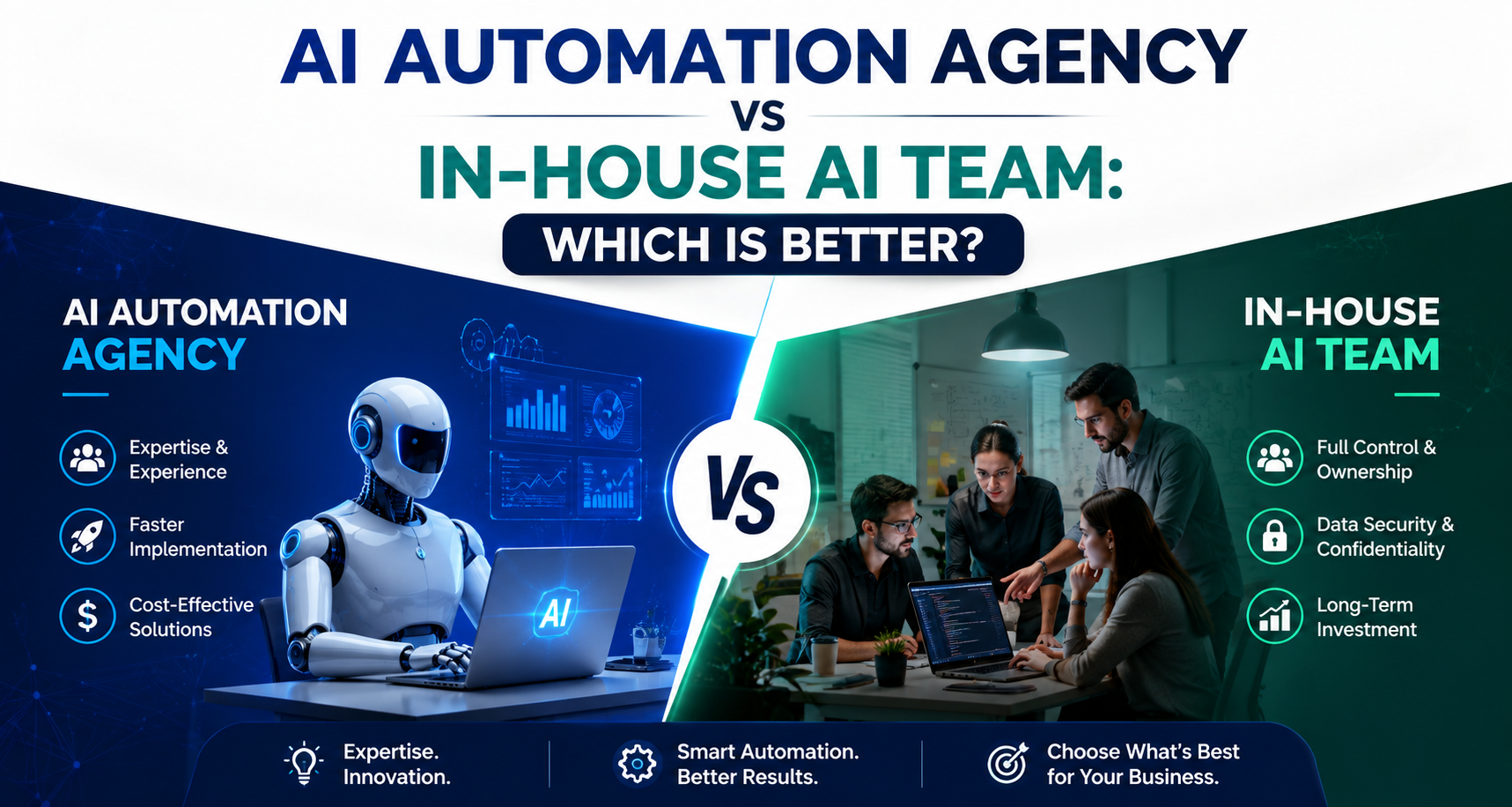
AI Automation Agency vs In-House AI Team: Which Is Better?
Introduction
Artificial intelligence is becoming an important part of modern business strategy. Companies are using AI to automate repetitive tasks, improve customer experiences, analyse data, accelerate operations, and help employees become more productive.
However, successfully implementing AI requires more than choosing an AI tool. Businesses need experienced professionals who can understand their goals, select the right technologies, build reliable solutions, integrate systems, and provide ongoing support.
This leads to an important question:
Should you hire an AI automation agency or build an in-house AI team?
Both options offer unique benefits. An AI automation agency can provide immediate access to specialized expertise and flexible resources. An in-house AI team can offer greater control, deeper knowledge of internal processes, and long-term ownership.
The right choice depends on several factors, including your budget, business goals, project complexity, timeline, internal capabilities, and long-term AI strategy.
In this article, we compare an AI automation agency vs an in-house AI team to help you determine which option is better for your business.
What Is an AI Automation Agency?
An AI automation agency is an external technology partner that helps businesses plan, develop, implement, and optimize AI-powered automation solutions.
Depending on the agency, services may include:
- AI automation strategy
- Custom AI software development
- AI agent development
- Generative AI solutions
- Intelligent workflow automation
- Business process automation
- AI-powered chatbots
- Document processing
- CRM and ERP automation
- API integration
- Machine learning solutions
- AI consulting
- Ongoing maintenance and support
Businesses can hire an agency for a specific project or work with it as a long-term technology partner.
An experienced AI Automation Agency in USA can provide access to AI engineers, software developers, automation specialists, data professionals, and project managers without requiring the business to hire every specialist internally.
What Is an In-House AI Team?
An in-house AI team consists of professionals employed directly by a company to manage its AI and automation initiatives.
A typical internal team may include:
- AI engineers
- Machine learning engineers
- Data scientists
- Software developers
- Data engineers
- AI product managers
- Automation specialists
- Cloud engineers
- DevOps professionals
An in-house team works directly within the organization's technology environment and develops solutions according to internal business requirements.
This approach can be particularly valuable for companies where AI is a core part of their long-term business strategy.
AI Automation Agency vs In-House AI Team: Quick Comparison
| Factor | AI Automation Agency | In-House AI Team |
|---|---|---|
| Initial Setup | Faster | Slower |
| Hiring Requirements | Minimal | High |
| Specialized Expertise | Immediately available | Requires recruitment |
| Upfront Investment | Generally lower | Generally higher |
| Business Knowledge | Requires onboarding | Deep internal knowledge |
| Control | Shared or contract-based | Complete internal control |
| Scalability | Flexible | Requires hiring |
| Project Speed | Often faster | Depends on team capacity |
| Long-Term Ownership | Depends on agreement | Fully internal |
| Best For | Projects and rapid implementation | Long-term AI strategy |
1. Cost and Investment
Cost is one of the biggest factors businesses consider when choosing between an agency and an in-house team.
AI Automation Agency
Hiring an agency can provide access to specialized professionals without the expense of maintaining a full-time AI department.
Businesses may avoid costs associated with:
- Recruitment
- Salaries
- Employee benefits
- Training
- Office infrastructure
- AI tools
- Development platforms
- Cloud resources
An agency may offer fixed-price projects, milestone-based contracts, or ongoing engagement models.
For businesses that need AI expertise for specific projects, this can be a flexible option.
In-House AI Team
Building an internal team requires a larger long-term investment.
Businesses may need to pay for:
- Recruitment
- Salaries
- Employee benefits
- Training
- Employee retention
- Software
- Cloud infrastructure
- Development tools
- Management
The cost increases as the organization hires more specialists.
Which Is Better?
For short-term projects or businesses beginning their AI journey, an agency may be more cost-effective.
For organizations with continuous AI requirements, an in-house team may provide better long-term value.
2. Access to Specialized Expertise
AI automation requires expertise across multiple disciplines.
A project may require knowledge of:
- Generative AI
- Machine learning
- Large language models
- AI agents
- Data engineering
- Software development
- Cloud computing
- API integration
- Cybersecurity
- Workflow automation
AI Automation Agency
An experienced agency can bring together specialists based on project requirements.
For example, a complex AI project may require an AI engineer, software developer, cloud expert, automation specialist, and QA professional.
An agency can provide access to these skills without requiring the business to hire each person permanently.
In-House AI Team
An internal team develops deep knowledge of the organization's products, customers, and processes.
However, recruiting every specialist can take considerable time.
Which Is Better?
An agency is often better when a business needs diverse or specialized expertise quickly.
An in-house team may be better when the company wants to develop deep internal AI capabilities over time.
3. Speed of Implementation
The faster a business can implement a successful AI solution, the sooner it may begin seeing value.
AI Automation Agency
An established agency already has:
- Experienced professionals
- Development processes
- Project management systems
- Technical resources
- AI development experience
This can help businesses move from idea to implementation faster.
In-House AI Team
Building an internal team requires:
- Defining roles
- Recruiting candidates
- Interviewing
- Hiring
- Onboarding
- Training
- Setting up infrastructure
Only after these steps can the team begin working on major AI initiatives.
Which Is Better?
If speed is a priority, an AI automation agency is often the better option.
4. Scalability
AI requirements can change as a business grows.
A small pilot project may eventually expand into a company-wide automation strategy.
AI Automation Agency
An agency can often scale its team based on project requirements.
A business may initially need a few specialists and later require additional:
- Developers
- AI engineers
- Data scientists
- Cloud experts
- Security professionals
- QA engineers
An agency can potentially provide additional resources as needed.
In-House AI Team
Scaling an internal team requires additional recruitment.
This may take time and increase operational costs.
Which Is Better?
For businesses that need flexible resources, an AI automation agency may provide greater scalability.
5. Understanding of Your Business
One major advantage of an in-house team is its understanding of the organization.
Internal employees already understand:
- Business processes
- Company culture
- Customer requirements
- Existing software
- Internal workflows
- Business objectives
This knowledge can help the team develop solutions that fit the organization.
An external agency needs time to learn about the business.
However, a professional agency can use discovery sessions, process analysis, workshops, and documentation to understand the organization's requirements.
Which Is Better?
An in-house team may have an advantage when deep business knowledge is critical.
However, an experienced agency can build strong domain understanding through effective collaboration.
6. Control and Ownership
Businesses should carefully consider how much control they need over their AI systems.
AI Automation Agency
When working with an agency, businesses should clearly define:
- Source code ownership
- Intellectual property
- Data ownership
- Access rights
- Documentation
- Maintenance responsibilities
These details should be included in the agreement.
In-House AI Team
An internal team provides direct control over:
- Development
- Data
- Infrastructure
- Source code
- Product roadmap
- AI strategy
Which Is Better?
An in-house team is generally better for businesses that require complete internal control.
However, an agency can also provide strong ownership and control when contracts are clearly structured.
7. Access to New AI Technologies
The AI ecosystem is evolving rapidly.
New AI models, frameworks, platforms, and automation tools are constantly emerging.
AI Automation Agency
An agency may work with multiple clients across industries and gain exposure to a variety of AI use cases.
This experience can help agencies identify practical applications of new technologies.
In-House AI Team
An internal team can also stay updated with AI developments, but its experience may be focused primarily on the organization's specific requirements.
Which Is Better?
An agency may offer broader exposure to different AI technologies and implementation strategies.
8. Integration With Existing Systems
AI automation usually needs to work with existing business applications.
Organizations may use:
- CRM platforms
- ERP systems
- Accounting software
- HR platforms
- Databases
- Cloud applications
- E-commerce systems
AI Automation Agency
An experienced agency can help integrate AI solutions with existing systems using APIs and other integration technologies.
In-House AI Team
An internal team already understands the organization's technology infrastructure.
This can simplify some integration decisions.
Which Is Better?
Both approaches can work well. The better choice depends on the technical skills available within the organization and the complexity of the required integrations.
9. Data Security and Privacy
AI systems often process sensitive information.
This may include:
- Customer data
- Financial information
- Employee records
- Business documents
- Intellectual property
AI Automation Agency
Businesses should carefully evaluate an agency's:
- Security policies
- Data handling practices
- Access controls
- Encryption
- Infrastructure
- Confidentiality agreements
In-House AI Team
An internal team provides direct control over data and infrastructure.
However, the organization is still responsible for implementing strong security practices.
Which Is Better?
Neither option is automatically safer.
The right choice depends on the security architecture, policies, access controls, and governance practices used by the organization or agency.
10. Maintenance and Long-Term Support
AI systems require ongoing maintenance.
This may include:
- Model updates
- Security improvements
- Performance monitoring
- Bug fixes
- Data management
- Software updates
- Workflow optimization
AI Automation Agency
An agency can provide ongoing support through a maintenance agreement.
This allows businesses to access technical expertise when needed.
In-House AI Team
An internal team manages maintenance directly.
This provides greater control but also increases internal responsibilities.
Which Is Better?
An agency may be better for businesses that prefer external technical support.
An in-house team may be better for organizations that already have strong internal technology capabilities.
11. Innovation and Strategic Flexibility
AI automation is not only about technology. It is also about identifying new opportunities.
An external agency may bring ideas from working with different businesses and industries.
An internal team, however, has a deeper understanding of the organization's long-term strategy.
Which Is Better?
An agency may provide broader external perspectives, while an in-house team may provide deeper strategic alignment.
A hybrid model can combine both advantages.
12. Employee and Team Collaboration
AI adoption affects employees across the organization.
An in-house team may find it easier to collaborate with internal departments because they are part of the same organization.
An agency may bring specialized technical expertise but needs effective communication with internal teams.
For successful AI adoption, businesses should ensure that:
- Employees understand the purpose of automation.
- Teams receive appropriate training.
- Business stakeholders participate in planning.
- AI systems are tested with real users.
- Feedback is collected after deployment.
Which Is Better?
The best option depends on how effectively the internal team and external partner collaborate.
When Should You Choose an AI Automation Agency?
An AI automation agency may be the better choice if:
- You need to launch quickly.
- You do not have internal AI expertise.
- You need specialized technical skills.
- You want flexible project resources.
- You are starting your AI journey.
- You have a limited technology team.
- You want to test AI before building internal capabilities.
For startups and small-to-medium-sized businesses, an agency can provide a practical way to access advanced AI expertise without building a large internal department.
When Should You Choose an In-House AI Team?
An in-house team may be better if:
- AI is central to your business.
- You have a long-term AI roadmap.
- You require continuous AI development.
- You want complete internal ownership.
- You have sufficient budget for hiring.
- You have enough AI projects to support a permanent team.
- Your organization requires deep internal domain knowledge.
Large enterprises with ongoing AI requirements may benefit from investing in internal AI capabilities.
What About a Hybrid AI Team?
Businesses do not always have to choose one option.
A hybrid approach combines internal employees with external AI specialists.
For example, the internal team may manage:
- AI strategy
- Business requirements
- Product ownership
- Data governance
- Long-term roadmap
The external agency may handle:
- Custom AI development
- Complex integrations
- AI automation implementation
- Specialized engineering
- Additional development capacity
This model allows businesses to maintain internal ownership while gaining access to external expertise.
For many organizations, a hybrid approach may provide the right balance between control, flexibility, expertise, and cost.
How to Decide Which Option Is Better
Before choosing between an AI automation agency and an in-house AI team, consider these questions:
1. What Is Your AI Strategy?
Are you implementing one or two projects, or do you plan to make AI a core part of your business?
2. How Quickly Do You Need Results?
If you need rapid implementation, an agency may be more suitable.
3. What Is Your Budget?
Compare the total cost of agency services with recruitment, salaries, benefits, infrastructure, and retention costs.
4. What Expertise Do You Already Have?
If you already have experienced AI professionals, expanding your internal team may be practical.
5. How Complex Is Your Project?
Specialized projects may benefit from external experts with experience in specific AI technologies.
6. How Much Control Do You Need?
If complete internal ownership is critical, an in-house team may be preferable.
7. What Are Your Long-Term Goals?
Your decision should support your long-term AI strategy rather than only your immediate project.
AI Automation Agency vs In-House AI Team: Which Is Better?
There is no single answer for every business.
An AI automation agency is often better for companies that need:
- Fast implementation
- Specialized expertise
- Flexible resources
- Lower initial investment
- External technical support
An in-house AI team may be better for organizations that need:
- Complete control
- Long-term AI capabilities
- Deep business knowledge
- Continuous development
- Internal ownership
A hybrid approach may be the best choice for organizations that want both internal control and external expertise.
Conclusion
The decision between an AI automation agency vs an in-house AI team depends on your business objectives, budget, technical capabilities, project requirements, and long-term strategy.
An AI automation agency can help businesses access specialized expertise, implement solutions faster, and scale projects without building a large internal team.
An in-house AI team can provide greater control, deeper business knowledge, and long-term internal capabilities.
For many businesses, the most practical approach may be to start with an AI automation agency, test high-value use cases, and gradually build internal AI capabilities as their needs grow.
The key is to focus on business outcomes rather than technology alone.
Choose the approach that helps your organization solve real problems, create measurable value, and build a sustainable AI strategy for the future.
Frequently Asked Questions
1. Is an AI automation agency better than an in-house AI team?
It depends on the business. An agency is often better for fast implementation and specialized expertise, while an in-house team may be better for organizations with long-term AI development needs.
2. Is hiring an AI automation agency cheaper?
For specific projects, an agency can be more cost-effective because businesses do not need to hire and maintain a full-time AI team. However, long-term costs depend on the number and complexity of projects.
3. When should a business build an in-house AI team?
Businesses should consider building an in-house AI team when AI is a core part of their long-term strategy and they have enough ongoing projects to support permanent AI professionals.
4. Can small businesses benefit from an AI automation agency?
Yes. Small businesses can use an agency to access AI expertise without investing in a large internal team. They can start with focused projects and expand automation as their business grows.
5. What is a hybrid AI team?
A hybrid AI team combines internal employees with external AI specialists. The internal team manages strategy and business requirements, while external experts provide specialized development and implementation support.
6. How do I choose the right AI automation agency?
Evaluate the agency's AI expertise, relevant experience, portfolio, security practices, communication, pricing, integration capabilities, scalability, and post-launch support.
7. Can an AI automation agency work with my internal developers?
Yes. An agency can collaborate with internal developers to provide specialized AI expertise, additional resources, complex integrations, or support for specific projects.
8. What is the biggest advantage of an in-house AI team?
The biggest advantage is direct control and deep understanding of the organization's business processes, data, technology infrastructure, and long-term objectives.

 English
 Arabic
 French
 Portuguese
 Deutsch
 Turkish
 Dutch
Dutch
 Italiano
 Russian
 Romaian
 Portuguese (Brazil)
 Greek
Greek
