


Hydrogen Pipelines Market to Reach USD 5.84 Billion by 2032, Growing at 12.0% CAGR
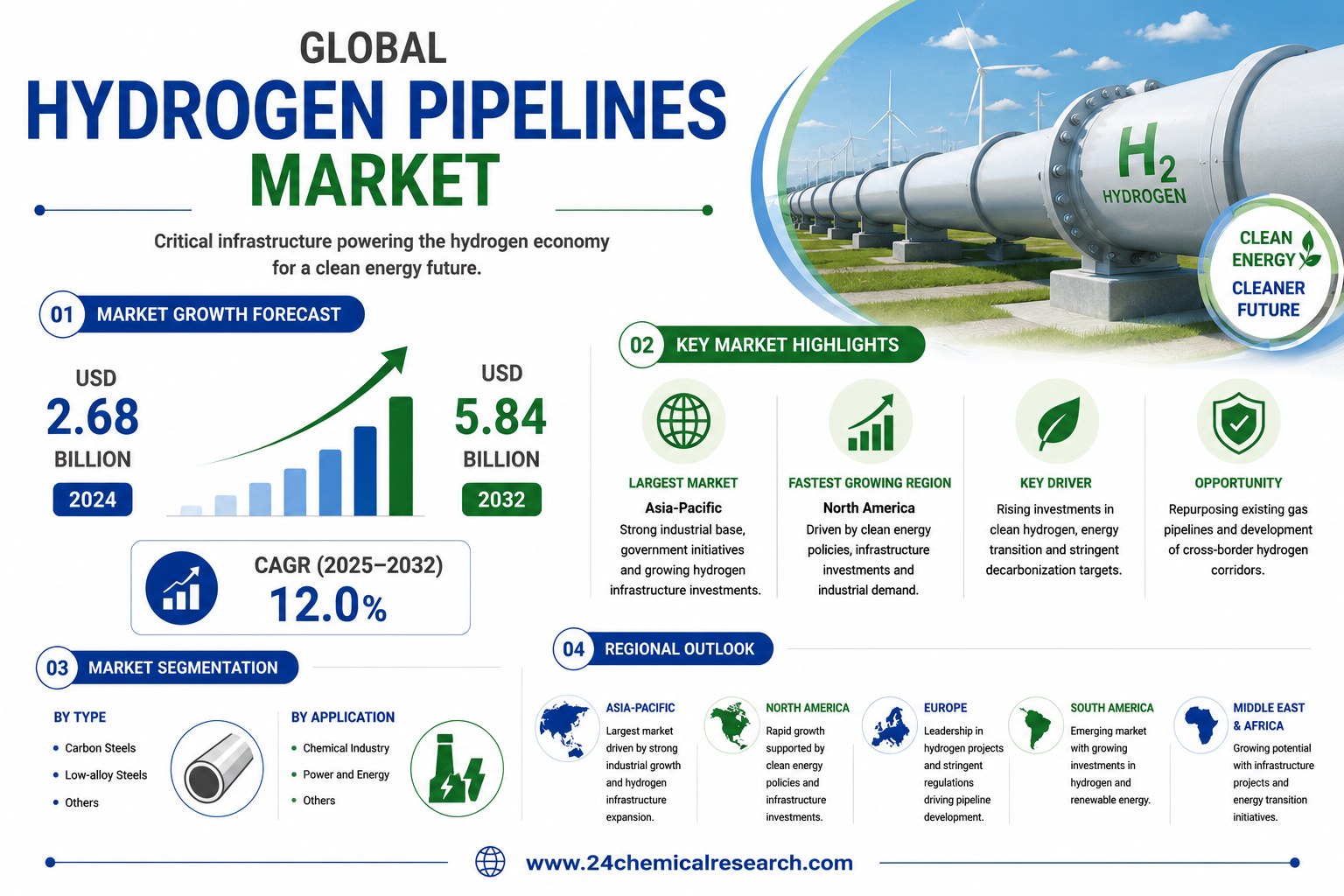
The global hydrogen pipelines market size was valued at USD 2.68 billion in 2024. The market is projected to grow from USD 3.01 billion in 2025 to USD 5.84 billion by 2032, exhibiting a CAGR of 12.0% during the forecast period.
Hydrogen pipelines are critical infrastructure designed to transport hydrogen gas from production facilities to end-users, including industrial plants, refueling stations for fuel cell vehicles, and other applications supporting the hydrogen economy. These pipelines face unique challenges, such as hydrogen embrittlement and corrosion, due to hydrogen's reactive nature, which can degrade pipeline materials over time. To mitigate these issues, pipelines require specialized materials like corrosion-resistant steels and advanced coatings.
The market growth is driven by increasing investments in clean energy solutions and government initiatives to decarbonize industries. Europe and North America are leading the adoption of hydrogen pipelines, with projects like the European Hydrogen Backbone aiming to establish a 28,000 km network by 2030. Key players such as Linde, Tenaris, and DNV are actively expanding their portfolios with advanced pipeline solutions to meet rising demand.
Download FREE Sample Report: https://www.24chemicalresearch.com/download-sample/297260/hydrogen-pipelines-market
Market Overview & Regional Analysis
Europe leads in hydrogen infrastructure integration, with the REPowerEU plan targeting 20 Mt of renewable hydrogen production by 2030 requiring extensive pipeline networks. The proposed European Hydrogen Backbone initiative could connect 28,000 km of pipelines across 11 countries by 2030. Germany's H2Global initiative and France's hydrogen valley projects demonstrate national commitments. The region benefits from existing gas infrastructure repurposing, though material compatibility issues necessitate comprehensive requalification processes. Stringent EU safety standards EN 13480 and ISO 14693 govern pipeline construction, fostering technological standardization. Cross-border projects like the Spain-France H2Med corridor highlight regional cooperation, while the Clean Hydrogen Partnership allocates €2 billion for infrastructure innovation.
North America is experiencing accelerated growth due to strong government backing for clean energy initiatives. The U.S. Department of Energy's Hydrogen Energy Earthshot program, aiming to reduce clean hydrogen costs to $1 per kilogram by 2031, is spurring infrastructure development. Canada has emerged as a key player with its National Hydrogen Strategy, committing over CAD 8 billion to decarbonize industries. However, technical challenges like hydrogen embrittlement in existing natural gas pipelines remain a concern, driving investments in specialized materials such as low-alloy steels. The region holds 2,600 km of dedicated hydrogen pipelines, primarily serving industrial clusters along the Gulf Coast. Localized demand centers are emerging in California and the Midwest, linked to clean hydrogen projects and fuel cell vehicle adoption.
Asia-Pacific dominates market growth, propelled by China's hydrogen roadmap targeting 50,000 hydrogen fuel cell vehicles and 1,000 refueling stations by 2035. Japan's Basic Hydrogen Strategy supports imports via specialized liquid hydrogen carriers while developing domestic pipeline networks. Australia is leveraging its renewable energy advantage to become a hydrogen export hub, with projects like the Asian Renewable Energy Hub. India's National Hydrogen Mission commits $2.3 billion to green hydrogen infrastructure. The region faces unique challenges including typhoon-resistant pipeline engineering in coastal areas and cost optimization for developing economies. Singapore's Jurong Island hydrogen-ready infrastructure exemplifies industrial cluster adaptation, while South Korea's Incheon hydrogen city project demonstrates urban integration.
South America shows emerging potential with Chile's National Green Hydrogen Strategy targeting 25 GW electrolysis capacity by 2030, requiring extensive pipeline networks for mining and export applications. Brazil's hydrogen legislation framework is progressing, though project execution faces financing hurdles. Argentina's natural gas infrastructure presents repurposing opportunities, while Colombia's hydrogen roadmap focuses on industrial decarbonization. The region benefits from abundant renewable resources but struggles with investment certainty and regulatory fragmentation. Limited local manufacturing capabilities for specialized pipeline materials increase import dependency. Cross-border pipeline proposals between Chile and Argentina could establish regional hydrogen trade, contingent upon political alignment and funding mechanisms.
The Middle East & Africa region is leveraging existing energy expertise for hydrogen infrastructure, with Saudi Arabia's NEOM project constructing a $5 billion green hydrogen plant and associated pipelines. UAE's hydrogen strategy 2050 supports pipeline integration with carbon capture clusters. South Africa's Hydrogen Society Roadmap targets domestic infrastructure development alongside export facilities. The region faces extreme environment challenges including desert corrosion and cooling requirements for pipeline efficiency. Africa's nascent hydrogen economy shows potential through projects like Namibia's Hyphen Hydrogen, though lacks legacy infrastructure for cost-effective conversion. Geopolitical stability concerns and financing gaps slow progress compared to other regions, while port-based hydrogen hubs offer alternative development pathways.
Key Market Drivers and Opportunities
Global Decarbonization Efforts Accelerating Hydrogen Pipeline Adoption
The push for carbon-neutral energy solutions is driving substantial investments in hydrogen infrastructure globally. With over 30 countries releasing national hydrogen strategies and roadmaps as of 2024, pipeline networks are becoming essential for connecting production hubs with industrial consumers. The European Union's REPowerEU plan alone allocates more than €20 billion for hydrogen infrastructure development through 2030, stimulating pipeline deployment across member states. These ambitious policy frameworks create a strong foundation for long-term market growth, as hydrogen emerges as a key component in hard-to-abate sector decarbonization.
Industrial Demand Growth in Refining and Chemical Sectors
Traditional hydrogen consumers in refining and chemical industries continue to drive steady pipeline demand, with ammonia production accounting for 55% of global hydrogen consumption. As these sectors transition to low-carbon hydrogen to meet emission reduction targets, pipeline retrofitting and new network construction are gaining momentum. The methanol and steel industries are also emerging as significant demand centers, particularly in regions with stringent carbon pricing mechanisms. This broadening industrial application base provides resilience against market fluctuations and supports infrastructure expansion.
Technological Advancements in Pipeline Materials and Construction
Recent breakthroughs in metallurgy and composite materials are overcoming historical limitations in hydrogen pipeline performance. Advanced low-alloy steels with specialized polymer linings demonstrate 40% greater resistance to hydrogen embrittlement compared to conventional carbon steel pipes. Simultaneously, modular construction techniques have reduced pipeline deployment timelines by up to 30%, enabling faster project execution. These innovations lower capital expenditure thresholds and improve operational reliability, making pipeline solutions more attractive for midstream developers.
Repurposing Existing Natural Gas Infrastructure
The potential conversion of decommissioned natural gas pipelines presents a $50-70 billion opportunity globally. Recent studies indicate that up to 40% of Europe's gas network could be retrofitted for hydrogen service at 30-50% of new build costs. Major energy companies are already piloting conversion projects, with several high-pressure transmission lines scheduled for hydrogen service by 2026. This asset repurposing strategy accelerates infrastructure deployment while reducing environmental impact.
Emerging Hydrogen Export Corridors
International hydrogen trade is driving demand for long-distance pipeline connections between production centers and demand hubs. Proposed projects like the 1,700 km European Hydrogen Backbone and MENA-Europe corridors could transport over 5 million tons annually by 2030. These transcontinental networks create opportunities for pipeline technology providers and engineering firms specializing in large-scale hydrogen transmission systems. The development of standardized interconnection protocols further enhances these trade opportunities.
Digitalization and Smart Pipeline Monitoring
Advanced monitoring technologies including distributed fiber optics and hydrogen sensors enable real-time pipeline integrity management. These systems can detect micro-leaks with 99% accuracy, significantly improving safety parameters. Predictive maintenance algorithms powered by machine learning reduce unplanned downtime by 30-40%, optimizing asset utilization. The integration of these digital solutions creates new service revenue streams while addressing critical safety concerns.
Challenges & Restraints
High Capital Intensity and Financing Challenges
Hydrogen pipeline projects require substantial upfront investment, with per-kilometer costs ranging between $1-4 million depending on diameter and terrain. This capital intensity creates significant barriers to entry, particularly in developing markets with limited access to low-cost financing. The need for specialized materials and construction techniques further elevates project costs compared to natural gas infrastructure. These financial hurdles slow down network expansion and require innovative public-private partnership models to overcome.
Regulatory Uncertainties and Standardization Gaps
The lack of harmonized international standards for hydrogen pipeline design and operation creates compliance complexities for cross-border projects. Varying safety regulations and permitting requirements across jurisdictions can delay project timelines by 18-24 months. Additionally, evolving certification frameworks for low-carbon hydrogen create uncertainty around future demand patterns, making infrastructure planning more challenging. These regulatory ambiguities discourage some investors and require coordinated policy action to resolve.
Market Segmentation by Type
● Carbon Steels
● Low-alloy Steels
● Others
Download FREE Sample Report: https://www.24chemicalresearch.com/download-sample/297260/hydrogen-pipelines-market
Market Segmentation by Application
● Chemical Industry
● Power and Energy
● Others
Market Segmentation and Key Players
● Linde PLC (Ireland)
● Tenaris S.A. (Luxembourg)
● Salzgitter AG (Germany)
● Pipelife International GmbH (Austria)
● SoluForce (Netherlands)
● Corinth Pipeworks (Greece)
● DNV (Norway)
● H2 Clipper (U.S.)
● Cenergy Holdings (Belgium)
● Gruppo Sarplast Srl (Italy)
● NPROXX (Netherlands)
● Hexagon Purus (Norway)
● Europipe GmbH (Germany)
● LIBERTY Steel Group (U.K.)
● PipeChina (China)
● GF Piping Systems (Switzerland)
● ArcelorMittal (Luxembourg)
● Jindal Saw Limited (India)
Report Scope
This report presents a comprehensive analysis of the global and regional markets for Hydrogen Pipelines, covering the period from 2024 to 2032. It includes detailed insights into the current market status and outlook across various regions and countries, with specific focus on:
● Sales, sales volume, and revenue forecasts
● Detailed segmentation by type and application
The report features in-depth competitive intelligence including:
● Company profiles
● Product specifications
● Production capacity and sales
● Revenue, pricing, gross margins
● Sales performance
It further examines the competitive landscape, highlighting the major vendors and identifying the critical factors expected to challenge market growth.
Our research methodology combines primary interviews with industry leaders and comprehensive data analysis of:
● Revenue and demand trends
● Product types and recent developments
● Strategic plans and market drivers
● Industry challenges, obstacles, and potential risks
Get Full Report Here: https://www.24chemicalresearch.com/reports/297260/hydrogen-pipelines-market
About 24chemicalresearch
Founded in 2015, 24chemicalresearch has rapidly established itself as a leader in chemical market intelligence, serving clients including over 30 Fortune 500 companies. We provide data-driven insights through rigorous research methodologies, addressing key industry factors such as government policy, emerging technologies, and competitive landscapes.
● Plant-level capacity tracking
● Real-time price monitoring
● Techno-economic feasibility studies
With a dedicated team of researchers possessing over a decade of experience, we focus on delivering actionable, timely, and high-quality reports to help clients achieve their strategic goals. Our mission is to be the most trusted resource for market insights in the chemical and materials industries.
Asia: +91 9169162030
Website: https://www.24chemicalresearch.com/

 English
 Arabic
 French
 Portuguese
 Deutsch
 Turkish
 Dutch
Dutch
 Italiano
 Russian
 Romaian
 Portuguese (Brazil)
 Greek
Greek
