


Computer Vision Use Cases: Manufacturing, Retail, and Healthcare
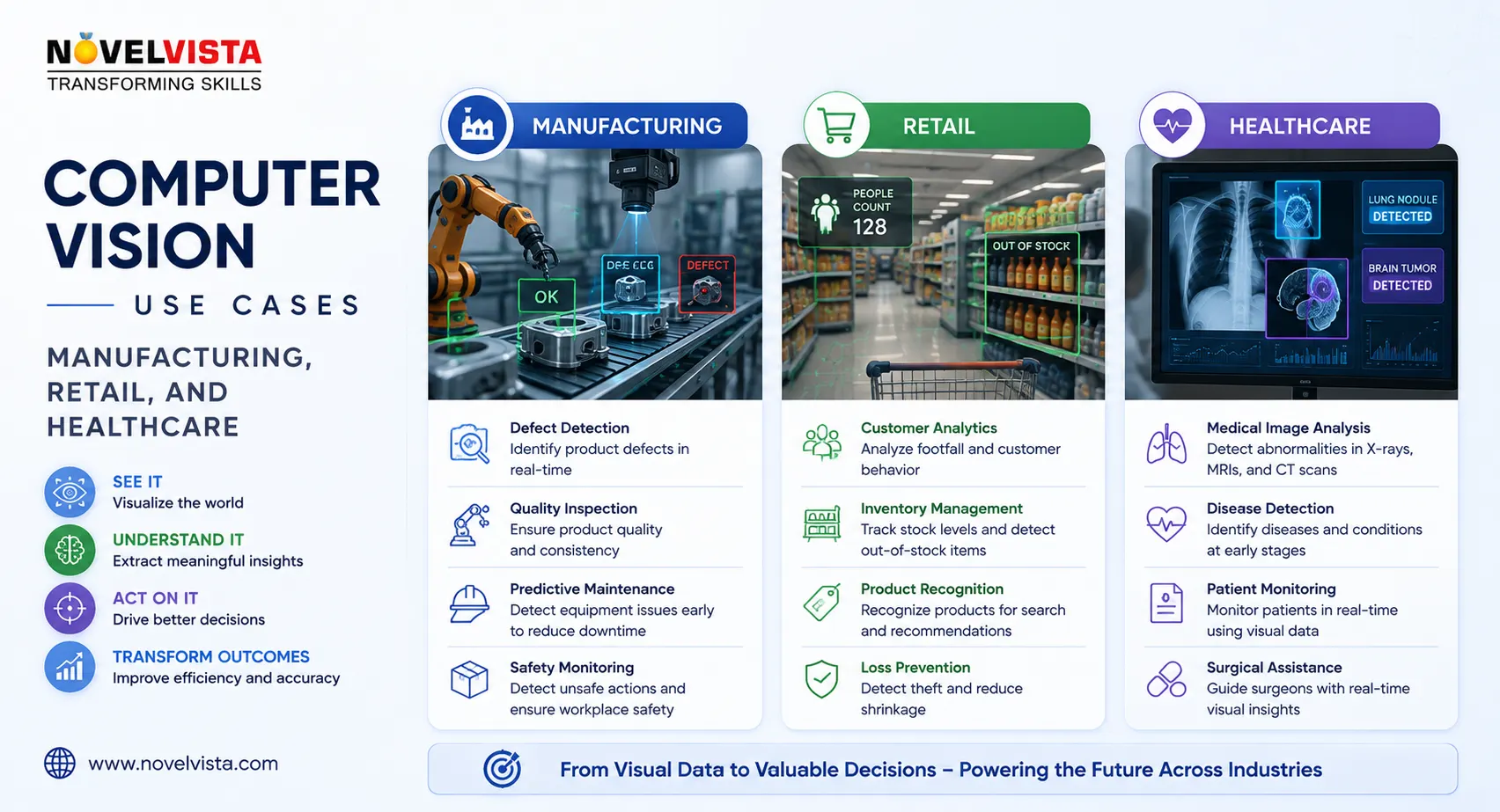
Computer vision is a branch of artificial intelligence that enables machines to interpret and analyse visual information. It allows software systems to examine images, videos, and live camera feeds to identify objects, detect patterns, track movement, and support business decisions.
Much like human vision, computer vision helps machines understand what is happening in the physical world. However, unlike manual inspection, AI-powered systems can process thousands of images consistently and operate continuously.
Manufacturing, retail, and healthcare are among the industries gaining the most practical value from this technology.
Computer Vision in Manufacturing
Manufacturers use computer vision to improve quality, safety, productivity, and operational efficiency.
Automated Quality Inspection
Quality inspection is one of the most common manufacturing use cases.
Cameras placed along a production line can capture images of products as they are manufactured. Computer vision models analyse these images to identify defects such as:
- Cracks or scratches
- Incorrect dimensions
- Missing components
- Surface damage
- Packaging errors
- Colour inconsistencies
For example, an automobile manufacturer can use computer vision to inspect painted vehicle panels for dents or coating defects. An electronics company can check whether every component has been correctly positioned on a circuit board.
Automated inspection is usually faster and more consistent than relying entirely on manual checks.
Predictive Maintenance
Computer vision can also support equipment maintenance.
Cameras and thermal imaging devices may detect visible signs of machinery problems, including leaks, corrosion, abnormal movement, overheating, and damaged components.
The system can alert maintenance teams before equipment completely fails. This helps reduce unplanned downtime, avoid expensive repairs, and extend machine life.
Worker Safety
Manufacturing environments often contain heavy machinery, hazardous materials, and restricted zones.
Computer vision systems can monitor whether workers are wearing helmets, gloves, safety jackets, masks, or other required protective equipment. They can also detect when someone enters an unsafe area or stands too close to operating machinery.
These systems should support workplace safety teams rather than replace proper supervision, training, and safety procedures.
Inventory and Production Monitoring
Computer vision can count products, track materials, and monitor production progress.
A factory may use cameras to verify how many units have moved through a production stage. Warehouse systems can detect pallets, containers, and raw materials without requiring employees to scan every item manually.
This provides operations teams with more accurate and timely inventory information.
Computer Vision in Retail
Retailers use computer vision to better understand stores, products, and customer behaviour.
Shelf and Inventory Monitoring
Empty shelves can result in missed sales and dissatisfied customers.
Computer vision systems can analyse store shelves and identify products that are unavailable, misplaced, incorrectly labelled, or running low. Employees can receive alerts when shelves require restocking.
The same technology can help retailers verify product displays and confirm that promotional items have been placed correctly.
Checkout Automation
Computer vision can recognise products at self-checkout stations or cashier-free stores.
Instead of scanning every barcode, a camera-based system may identify products based on their appearance. Some systems combine visual recognition with shelf sensors and customer tracking to determine which products have been selected.
This can reduce checkout times, although accuracy, customer consent, and data privacy must be carefully managed.
Customer Behaviour Analysis
Retailers can analyse anonymous movement patterns to understand how customers interact with a store.
Computer vision may help determine:
- Which areas receive the most traffic
- How long customers remain near a display
- Where queues frequently develop
- Which store layouts encourage engagement
- Whether promotional displays attract attention
These insights help retailers improve store design, staff allocation, and product placement.
Facial recognition is not necessary for most of these applications. Privacy-friendly systems can analyse movement and footfall without identifying individuals.
Loss Prevention
Computer vision can help identify suspicious activities such as concealed items, unusual product movement, or unauthorised access to restricted areas.
Retailers may use these systems to support security teams and reduce theft. However, organisations must test them carefully to avoid inaccurate alerts, unfair targeting, or intrusive surveillance.
Computer Vision in Healthcare
Healthcare applications require particularly high levels of accuracy, privacy, security, and human oversight.
Medical Image Analysis
Computer vision can assist doctors in examining X-rays, CT scans, MRI scans, ultrasound images, and pathology slides.
AI models may highlight suspicious regions, measure abnormalities, or help detect signs of diseases such as cancer, pneumonia, fractures, or eye disorders.
These systems are designed to support medical professionals. A qualified clinician should remain responsible for diagnosis and treatment decisions.
Patient Monitoring
Cameras and visual sensors can monitor patient movement in hospitals, care centres, or rehabilitation facilities.
A system may detect when a patient falls, leaves a bed unexpectedly, or requires assistance. It can notify healthcare staff so they can respond quickly.
Computer vision can also support physical therapy by tracking posture and movement during rehabilitation exercises.
Surgical Assistance
During surgery, computer vision may help track instruments, identify anatomical structures, and provide visual guidance.
Robotic and image-guided surgical systems can combine camera data with medical imaging to help surgeons perform precise procedures. These technologies can improve visibility and support better decision-making during complex operations.
Administrative Automation
Healthcare organisations process large numbers of forms, prescriptions, laboratory reports, and insurance documents.
Computer vision combined with optical character recognition can extract information from scanned documents and handwritten or printed records. This reduces manual data entry and improves document-processing efficiency.
Challenges and Responsible Use
Computer vision systems depend heavily on the quality and diversity of their training data. Poor lighting, unusual camera angles, unclear images, and unfamiliar objects may reduce accuracy.
Models can also produce biased results if their datasets do not represent real-world conditions fairly.
Organisations should therefore evaluate computer vision systems continuously, protect personal data, define human-review processes, and clearly communicate how cameras and visual information are being used.
Conclusion
Computer vision is helping manufacturers inspect products, retailers manage stores, and healthcare professionals analyse medical information. Its greatest value comes from automating repetitive visual tasks while providing people with faster and more consistent insights.
When implemented responsibly, computer vision can improve quality, safety, efficiency, and service delivery. The objective is not simply to give machines the ability to see, but to help organisations make better decisions from what those machines observe.

 English
 Arabic
 French
 Spanish
 Portuguese
 Deutsch
 Turkish
 Italiano
 Russian
 Romaian
 Portuguese (Brazil)
 Greek
Greek
