


Named Entity Recognition and Sentiment Analysis: Practical Use Cases
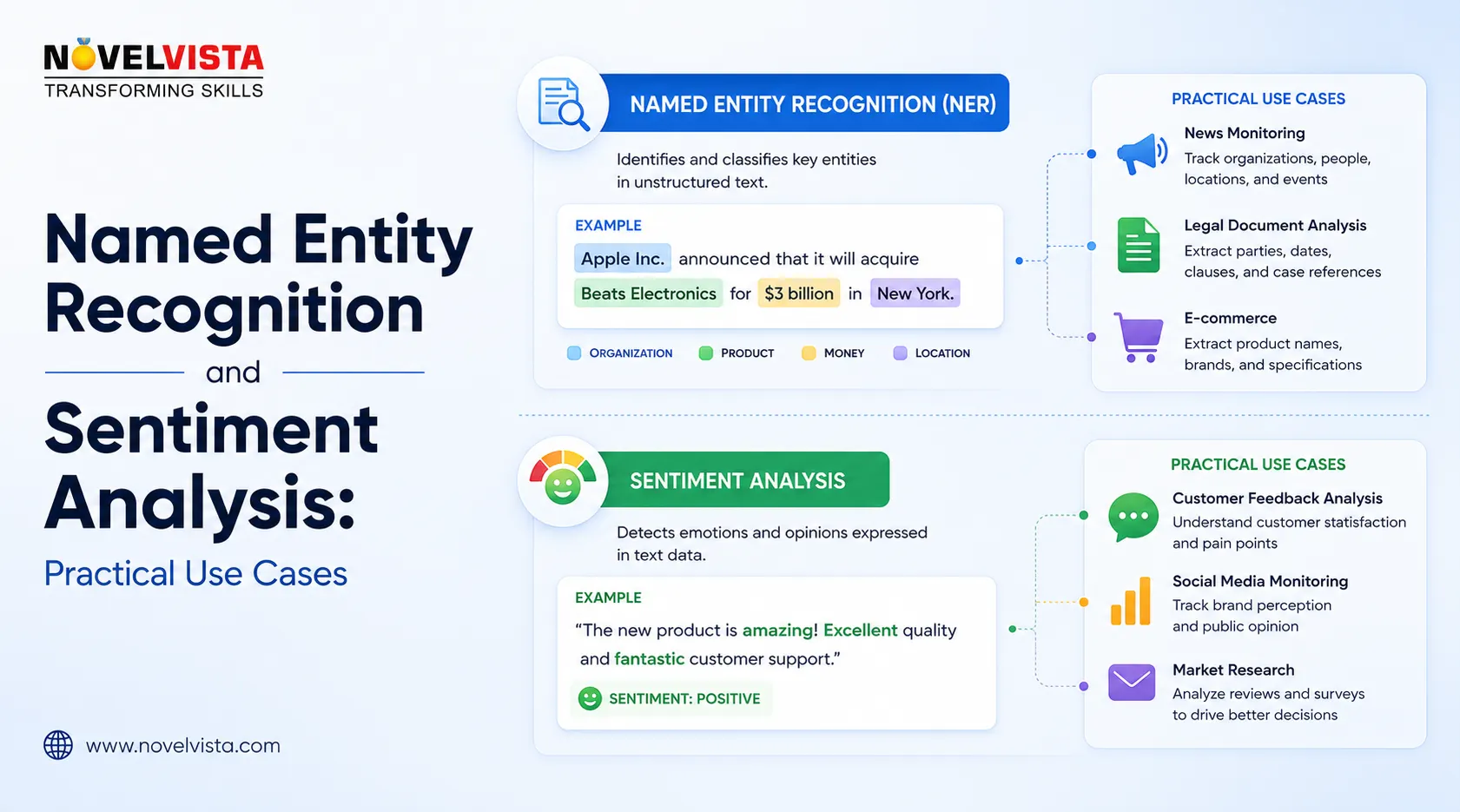
Businesses generate enormous amounts of text every day through emails, customer reviews, support tickets, social media posts, survey responses, news articles, and internal documents. Reading and analysing this information manually is slow, expensive, and difficult to scale.
Natural Language Processing, or NLP, helps computers understand and process human language. Two widely used NLP techniques are Named Entity Recognition and Sentiment Analysis. Although they solve different problems, they are often combined to uncover valuable insights from unstructured text.
What Is Named Entity Recognition?
Named Entity Recognition, commonly known as NER, is the process of identifying and classifying important entities within text.
These entities may include:
- People
- Organisations
- Locations
- Products
- Dates
- Monetary values
- Events
- Job titles
Consider the following sentence:
“Microsoft announced a new AI investment in India on 15 July.”
An NER system may identify:
- Microsoft as an organisation
- India as a location
- 15 July as a date
NER transforms unstructured text into organised information that software systems can search, analyse, and store.
Instead of treating a document as one large block of words, NER helps a system understand which words represent meaningful real-world objects.
What Is Sentiment Analysis?
Sentiment Analysis determines the emotional tone or opinion expressed in text. It usually classifies content as positive, negative, or neutral.
For example:
“The new mobile application is easy to use and very fast.”
This statement would probably be classified as positive.
“The latest update caused the application to crash repeatedly.”
This statement would probably be classified as negative.
Advanced sentiment analysis systems can also detect emotions such as satisfaction, frustration, anger, excitement, disappointment, or urgency. Some models provide a sentiment score instead of assigning only one category.
Sentiment analysis helps organisations understand what people think and feel without manually reading every comment or message.
Customer Feedback Analysis
One of the most common applications of sentiment analysis is customer feedback monitoring.
Companies receive feedback through review platforms, surveys, emails, social media, and support systems. Sentiment analysis can automatically classify these responses and highlight negative feedback that requires immediate attention.
NER can add another layer of detail by identifying the products, services, branches, employees, or locations mentioned in the feedback.
For example, a hotel chain may analyse the sentence:
“The staff at the Mumbai branch were helpful, but the room was not clean.”
NER identifies Mumbai as a location, while sentiment analysis detects positive sentiment about the staff and negative sentiment about room cleanliness.
This enables the company to understand not only whether the customer is satisfied, but also which part of the experience caused the reaction.
Social Media Monitoring
Brands are mentioned thousands of times across social media platforms. Manually tracking these conversations is rarely practical.
NER can identify brand names, products, competitors, public figures, and locations mentioned in posts. Sentiment analysis can then determine whether those mentions are positive, negative, or neutral.
For example, a smartphone company can monitor public reactions to a new product launch. It may discover that customers like the camera quality but are unhappy with battery performance.
Marketing and product teams can use these insights to improve campaigns, address concerns, and prioritise future enhancements.
Customer Support Ticket Routing
Support teams often receive large volumes of tickets covering different products and technical problems.
NER can extract important details such as product names, account numbers, operating systems, error codes, dates, and service locations. Sentiment analysis can identify customers who appear frustrated or angry.
The system can then automatically route tickets to the correct team and prioritise urgent or highly negative cases.
For example, a message containing an application name, payment reference, and strong negative sentiment may be sent directly to a specialised billing support team.
This reduces response times and helps support teams focus on the cases that need the most attention.
Financial and News Analysis
Financial institutions use NLP to analyse news reports, company announcements, market commentary, and regulatory documents.
NER can identify companies, executives, currencies, countries, industries, and financial values. Sentiment analysis can estimate whether a news report is likely to create positive or negative market perception.
An investment platform could track news about a particular company and measure how sentiment changes over time. Analysts can then combine these signals with financial data to support research and risk assessment.
However, sentiment analysis should not be treated as a complete investment strategy. Language can be ambiguous, and market reactions depend on many factors.
Recruitment and Human Resources
NER can extract candidate information from resumes, including names, qualifications, companies, job titles, locations, and technical skills.
Sentiment analysis may be used to study employee survey responses and identify common concerns related to workload, management, workplace culture, or career development.
Organisations must apply these technologies carefully in employment-related processes. Biased training data or inaccurate interpretation can lead to unfair decisions. Human review should remain part of high-impact recruitment and employee-management workflows.
Healthcare Applications
Healthcare organisations process clinical notes, patient feedback, research papers, and medical reports.
NER can identify symptoms, medicines, diseases, treatments, and medical procedures. Sentiment analysis can help analyse patient experiences and identify dissatisfaction with waiting times, communication, or service quality.
Because healthcare information is sensitive, organisations must implement strong privacy, security, and governance controls.
Challenges and Limitations
Both NER and sentiment analysis face challenges.
Names may have different meanings depending on context. Sarcasm, humour, slang, spelling mistakes, and mixed emotions can make sentiment difficult to detect. A sentence may also express different sentiments about multiple subjects.
For example:
“The design is excellent, but the performance is disappointing.”
A basic model may struggle to classify the overall statement correctly. Aspect-based sentiment analysis solves this problem by evaluating sentiment separately for design and performance.
Models must also be tested across different languages, industries, and user groups. A model trained on general social media posts may not perform accurately on legal, medical, or technical documents.
Combining NER and Sentiment Analysis
NER explains who or what is being discussed, while sentiment analysis explains how the writer feels about it.
When combined, these techniques help organisations answer more useful questions:
Which product receives the most complaints? Which location has the highest customer satisfaction? How do people feel about a competitor? Which support cases require immediate attention?
Together, Named Entity Recognition and Sentiment Analysis turn large amounts of unstructured text into actionable business intelligence. Their practical value lies not simply in understanding words, but in connecting people, organisations, products, and events with the opinions expressed about them.

 English
 French
 Spanish
 Portuguese
 Deutsch
 Turkish
 Dutch
Dutch
 Italiano
 Russian
 Romaian
 Portuguese (Brazil)
 Greek
Greek
