


Organic Meat Market to Cross USD 37.3 Billion by 2035
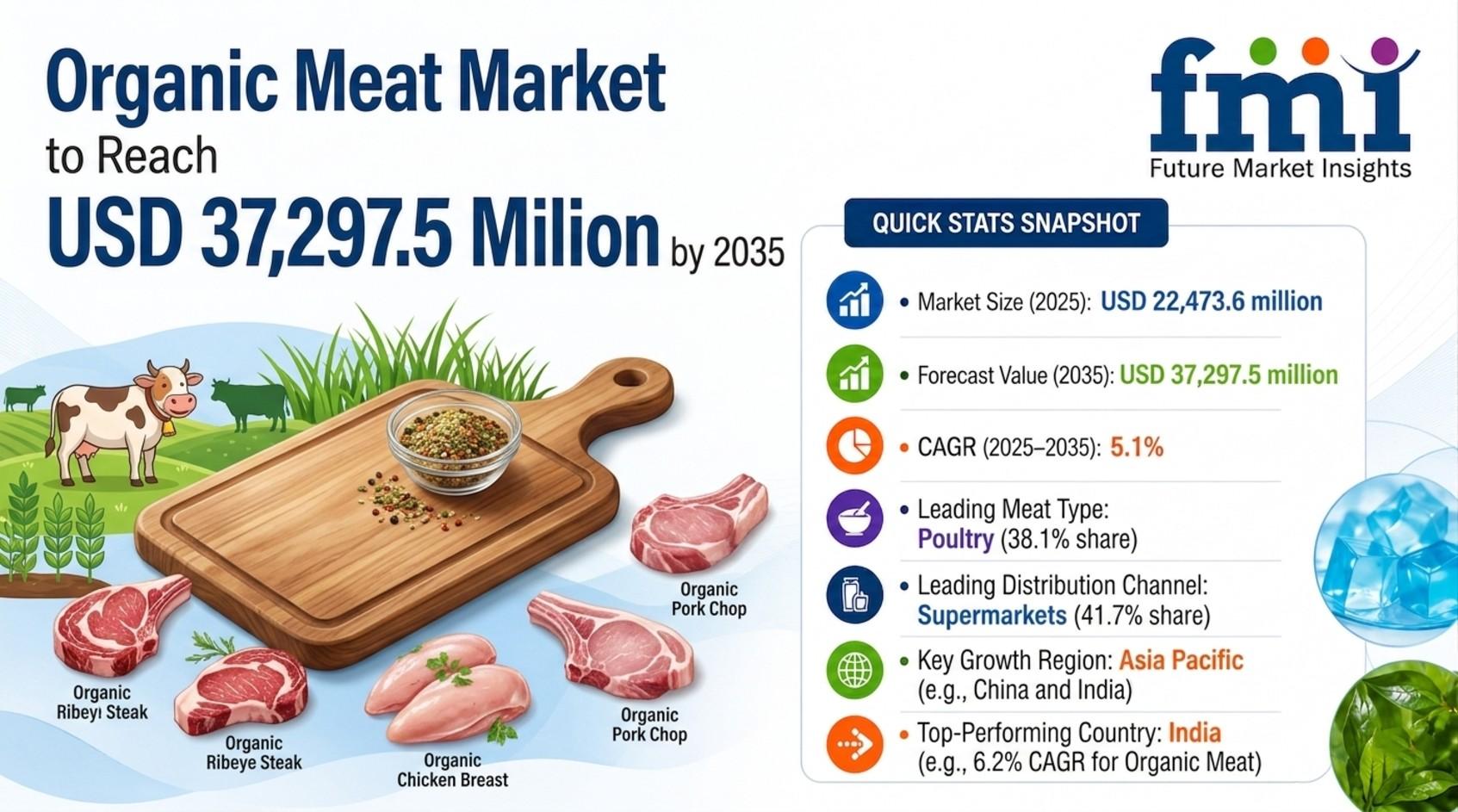
The global organic meat market is experiencing steady growth as health-conscious and environmentally aware consumers actively seek transparency, animal welfare standards, and chemical-free sourcing in their food options, according to latest insights by Future Market Insights. Produced from livestock raised on 100% organic feed without synthetic growth hormones, prophylactic antibiotics, or genetically modified organisms (GMOs), organic meat serves as a premier protein choice worldwide. The global industry, valued at USD 22,473.6 million in 2025, is projected to expand at a Compound Annual Growth Rate (CAGR) of 5.1% over the ten-year forecast period, achieving a total market valuation of USD 37,297.5 million by 2035.
Get detailed market forecasts, competitive benchmarking, and pricing trends:
https://www.futuremarketinsights.com/reports/sample/rep-gb-2502
Market Performance Overview (2025–2035)
To map out the key livestock types, retail distribution channels, and regional demand centers guiding this USD 14.8 billion market scale-up, an analysis of leading segment allocations highlights where global commercial demand is concentrated:
· Poultry Meat Type Segment (38.1% share): Dominates the livestock category in 2025, favored for its affordability, shorter rearing cycles, lower production costs compared to beef or pork, and widespread adoption across global culinary traditions.
· Supermarkets & Hypermarkets Sales Channel (41.7% share): Commands retail distribution, as mass-market grocery chains expand private-label organic meat lines, deploy QR-code-enabled farm-to-shelf traceability, and integrate organic cuts alongside conventional meats.
· Beef and Pork Segments: Experience strong demand in premium butcher shops, subscription meat boxes, and foodservice channels, supported by rising consumer interest in grass-fed and pasture-raised certifications.
Technical Drivers and Supply Chain Dynamics
The integration of organic meat across household retail and commercial foodservice channels is propelled by three primary industry catalysts:
Consumer Concerns Over Antibiotics and Hormones
Escalating awareness regarding antibiotic-resistant bacteria and synthetic growth hormone residues in conventional livestock farming is compelling health-conscious shoppers to trade up to certified organic meats. Consumers view organic certification labels as a proxy for food safety and superior nutritional quality.
Government Policy Incentives and Welfare Regulations
Governments across North America and Europe are fortifying organic livestock certification frameworks. Policies such as the EU Common Agricultural Policy (CAP) subsidies and USDA Organic Program enforcement provide structural financial and regulatory backing for farmers transitioning conventional acreage to organic pasture standards.
Precision Livestock Farming & Digital Traceability
The adoption of precision livestock tracking (IoT sensors, automated herd health monitoring) and blockchain-based QR code labeling allows processors to provide full supply chain transparency. Consumers can verify animal origin, feed credentials, and humane slaughter certifications directly from their smartphones.
Industrial Infrastructure & Production Challenges
Organic meat producers, processors, and retail buyers face specific operational constraints:
· High Production & Organic Feed Costs: Organic animal husbandry requires significantly more land, longer rearing timelines, and certified organic feed (which carries a price premium over standard grain). These factors drive higher retail price points that limit rapid adoption among price-sensitive, mass-market demographics.
· Cold-Chain & Cross-Contamination Management: Preventing cross-contamination in processing facilities that handle both organic and conventional meat requires strict segregation, dedicated equipment cleaning protocols, and uncompromised cold-chain logistics.
Regional Growth Profile
Regional analysis reflects strong, established market leadership in North America and Western Europe alongside rapid, middle-class-driven expansion across East Asia:
· United States (4.9% CAGR): Represents the single largest national market, driven by high per-capita organic food spend, well-established USDA Organic brand trust, and strong penetration across urban supermarkets, specialty delis, and meat subscription services.
· South Korea (4.9% CAGR): Ties for the highest country-level growth rate, supported by younger, digital-first parents purchasing organic poultry and beef via health-focused food e-commerce platforms.
· European Union (4.8% CAGR): Led by Germany, France, the UK (4.7%), and the Netherlands, where EU CAP subsidies, "EU Organic" green leaf labeling, and high consumer commitment to climate-conscious agriculture sustain steady demand.
· Japan (4.6% CAGR): Experiencing steady growth as urban consumers seek clean-label, low-impact protein sources to replace conventional imports.
Competitive Landscape
The global organic meat landscape is moderately consolidated, featuring a combination of specialized organic pioneers, large-scale industrial meat processors deploying organic sub-brands, and regional livestock cooperatives.
Applegate Farms leads the market with an estimated 18–21% market share, recognized for its certified humane poultry, antibiotic-free turkey, and organic sausage SKUs. Tyson Foods (NatureRaised Farms) holds 15–18% share, leveraging national distribution scale and digital traceability. Meyer Natural Foods (12–14% share) specializes in organic grass-fed beef through regenerative grazing initiatives, while Perdue Farms (10–13% share) commands a strong position in organic chicken through no-antibiotics-ever farming. Other key participants holding 34–38% combined share include Niman Ranch, Organic Prairie, Hain Pure Protein, Verde Farms, and Bell & Evans.
Full Report for Detailed Insights: https://www.futuremarketinsights.com/reports/organic-meat-market
Frequently Asked Questions
What is the projected valuation of the global organic meat market by 2035?
The global organic meat market is projected to reach USD 37,297.5 million by 2035, expanding from an estimated baseline valuation of USD 22,473.6 million in 2025 at a CAGR of 5.1%.
Why does Poultry lead the Meat Type segment?
Poultry commands a 38.1% share in 2025 because it is the most affordable, versatile, and widely consumed organic protein, benefiting from shorter production cycles and lower retail price premiums compared to beef or pork.
What exclusions govern the physical boundaries of this market report?
The scope strictly covers certified organic meat products (beef, pork, poultry, mutton). It explicitly excludes uncertified conventional meats, non-meat plant-based protein substitutes (without organic meat content), and livestock feed commodities prior to animal consumption.
Explore More Related Studies Published by FMI Research:
Fish Gelatin Market : https://www.futuremarketinsights.com/reports/fish-gelatin-market
Food and Beverage Additive Market : https://www.futuremarketinsights.com/reports/food-and-beverages-additives-market
Brown Rice Market : https://www.futuremarketinsights.com/reports/brown-rice-market
About Future Market Insights (FMI)
Future Market Insights, Inc. is an ESOMAR-certified, ISO 9001:2015 market research and consulting organization trusted by Fortune 500 companies. With a global presence across the U.S., UK, India, and Dubai, FMI delivers data-driven insights across 30+ industries and 1200 markets worldwide.
Contact Us
Future Market Insights Inc.
Christiana Corporate, 200 Continental Drive,
Suite 401, Newark, Delaware – 19713, USA
T: +1-347-918-3531
For Sales Enquiries: sales@futuremarketinsights.com
Website: https://www.futuremarketinsights.com

 English
 Arabic
 French
 Spanish
 Portuguese
 Deutsch
 Turkish
 Dutch
Dutch
 Russian
 Romaian
 Portuguese (Brazil)
 Greek
Greek
