


Overfitting vs. Underfitting: How to Build Models That Generalize
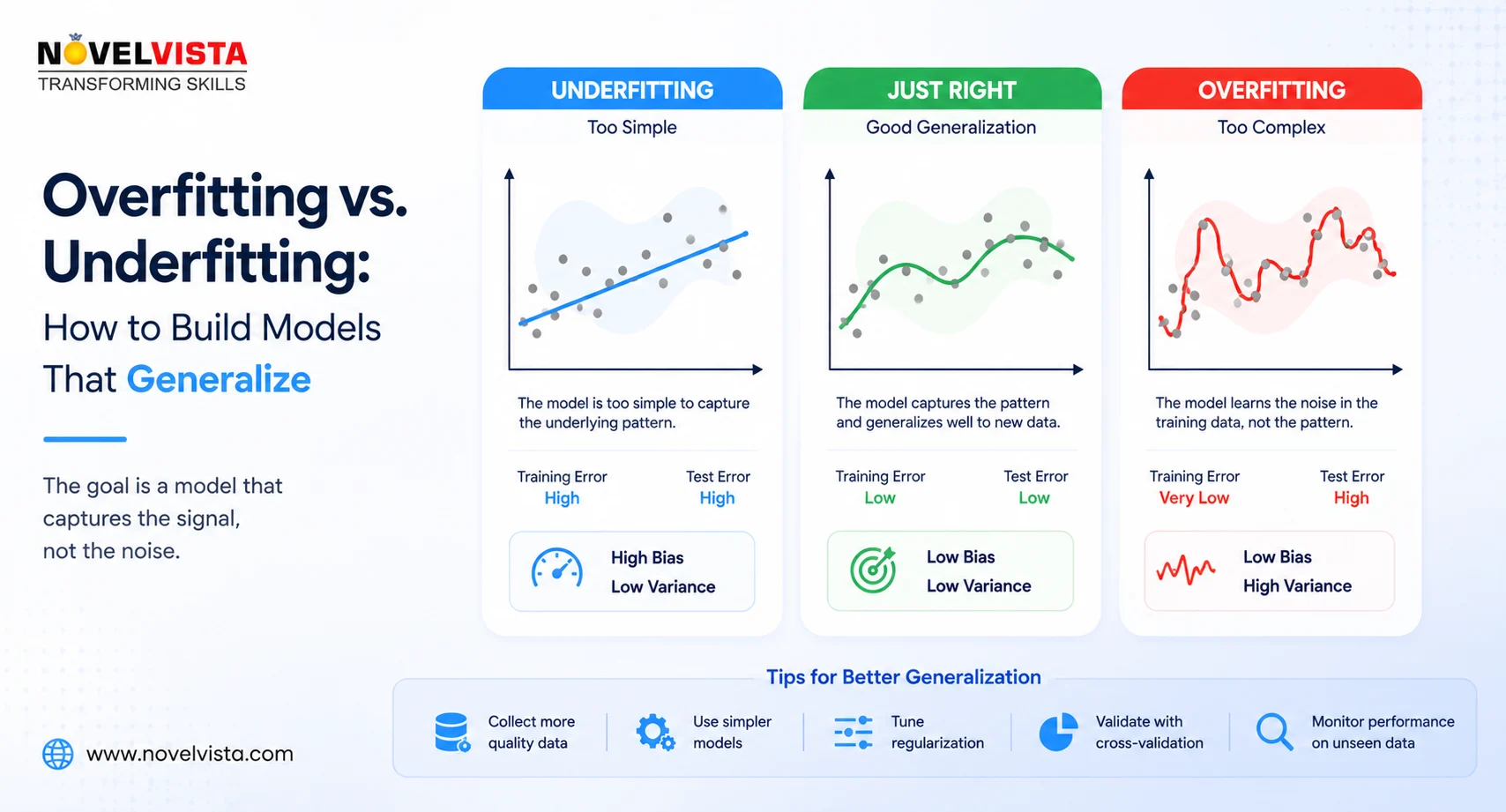
Building a machine learning model is not simply about achieving high accuracy on training data. The real objective is to create a model that performs well on new, unseen information. This ability is known as generalization.
Two of the most common obstacles to generalization are overfitting and underfitting. An overfitted model learns the training data too closely, including its noise and irregularities. An underfitted model fails to learn enough from the data and produces overly simplistic predictions.
Understanding the difference between these problems is essential for developing reliable machine learning systems.
What Is Overfitting?
Overfitting occurs when a model performs exceptionally well on its training data but poorly on validation or test data. The model effectively memorizes the examples it has already seen instead of learning patterns that apply more broadly.
Imagine training a fraud detection model using historical transactions. An overfitted model may learn very specific combinations of transaction amounts, locations, and account details from past fraud cases. When a new fraud pattern appears, the model may fail to identify it because the new transaction does not exactly match what it memorized.
Overfitting is more likely when:
- The model is excessively complex
- The training dataset is too small
- The data contains significant noise
- Too many features are included
- Training continues for too many iterations
- There is insufficient regularization
A common sign of overfitting is a large gap between training performance and validation performance. For example, a model may achieve 98% training accuracy but only 75% validation accuracy.
What Is Underfitting?
Underfitting occurs when a model is too simple to capture the important relationships in the data. It performs poorly on both the training dataset and unseen data.
For example, suppose a company wants to predict customer churn using product usage, support interactions, payment history, contract duration, and customer satisfaction. A model that considers only one variable, such as contract duration, may miss important patterns and deliver weak predictions.
Underfitting can happen when:
- The model is too simple
- Important features are missing
- The training duration is insufficient
- Excessive regularization is applied
- Data relationships are nonlinear, but the model assumes linearity
- Features are poorly prepared or transformed
A model that underfits may show low training accuracy and similarly low validation accuracy. It has not learned enough from the available information.
The Bias-Variance Trade-Off
Overfitting and underfitting are closely connected to the bias-variance trade-off.
Bias refers to errors caused by assumptions that are too restrictive. A high-bias model is usually too simple and is more likely to underfit.
Variance refers to how sensitive a model is to changes in the training data. A high-variance model may perform very differently when trained on a slightly different dataset, making it more likely to overfit.
The goal is not to eliminate bias or variance completely. Instead, model developers must find an appropriate balance where the model is complex enough to identify meaningful patterns but not so complex that it memorizes noise.
How to Detect Overfitting and Underfitting
The most reliable method is to separate data into training, validation, and test datasets.
The training dataset is used to teach the model. The validation dataset supports model selection and hyperparameter tuning. The test dataset provides a final, independent assessment of model performance.
Learning curves can also reveal important patterns. These curves show training and validation performance as the amount of data or number of training iterations increases.
When training performance improves but validation performance begins to decline, overfitting is likely occurring. When both training and validation performance remain poor, the model is probably underfitting.
Cross-validation provides another useful technique. It trains and evaluates the model across different subsets of the dataset, producing a more reliable view of how well the model may perform on unseen data.
How to Reduce Overfitting
One of the most effective ways to reduce overfitting is to collect more training data. A larger and more diverse dataset makes it harder for the model to memorize individual examples.
Regularization is another widely used technique. Methods such as L1 and L2 regularization add penalties for unnecessary complexity, encouraging the model to use simpler patterns.
Other approaches include:
- Removing irrelevant features
- Simplifying the model architecture
- Applying dropout in neural networks
- Using early stopping
- Pruning decision trees
- Performing data augmentation
- Combining models through ensemble methods
Early stopping is particularly useful in deep learning. It monitors validation performance and stops training when the model begins to perform worse on unseen data.
How to Address Underfitting
Underfitting usually requires increasing the model’s learning capacity. This may involve selecting a more sophisticated algorithm, adding useful features, or training for a longer period.
Feature engineering can make a major difference. Raw data may not expose the patterns a model needs. Creating ratios, interaction variables, time-based features, or domain-specific indicators can help the model understand the problem more effectively.
Reducing excessive regularization may also improve performance. If the model is being constrained too heavily, it may not have enough flexibility to capture meaningful relationships.
Building Models That Generalize
A model that generalizes well is developed through continuous experimentation rather than a single training run. Teams must compare algorithms, test feature sets, tune hyperparameters, and evaluate results using consistent metrics.
Data quality is equally important. Even a well-designed algorithm will struggle when the training data is incomplete, biased, outdated, or unrepresentative of real-world conditions.
Model monitoring should continue after deployment. Customer behaviour, market conditions, fraud techniques, and operational processes can change over time. This phenomenon, known as data drift or concept drift, can reduce model accuracy even when the original model was well balanced.
The best machine learning model is therefore not the one that achieves the highest training score. It is the one that delivers stable, reliable performance on data it has never seen before. By managing model complexity, using proper validation methods, improving data quality, and monitoring performance continuously, organizations can build models that provide genuine business value rather than impressive but misleading laboratory results.

 English
 Arabic
 French
 Spanish
 Portuguese
 Deutsch
 Turkish
 Dutch
Dutch
 Italiano
 Russian
 Romaian
 Portuguese (Brazil)
