


Fraud Detection with AI: How Machine Learning Flags Suspicious Transactions
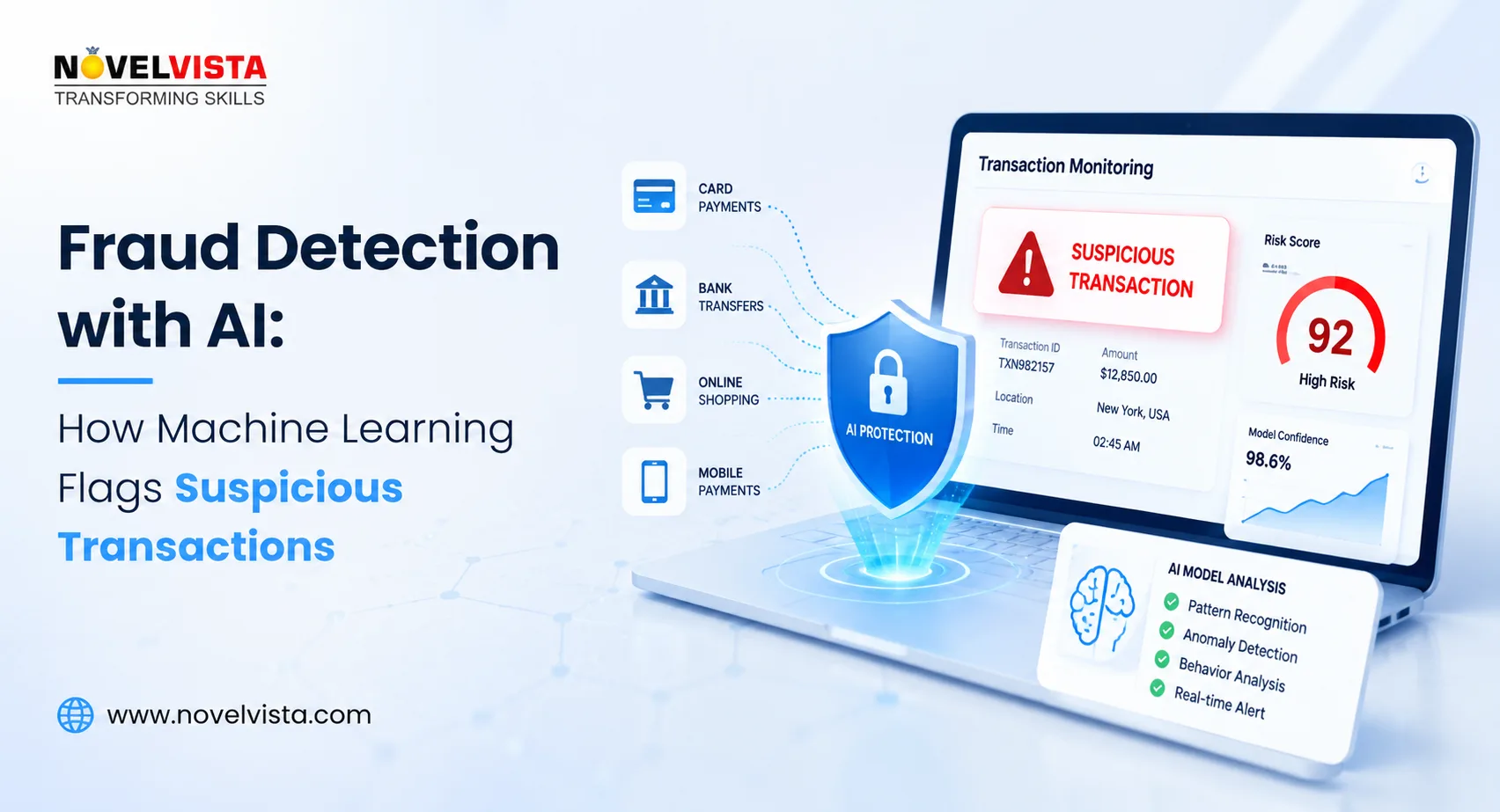
Financial fraud has become faster, more sophisticated, and more difficult to detect using traditional methods alone. As Ai for Finance Professional digital payments, online banking, e-commerce, and mobile wallets continue to grow, organizations must analyze millions of transactions without delaying legitimate customers. This is where artificial intelligence and machine learning are transforming fraud detection.
Instead of relying only on fixed rules, machine learning systems study transaction patterns, identify unusual behavior, and calculate the likelihood that a transaction may be fraudulent. This allows banks, fintech companies, insurers, payment processors, and online marketplaces to respond to suspicious activity in real time.
Why Traditional Fraud Detection Is No Longer Enough
Traditional fraud detection systems typically use predefined rules. For example, a transaction may be flagged when it exceeds a certain amount, originates from a high-risk location, or involves several failed login attempts.
These rules are useful, but they have limitations. Fraudsters quickly learn how to avoid known thresholds. A criminal may deliberately keep transactions below a reporting limit or spread activity across multiple accounts. Rule-based systems can also generate large numbers of false positives, causing legitimate transactions to be blocked.
Machine learning adds a more adaptive layer. It can evaluate hundreds of variables simultaneously and discover relationships that may not be obvious to human analysts.
How Machine Learning Detects Fraud
A fraud detection model is trained using historical transaction data. This data may include previously confirmed fraudulent transactions as well as legitimate ones. The model learns the characteristics associated with each category.
When a new transaction occurs, the system examines factors such as:
- Transaction amount
- Time and location
- Customer spending history
- Device and browser details
- Merchant category
- Login behaviour
- Frequency of recent transactions
- Payment method
- Account age
- Relationships between accounts
The model then assigns a risk score. A low-risk transaction may be approved immediately, while a high-risk transaction may be blocked, delayed, or sent for manual review.
For example, purchasing an expensive electronic device may be normal for one customer but highly unusual for another. The model evaluates the transaction within the context of the individual customer’s past behaviour.
Supervised and Unsupervised Learning
Supervised learning is commonly used when organisations have labelled data showing which past transactions were genuine and which were fraudulent. Algorithms such as logistic regression, decision trees, random forests, gradient boosting, and neural networks can be trained to classify new transactions.
However, supervised learning may struggle with completely new fraud techniques because the model has not seen similar examples before.
Unsupervised learning helps address this challenge. It identifies unusual clusters, anomalies, and behavioural deviations without requiring every transaction to be labelled. If an account suddenly behaves differently from similar accounts, the system may flag it for investigation.
Many modern fraud platforms combine supervised and unsupervised learning to balance known fraud detection with the discovery of emerging threats.
Real-Time Fraud Detection
Speed is critical. A model that detects fraud several hours after a transaction may be too late to prevent financial loss.
Real-time fraud systems process information within milliseconds. They may compare a transaction against historical activity, known fraud patterns, device reputation, location data, and network relationships before approving the payment.
When risk is high, the system can trigger additional authentication, such as a one-time password, biometric check, or customer confirmation. This risk-based approach improves security without creating unnecessary friction for every user.
The Role of Behavioural Analytics
Behavioural analytics focuses on how a person normally interacts with a digital platform. It may examine typing speed, navigation patterns, mouse movement, transaction timing, and device usage.
A fraudster may have valid login credentials, but their behaviour can still appear different from the legitimate account holder. These subtle differences give machine learning systems additional signals that passwords and security questions cannot provide.
Behavioural analysis is particularly useful for detecting account takeover, identity theft, and unauthorized access.
Key Challenges
AI-based fraud detection is powerful, but it is not perfect. Fraud cases are usually rare compared with legitimate transactions, creating an imbalanced dataset. Models must therefore be carefully evaluated so that they do not simply classify nearly everything as legitimate.
False positives are another challenge. Blocking genuine customers can damage trust, reduce sales, and increase support costs.
Data privacy and model explainability are equally important. Organisations must be able to justify why a transaction was flagged, particularly in regulated sectors. Human oversight remains essential for reviewing complex cases and improving model performance.
The Future of AI in Fraud Prevention
Fraud detection is moving toward continuous, adaptive intelligence. Future systems will combine transaction analysis, behavioural biometrics, graph analytics, identity intelligence, and generative AI-assisted investigations.
Graph-based machine learning is especially promising because it can reveal hidden relationships between accounts, devices, merchants, and payment methods. Instead of evaluating transactions independently, organisations can identify organised fraud networks.
Ultimately, AI does not replace fraud analysts. It helps them focus on the highest-risk cases, investigate faster, and respond with better evidence.
As fraud techniques evolve, machine learning provides organisations with the speed, scale, and adaptability required to protect customers while maintaining a smooth digital experience.

 English
 Arabic
 French
 Spanish
 Portuguese
 Deutsch
 Turkish
 Dutch
Dutch
 Italiano
 Russian
 Romaian
 Portuguese (Brazil)
