


How Does WhatsApp Cloud API Support Business Growth and Automation?
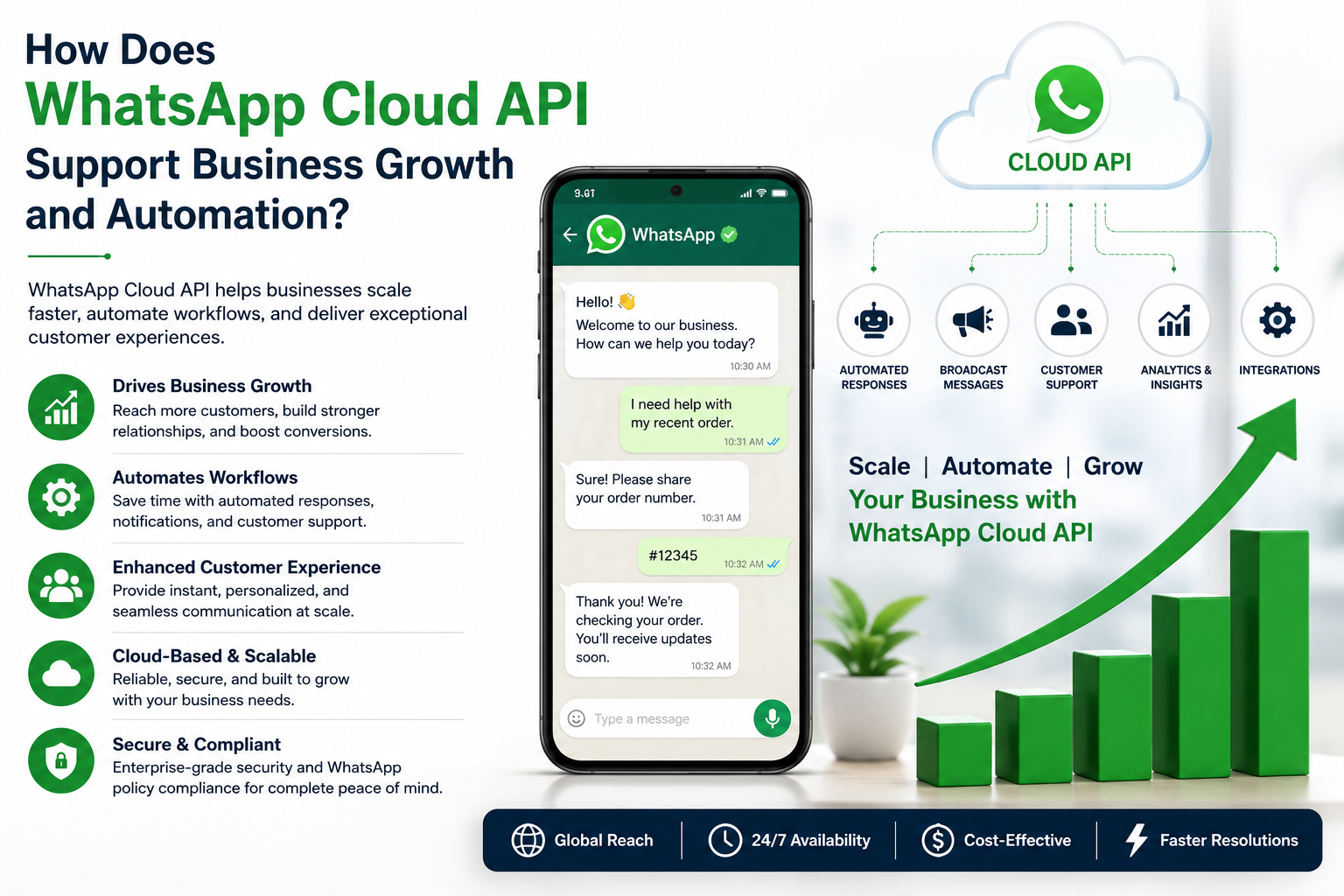
WhatsApp has transformed from a personal messaging application into a powerful business communication platform. With 3.3 billion monthly active users and 98% message open rates, it has become the default customer communication channel for businesses across India, Brazil, Indonesia, Mexico, UAE, Spain, and most of the rest of the world. The WhatsApp Cloud API represents a fundamental shift in how enterprises can leverage this platform at scale, enabling seamless integration with existing business systems while automating customer interactions.
The WhatsApp Cloud API is an interface that allows developers direct access to data in WhatsApp's cloud. With this API, companies can integrate various functions into their applications, such as sending and receiving messages, retrieving profile information, and managing group chats within the WhatsApp Business Platform. As businesses increasingly recognize the value of WhatsApp for customer engagement, understanding how to effectively implement and utilize the Cloud API has become essential for competitive advantage.
Understanding WhatsApp Cloud API
What Is WhatsApp Cloud API?
WhatsApp Cloud API is Meta's hosted version of the WhatsApp Business API. Since October 2025, it is the only option for new integrations after the on-premise API was deprecated. Cloud API supports up to 500 messages per second with no self-hosted infrastructure required.
This represents a significant evolution in WhatsApp's enterprise offerings. Unlike the deprecated on-premises solution, the Cloud API eliminates the need for businesses to maintain their own infrastructure, making enterprise-grade messaging accessible to organizations of all sizes.
Key Differences from Previous Solutions
WhatsApp Business API is a paid, per-message platform that lets medium-large businesses run WhatsApp at scale — multi-agent, automated, CRM-integrated — unlike the single-device Business App. The shift to cloud-based infrastructure ensures automatic updates, enhanced security, and reliable uptime without requiring dedicated IT resources.
Business Growth Opportunities with WhatsApp Cloud API
Market Expansion and Revenue Potential
The financial opportunity presented by WhatsApp Cloud API is substantial. A 2025 Juniper Research study estimates that business messaging on WhatsApp will generate $3.6 billion in revenue by 2028. This projection reflects the growing recognition among enterprises that WhatsApp represents a critical channel for customer engagement and revenue generation.
The WhatsApp Business API platform is projected to grow at an annual growth rate of around 20.7% between 2025 and 2033, reflecting rising demand for scalable real-time messaging solutions that support richer business interactions. This growth trajectory positions early adopters to capture market share and establish stronger customer relationships.
Enhanced Customer Engagement
WhatsApp's exceptional engagement metrics make it invaluable for business growth. WhatsApp Business Platform processes over 100 million messages daily across businesses worldwide, demonstrating the platform's capacity and reliability at enterprise scale.
The high open rates and click-through rates enable businesses to achieve significantly better engagement compared to traditional communication channels. This improved engagement translates directly into increased conversion rates, higher customer retention, and improved customer lifetime value.
Multi-Channel Communication Strategy
The Cloud API enables businesses to integrate WhatsApp into a comprehensive omnichannel communication strategy. By 2026, most enterprises use Meta's Cloud API in a layered setup that's easier to maintain over time. WhatsApp-specific logic stays separate from core business systems, letting teams tweak and improve things without breaking everything else.
This architectural approach provides flexibility, scalability, and resilience while allowing teams to continuously optimize their WhatsApp strategy independently of core business systems.
Automation Capabilities: Driving Operational Efficiency
The Automation Revolution in Retail and Services
Automation represents one of the most powerful features of WhatsApp Cloud API for business growth. Over 53% of retailers now automate WhatsApp messaging, often using bots for FAQs, order tracking, and returns. This widespread adoption reflects the significant operational efficiencies and customer satisfaction improvements that automation delivers.
Advanced Chatbot Features
The WhatsApp Business API supports full chatbot automation including FAQ deflection, lead qualification, order tracking, abandoned cart recovery, appointment booking, and catalog browsing. Most BSPs provide visual chatbot builders plus webhook layers for custom logic.
These automation capabilities allow businesses to handle routine customer interactions 24/7 without human intervention, freeing support teams to focus on complex issues and high-value customer interactions. The ability to seamlessly escalate conversations from chatbots to human agents creates a superior customer experience while maintaining operational efficiency.
Intelligent Message Templates
You can also set up automated messages to answer frequently asked questions and improve customer service via WhatsApp. This strengthens customer loyalty and helps boost sales. You can share special offers and discounts to attract customer interest and drive conversions.
Template-based messaging enables personalized communication at scale. November 1, 2024 — Service conversations became free and unlimited. Previously, businesses got a limited number of free customer-service conversations per month and paid after that. That cap was removed entirely, meaning most customer support interactions on WhatsApp are now free.
This pricing shift significantly improves the economics of customer service automation, making WhatsApp an increasingly attractive channel for support operations.
Implementation and Pricing Models
Current Pricing Structure
Understanding WhatsApp Cloud API pricing is essential for budgeting and ROI calculations. July 1, 2025 — Per-conversation billing for template messages ended. Service conversations became free and unlimited (since Nov 2024). Marketing/Utility/Authentication templates are billed per message by category + country (since July 2025).
This per-template-message billing model provides greater transparency and predictability compared to previous conversation-based pricing, allowing businesses to accurately forecast costs based on message volume and type.
Getting Started: The Setup Process
Any business with more than one customer-service agent or volumes above 500 messages/month should use the API. The setup process involves working with a Business Solution Provider (BSP) to configure the necessary components for go-live.
Businesses must establish a Meta Business account, create a WhatsApp Business app, verify their business identity, and configure message templates before launching. This process ensures compliance and proper business verification, which is essential for maintaining the trust of customers and avoiding potential restrictions.
Choosing the Right Business Solution Provider
Unlike the free Business App, the API supports unlimited agents, automation, and compliant broadcasts. You need a BSP (Business Solution Provider) like Ominiflow for inbox, chatbots, and onboarding — Meta has no end-user dashboard.
Selecting an appropriate BSP is crucial, as these providers offer the practical tools and interfaces necessary to effectively manage WhatsApp messaging, automation, and customer interactions. The right BSP can dramatically accelerate implementation and improve long-term success.
Future Growth and Innovation
Expected API Enhancements
Enhanced Automation and Personalization: Upcoming WhatsApp API improvements will offer more AI-driven automation, enabling businesses to deliver personalized, real-time interactions. Deeper E-Commerce Capabilities: The API is likely to support in-chat shopping features, such as carts, restock notifications, and personalized product pushes, further turning WhatsApp into a commerce platform.
These anticipated enhancements promise to expand WhatsApp's utility beyond messaging into full-fledged commerce and engagement platforms, creating new revenue opportunities for forward-thinking businesses.
Cloud Infrastructure Expansion
Cloud API Adoption and Scalability: More businesses will move to WhatsApp's cloud-based API, providing higher reliability, better uptime, and easier scalability for large message volumes without heavy infrastructure.
The continued evolution of cloud infrastructure ensures that WhatsApp remains a viable solution regardless of business scale or growth trajectory.
Best Practices for Success
Building for Scale and Compliance
At minimum, developers, marketing, and compliance teams should collaborate. This ensures the system is useful, compliant, and maintainable. Successful implementations require cross-functional coordination and a commitment to building sustainable systems from the outset.
Long-Term Strategic Approach
Teams seeing the best results treat WhatsApp as a long-term engagement channel, not a quick win. They invest in clean API architecture and cover the basics. Consent and privacy rules are followed closely.
Businesses that approach WhatsApp Cloud API strategically, with proper architecture and compliance frameworks in place, realize significantly better returns than those seeking quick implementations.
Conclusion: The Strategic Imperative
WhatsApp Cloud API represents far more than an incremental improvement in business messaging capabilities. It is a fundamental transformation of how enterprises communicate with customers at scale. The combination of exceptional engagement metrics, advanced automation capabilities, flexible pricing, and cloud-based reliability creates a compelling business case for adoption.
Meta's documentation reports that WhatsApp Business Platform processes over 100 million messages daily across businesses worldwide, demonstrating both the proven capability and the competitive necessity of this platform. As businesses across industries recognize WhatsApp's strategic value, early adopters who build robust, compliant, and well-architected implementations will establish competitive advantages that compound over time.
The convergence of powerful automation, robust API capabilities, transparent pricing, and massive user base positions WhatsApp Cloud API as an essential component of modern business communication strategy. Organizations that thoughtfully implement WhatsApp Cloud API with clear business objectives, appropriate resources, and a commitment to customer experience will unlock significant growth opportunities and operational efficiencies that directly impact revenue and profitability.

 English
 Arabic
 French
 Spanish
 Portuguese
 Deutsch
 Turkish
 Dutch
Dutch
 Italiano
 Romaian
 Portuguese (Brazil)
 Greek
Greek
