


A Practical Guide to Aviation and Navigation Antennas (ILS, DME, ADS-B)
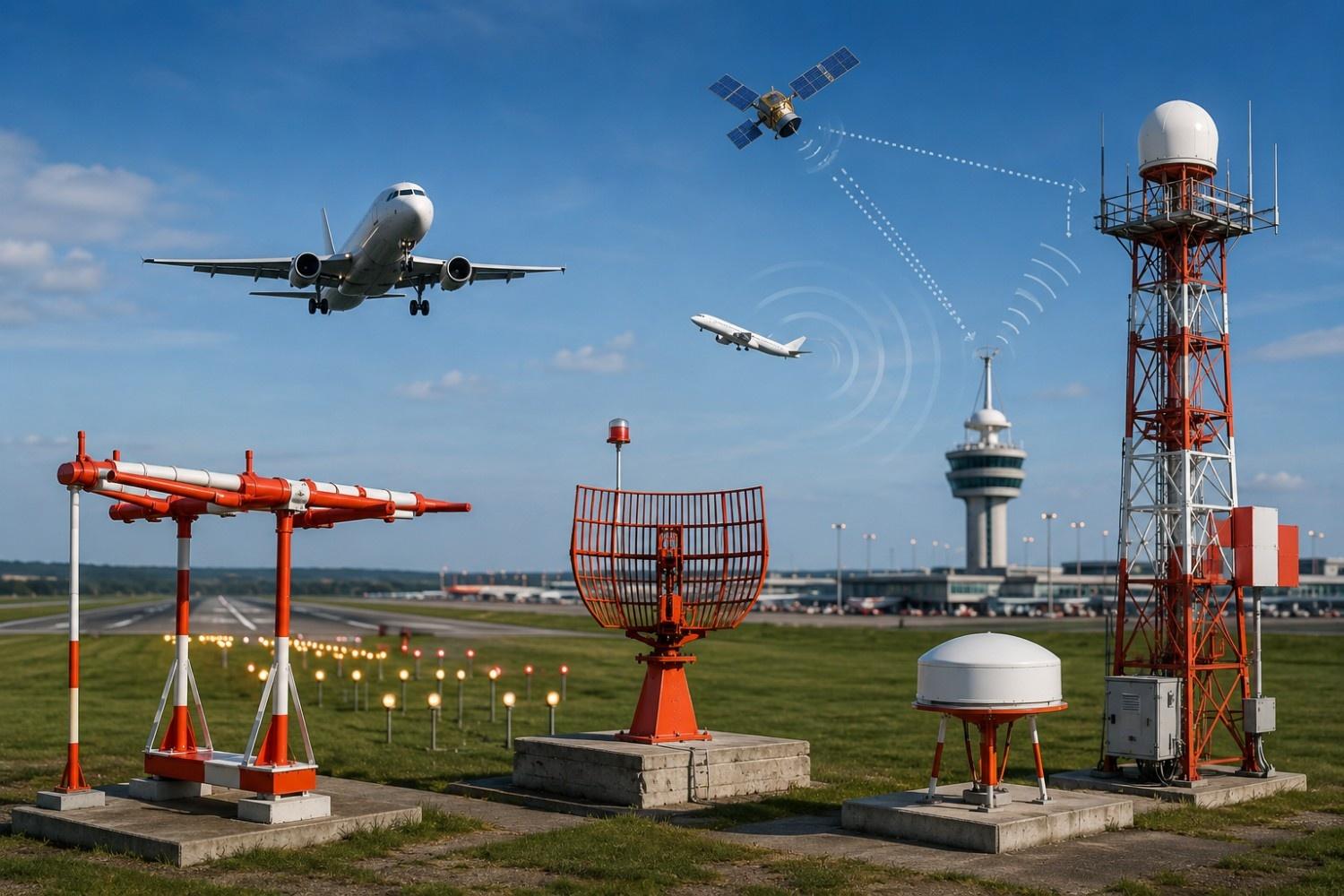
Aviation and navigation antennas help aircraft communicate with ground systems and navigate safely during every stage of a flight. Some of the most important antennas are the Instrument Landing System (ILS) antenna, Distance Measuring Equipment (DME) antennas, and Automatic Dependent Surveillance-Broadcast antennas. All these antennas are very helpful in aviation and navigation in airports and other situations.
ILS antennas guide aircraft during landing. DME antennas measure the distance between an aircraft and a ground station. And ADS-B antennas give aircraft position and flight data for air traffic monitoring. Together, these antennas support air traffic management at airports and across airspace worldwide.
What Are Aviation and Navigation Antennas (ILS, DME, ADS-B)?
Pilots need to know where they are and where they are going. Without this knowledge, they cannot succeed on any mission. Proper information ensures they can land safely even when they can barely see the runway. That is why ILS, DME, and ADS-B antennas come in. Each one does a different job. These antennas help in aviation and navigation; that is why they also come in the categories of aviation and navigation antennas (ILS, DME, and ADS-B).
ILS stands for Instrument Landing System. It's a ground setup that helps guide a plane down the right path toward the runway. DME, or Distance Measuring Equipment, tells the aircraft how far it is from a ground station at any given moment. ADS-B works differently. Short for Automatic Dependent Surveillance-Broadcast, it sends out the plane's position. It tells altitude, and speed so air traffic control and other aircraft can see exactly where it is in real time.
Put together, these three antennas play a crucial role in keeping flights on track and airspace organized. They are a very reliable wireless solution when the weather turns bad or the skies get crowded. The support of these antennas prevents any potential and expected accidents and protects the public and the aircraft as well.
How Do ILS, DME, and ADS-B Antennas Work?
Each system uses its own kind of signal and its own antenna design.
ILS antennas send out two signals. One is called the localizer, and it tells the plane if it's lined up properly with the center of the runway. The other is the glide slope. It controls the angle of descent. The aircraft picks up both signals and stays on the correct path. It can be provided either through automatic adjustments or the pilot's own inputs.
DME works like a question-and-answer. The plane sends a signal, the ground station sends one back, and the time it takes to go back and forth tells the aircraft how far away it is. This keeps happening throughout the flight, so the cockpit always has an updated distance reading.
ADS-B doesn't ask questions at all, it just broadcasts. The plane pulls its own position from GPS and sends that data out to anyone listening, ground stations included. No back-and-forth needed. That's a big reason ADS-B has taken over from older radar-based tracking in a lot of modern airspace.
Key Features of Aviation and Navigation Antennas
A few things really matter here. First is getting the frequency exactly right, since even a small error can throw off a distance reading or a landing signal. ILS runs on VHF, DME runs on UHF, and ADS-B usually sits at 1090 MHz. Each antenna has to be built for its exact frequency.
Toughness is just as important. These antennas sit on the outside of planes or on ground equipment, dealing with heat, cold, vibration, moisture, and sometimes de-icing chemicals. They need solid housing and good weatherproofing to survive years of that kind of punishment.
Signals also need to come through clean, even with interference around. Airports are packed with radio equipment running at the same time, so these antennas need good shielding and filtering to avoid picking up noise from everything else nearby.
And finally, they need to meet aviation standards. Certifications from groups like the FAA, EASA, or ICAO show that an antenna is trusted and authentic. It indicates that it meets the safety bar required for real-world use in controlled airspace.
Applications of ILS, DME, and ADS-B Antennas
Airports install ILS antennas to help planes land safely, especially in fog. Whenever there is heavy weather, or at night when the runway isn't easy to see, antennas help pilots in safe landing. Both commercial airports and military airfields depend on ILS to keep landings safe no matter the conditions.
DME antennas help during the whole flight, not just the landing. Pilots use the constant distance readings to plan things like descent timing, holding patterns, and fuel needs.
ADS-B has become close to standard now, thanks to rules in places like the US and Europe requiring it on most aircraft. Air traffic controllers get a much clearer picture of where planes actually are compared to older radar, and pilots get a better sense of what's flying nearby too.
Military and government aircraft use all three types too, often with extra ruggedness or custom frequencies built for specific missions.
Why Choose Antenna Experts for Aviation and Navigation Antennas?
Antenna Experts has spent decades working in RF engineering, building aviation antennas made for the demands of ILS, DME, and ADS-B systems. Every antenna is built to hit the right frequency. Our antennas survive tough conditions, and keep working reliably through heat, cold, and vibration.
The company works with airports, aviation authorities, defense groups, and system integrators, offering both ready-made antennas and custom builds for specific platforms or mounting needs. Antenna Experts stick to recognized aviation and quality standards, so customers can trust the performance over the long run.
If you're looking for solid navigation and surveillance antennas, Antenna Experts has the engineering background and manufacturing know-how to back up critical aviation projects.
FAQ
What is the difference between DME and ADS-B?
DME figures out the distance between a plane and a ground station by sending a signal back and forth. ADS-B just broadcasts the plane's GPS position, altitude, and speed, no back-and-forth needed, so air traffic control and other aircraft can track it directly.
Why is ILS important for landing in poor weather?
ILS gives pilots exact guidance, left-right and up-down, toward the runway. That makes it possible to land safely even when it's too foggy or dark to see the runway by eye.
Do all aircraft need ADS-B antennas?
In a lot of places now, the rules require ADS-B on most commercial and general aviation planes flying in controlled airspace. It's become pretty close to standard equipment.

 English
 Arabic
 French
 Spanish
 Portuguese
 Turkish
 Dutch
Dutch
 Italiano
 Russian
 Romaian
 Portuguese (Brazil)
 Greek
Greek
