


In-Wall Digital Timer Market to Reach USD 883 Million by 2034
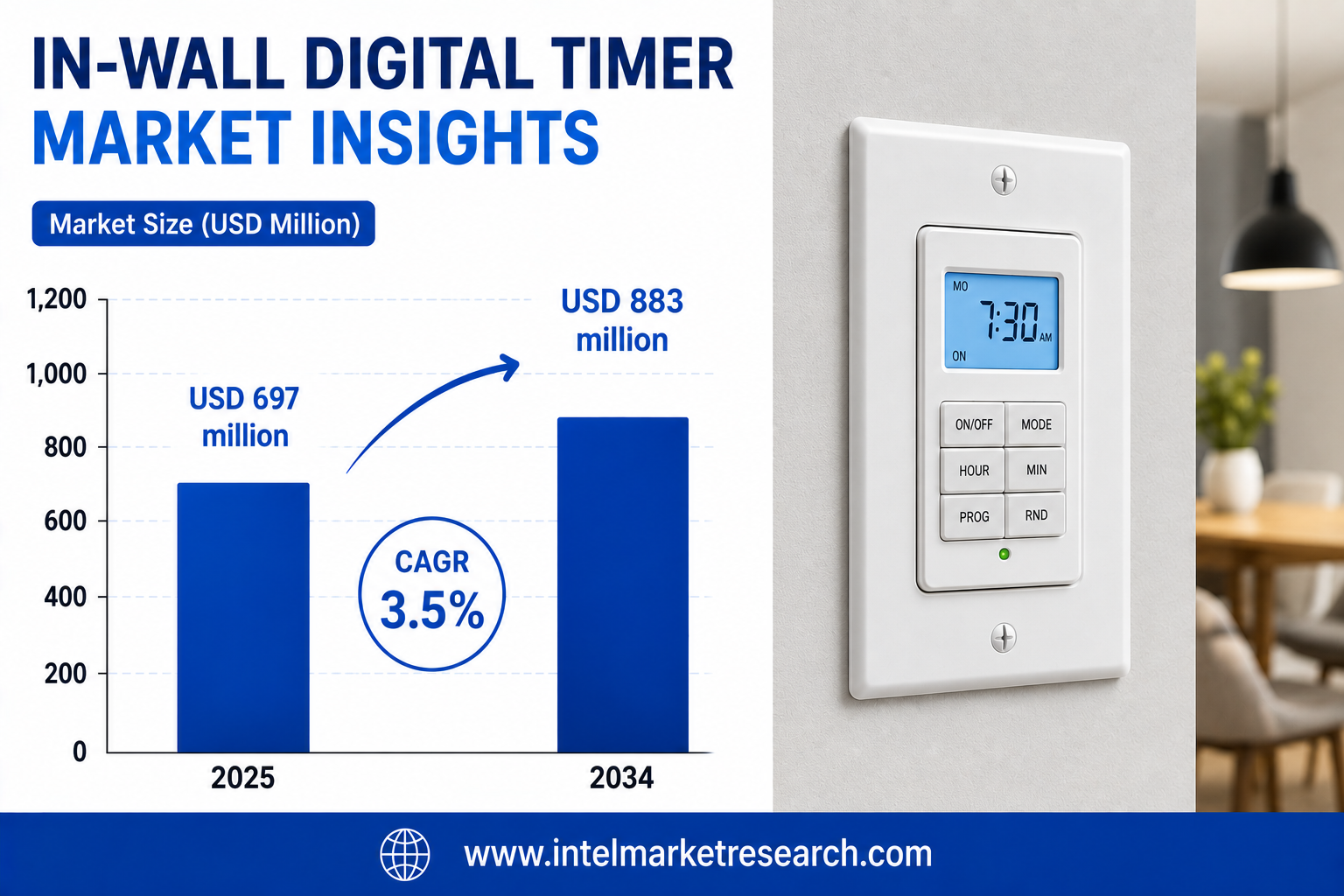
According to a new report from Intel Market Research, the global In‑Wall Digital Timer market was valued at USD 697 million in 2025 and is projected to reach USD 883 million by 2034, growing at a robust CAGR of 3.5 % during the forecast period (2025–2034). This growth is driven by the accelerating focus on energy efficiency, rapid adoption of smart‑home technologies, and increasingly stringent building‑code requirements that favour automated lighting control.
In‑Wall Digital Timers are integrated timing devices installed within wall boxes; they enable automated on/off control of lighting and electrical loads according to programmable schedules. Featuring digital displays, adjustable settings and precise timing, these units blend seamlessly into residential, commercial and light‑industrial interiors while supporting energy‑saving and security functions.
📥 Download FREE Sample Report:
In‑Wall Digital Timer Market - View in Detailed Research Report
What is an In‑Wall Digital Timer?
An In‑Wall Digital Timer is a concealed, programmable electronic controller that resides inside a standard electrical wall box. Unlike traditional plug‑in timers, it connects directly to a building’s wiring, allowing precise scheduling of lighting, HVAC, and other electrical loads without visible hardware on the surface. The devices typically incorporate a microcontroller, a digital display, and optional connectivity modules (Wi‑Fi, Ethernet, or Zigbee) that facilitate remote programming through smartphone apps or building‑automation platforms. By automating on/off cycles, the timers help reduce standby power, extend equipment lifespan, and provide enhanced security through timed illumination.
Market Overview
The upward trajectory of the In‑Wall Digital Timer market stems from a confluence of macro‑level forces. Energy‑efficiency legislation in many jurisdictions now mandates automated lighting controls for new constructions and major retrofits. Simultaneously, the smart‑home movement has shifted consumer expectations toward seamless, invisible automation that integrates with voice assistants and mobile ecosystems. Leading manufacturers such as Honeywell, Leviton and Schneider Electric have responded with product portfolios that feature higher amperage ratings, enhanced connectivity, and modular firmware updates, thereby expanding the addressable market across residential, commercial and light‑industrial segments.
Supply‑chain dynamics also play a pivotal role. The stability of microcontroller and IC supplies directly influences unit cost structures, while price fluctuations in these components affect the overall profitability of timer assemblers. Despite occasional volatility, the industry has demonstrated resilience through component consolidation and the adoption of integrated system‑on‑chip solutions that reduce bill‑of‑materials complexity.
Key Market Drivers
1. Growing Adoption in Smart Homes
Builders and retrofit contractors are installing In‑Wall Digital Timer solutions to synchronize lighting, HVAC, and appliance cycles. This integration reduces peak demand while delivering measurable utility‑bill reductions. The trend is underpinned by a clear return‑on‑investment narrative for property owners, who benefit from lower energy consumption and enhanced occupant comfort.
2. Regulatory Incentives for Energy Efficiency
Municipal and national building codes increasingly require timers or occupancy sensors in new commercial and multi‑family projects. These mandates generate a steady pipeline of projects that directly feed the In‑Wall Digital Timer market, as developers prefer wall‑mounted solutions to meet compliance without extensive rewiring.
➤ “Timer‑based controls have become the default baseline for any energy‑conscious construction, setting a new standard for building automation.”
3. Remote Programmability and Predictive Maintenance
The ability to program timers remotely via Wi‑Fi or wired Ethernet enables facility managers to implement predictive maintenance strategies. Real‑time data visibility supports more efficient resource allocation, reinforcing the business case for wider deployment across both new builds and existing assets.
Market Challenges
Installation Complexity
Unlike plug‑in timers, wall‑mounted units demand precise wiring, conduit planning, and sometimes structural modifications. Smaller contractors lacking dedicated electrical teams may hesitate, slowing market penetration in the residential segment.
Cost Sensitivity
The upfront price of a digital timer with advanced connectivity often exceeds that of conventional mechanical timers. Buyers focused on short‑term capital expenditure may defer adoption until total cost‑of‑ownership calculations become clearer.
Supply‑Chain Volatility
Fluctuations in semiconductor component lead times introduce uncertainty for distributors, compelling them to hold excess inventory or risk stock‑outs, both of which add friction to the sales cycle.
Market Restraints
Limited Consumer Awareness
A sizable portion of end‑users remain unaware of the performance advantage wall‑mounted timers have over legacy solutions. This knowledge gap depresses demand, especially in markets where DIY upgrades dominate.
Compatibility Issues
Integration with legacy building‑management systems can require proprietary adapters or custom firmware, increasing perceived complexity and deterring technically proficient buyers.
Emerging Opportunities
Integration with IoT Platforms
Cloud‑enabled timers that expose RESTful APIs unlock new revenue streams through subscription‑based analytics services. Companies that bundle hardware with a SaaS layer can differentiate themselves and command premium pricing.
Large‑Scale Retrofits for ESG Targets
Corporations pursuing environmental‑social‑governance (ESG) objectives are retrofitting aging office parks with granular energy controls. In‑Wall Digital Timers, centrally managed via cloud dashboards, present a cost‑effective pathway to achieve load‑shifting goals without massive capital outlays.
Emerging Markets and Smart‑Grid Initiatives
Countries with aggressive electrification agendas are poised to adopt timer technology as part of national smart‑grid strategies. Early entrants that localize firmware and support regional communication standards stand to capture a disproportionate share of future sales.
Regional Market Insights
-
North America: The largest market in 2025, driven by stringent building codes, mature consumer demand for convenience, and a robust distribution network. Voice‑controlled ecosystems and modular firmware updates are key adoption enablers.
-
Europe: Dominant market share with a strong focus on nearly zero‑energy building (nZEB) mandates. Open‑source protocols such as KNX and Zigbee are widely supported, fostering interoperability across the continent.
-
Asia‑Pacific: Fastest‑growing region, fueled by rapid urbanization, emerging energy‑code requirements, and a split between cost‑sensitive mass markets and high‑precision premium segments in Japan.
-
Latin America: Growth supported by government incentives for energy conservation and an expanding middle class that values convenience. Brazil leads in multi‑family adoption, while Mexico remains nascent.
-
Middle East & Africa: Divergent dynamics; luxury real‑estate projects in the GCC integrate feature‑rich timers, whereas African markets prioritize basic electricity‑management solutions for commercial facilities.
Market Segmentation
By Type
-
18‑Hour In‑Wall Digital Timer
-
24‑Hour In‑Wall Digital Timer
-
Other Timer Configurations
By Application
-
Residential
-
Commercial
-
Industrial
-
Others
By End User
-
Homeowners
-
Facility Managers
-
Electrical Contractors
By Functionality
-
Energy Management
-
Lighting Control
-
Security Integration
-
Others
By Installation Environment
-
New Construction
-
Renovation Retro‑fit
-
Smart‑Home Integration
-
Others
Competitive Landscape
Honeywell continues to dominate revenue generation in the global arena, leveraging its extensive distribution network and deep integration with building‑automation platforms. Its portfolio, anchored by the XTR series, blends microcontroller robustness with flexible programming, allowing large‑scale commercial developers to standardize timing solutions across multiple sites. Leviton, while trailing Honeywell in absolute sales, commands a sizable share through aggressive OEM partnerships that embed its timers in residential retrofit kits.
The market structure reflects a tiered concentration: a handful of multinational manufacturers control the bulk of unit volumes, while mid‑size assemblers such as Intermatic and Theben occupy niche segments focused on specialty applications like HVAC sequencing and low‑voltage lighting control. This stratification creates clear entry barriers for newcomers, as scale economies and certification regimes favor established players.
Beyond the top tier, a diverse set of manufacturers competes on differentiation rather than sheer volume. Schneider Electric’s EcoStruxure‑aligned timers appeal to smart‑building projects that require seamless IoT connectivity, whereas Panasonic’s emphasis on compact form factors suits high‑density housing retrofits. European specialist Hugo Müller has cultivated a reputation for rugged enclosures suitable for industrial light‑maintenance facilities, and Enerlites differentiates through ultra‑low‑power consumption modules that attract energy‑management consultants. Regional challengers such as Hager (Germany) and BN‑LINK (Spain) focus on localized code compliance and rapid after‑sales service, while emerging entrants like MTLC and Mayer Electric target price‑sensitive markets in South‑East Asia with stripped‑down designs.
List of Key In‑Wall Digital Timer Companies Profiled
-
Honeywell
-
Intermatic
-
Schneider Electric
-
Hugo Müller
-
Enerlites
-
Theben
-
Eaton
-
Hager
-
BN‑LINK
-
Mayer Electric
-
MTLC
Report Deliverables
-
Global and regional market forecasts from 2025 to 2034
-
Strategic insights into technology adoption, regulatory trends, and supply‑chain dynamics
-
Competitive profiling of 14+ key players, including revenue estimates, product portfolios, and recent strategic moves
-
SWOT analysis for leading manufacturers and emerging entrants
-
Pricing trends, cost‑structure breakdowns, and profitability benchmarks
-
Comprehensive segmentation by type, application, end user, functionality and installation environment
-
Investment hotspot identification across North America, Europe and Asia‑Pacific
-
Actionable recommendations for product development, partnership models and market‑entry strategies
📘 Get Full Report Here:
In‑Wall Digital Timer Market - View Detailed Research Report
About Intel Market Research
Intel Market Research is a leading provider of strategic intelligence, offering actionable insights in biotechnology, pharmaceuticals, and healthcare infrastructure. Our research capabilities include:
-
Real-time competitive benchmarking
-
Global clinical trial pipeline monitoring
-
Country-specific regulatory and pricing analysis
-
Over 500+ healthcare reports annually
Trusted by Fortune 500 companies, our insights empower decision‑makers to drive innovation with confidence.
🌐 Website: https://www.intelmarketresearch.com
📞 Asia‑Pacific: +91 9169164321
🔗 LinkedIn: Follow Us

 English
 Arabic
 Spanish
 Portuguese
 Deutsch
 Turkish
 Dutch
Dutch
 Italiano
 Russian
 Romaian
 Portuguese (Brazil)
 Greek
Greek
