


Anomaly Detection in AIOps: Spotting Problems Before Users Notice
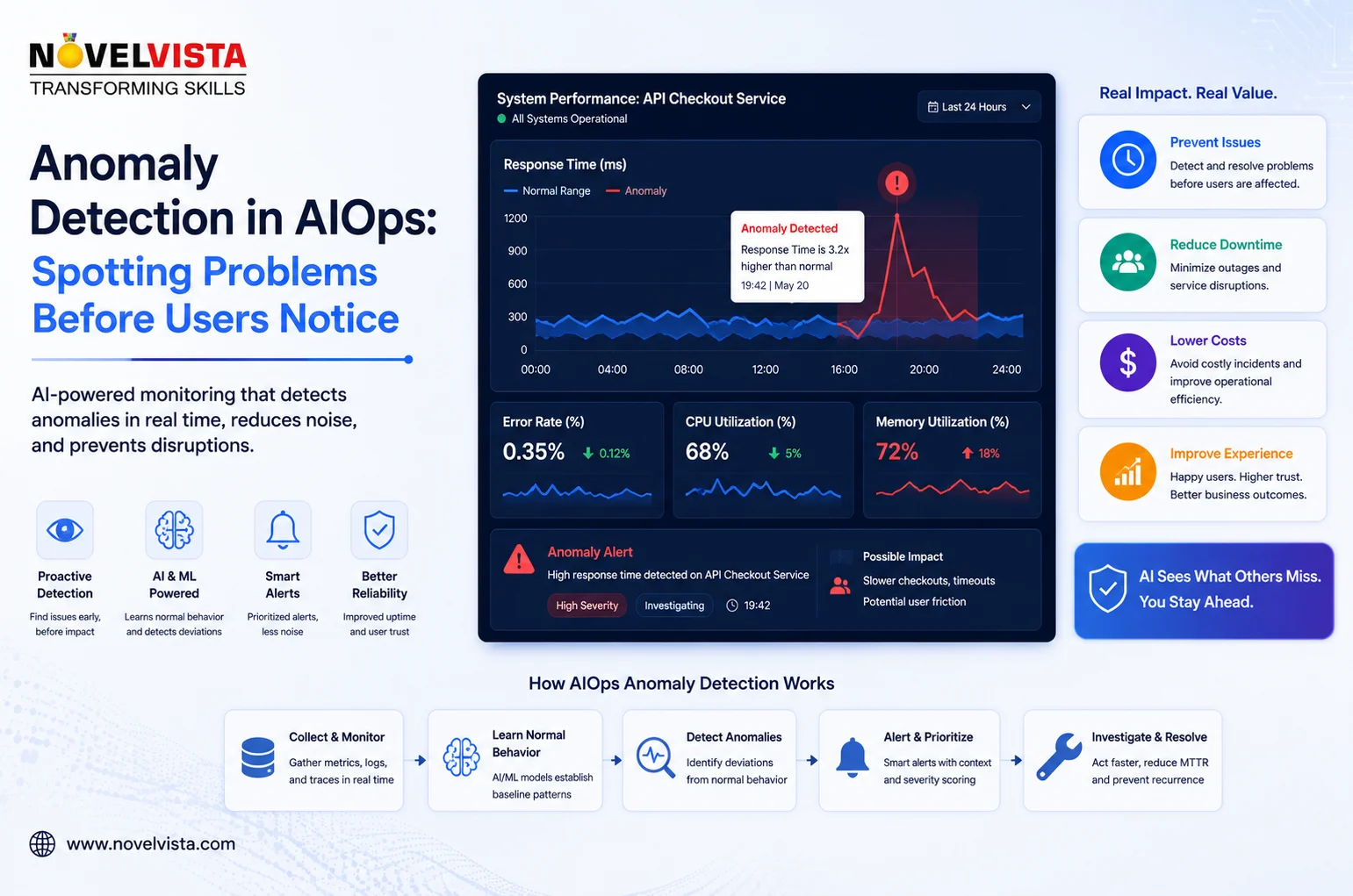
Modern IT environments generate enormous volumes of operational data every second. Applications, servers, containers, cloud platforms, databases, networks, and security systems continuously produce logs, metrics, traces, alerts, and events.
For operations teams, the challenge is no longer collecting data. The real challenge is identifying which signals indicate an emerging problem.
Traditional monitoring systems depend heavily on fixed thresholds. An alert may be triggered when CPU utilization exceeds 90%, response time rises above two seconds, or disk usage reaches a predefined limit. Although these rules are useful, they often fail to detect unusual behaviour that does not cross a static threshold.
Anomaly detection in AIOps provides a more adaptive approach. It uses statistical methods and machine learning to identify patterns that differ from normal system behaviour. This helps IT teams detect problems earlier, reduce alert noise, and respond before customers experience a visible service disruption.
What Is Anomaly Detection in AIOps?
Anomaly detection is the process of identifying data points, events, or behaviours that significantly differ from an expected pattern.
In an AIOps environment, anomalies may include:
- A sudden increase in application latency
- An unexpected decline in transaction volume
- Unusual memory consumption
- Abnormal network traffic
- Repeated authentication failures
- A change in error-message frequency
- An unexpected dependency failure
- A gradual deterioration in database performance
AIOps platforms analyse historical and real-time operational data to establish a baseline of normal behaviour. When the system identifies a meaningful deviation from that baseline, it generates an anomaly signal for further investigation.
Unlike basic threshold monitoring, anomaly detection can consider seasonality, workload changes, service dependencies, and historical behaviour.
Why Static Thresholds Are Not Enough
Static thresholds assume that a single value represents abnormal behaviour in every situation. In practice, enterprise systems rarely operate that consistently.
A transaction-processing application may experience high CPU utilisation during business hours but low utilisation overnight. A fixed threshold may generate repeated alerts during predictable demand peaks, even when the application is functioning normally.
The opposite problem can also occur. A database response time may increase gradually from 200 milliseconds to 900 milliseconds. If the alert threshold is set at one second, the service may already be degraded before an alert is generated.
Anomaly detection evaluates behaviour in context. It can recognise that a value is unusual for a particular service, time period, location, or workload, even when the value does not violate a predefined limit.
This enables operations teams to identify subtle changes that traditional monitoring may overlook.
How AIOps Learns Normal Behaviour
An AIOps platform creates baselines using historical operational data. These baselines may consider:
- Time of day
- Day of the week
- Seasonal business activity
- Application release cycles
- Infrastructure capacity
- User traffic
- Geographic patterns
- Service dependencies
For example, an e-commerce platform may normally experience increased traffic every evening and a significant peak during promotional campaigns. The AIOps system learns these patterns and avoids treating every traffic increase as an incident.
However, if transaction volume falls unexpectedly during a normally busy period, the system may identify the decline as an anomaly.
Machine learning models can continuously update these baselines as infrastructure, workloads, and user behaviour change. This makes anomaly detection more flexible than manually maintained monitoring rules.
Types of Operational Anomalies
AIOps platforms may detect several forms of anomalies.
Point anomalies occur when an individual data point is significantly different from the normal range. A sudden spike in error rate is a typical example.
Contextual anomalies are unusual only under specific conditions. High CPU usage may be normal during a scheduled batch process but abnormal during a low-traffic period.
Collective anomalies involve a sequence of events that becomes suspicious when analysed together. A gradual increase in latency across several connected services may indicate a developing infrastructure problem.
Multivariate anomalies occur when the relationship between multiple metrics changes. CPU, memory, latency, and transaction volume may all appear acceptable individually, but their combined behaviour may reveal a hidden performance issue.
Detecting Problems Before Service Failure
The most valuable use of anomaly detection is identifying early warning signals.
Consider an application that depends on a database cluster. Before the database fails, several small changes may occur:
- Query response time begins increasing.
- Connection-pool usage rises.
- Memory pressure becomes unstable.
- Retry messages appear more frequently.
- Application latency gradually increases.
Individually, these signals may not trigger a traditional alert. An AIOps platform can correlate them and determine that the combined pattern is unusual.
The operations team can then investigate and resolve the underlying problem before users encounter failed transactions or application errors.
Reducing Alert Noise
Operations teams frequently struggle with alert fatigue. A single infrastructure issue can generate hundreds of alerts from connected applications, services, and monitoring tools.
AIOps platforms can group related anomalies into a single operational incident. They may use topology data, timing, dependency relationships, and event similarity to identify which alerts are symptoms and which signal the probable source of the problem.
For example, failures across several applications may all be connected to one unavailable authentication service. Instead of presenting separate alerts for every application, the platform can highlight the authentication service as the likely root cause.
This allows teams to focus on the underlying issue rather than investigating every symptom independently.
Combining Anomaly Detection with Automation
Anomaly detection becomes even more valuable when connected to automated remediation.
When a low-risk anomaly is detected, the AIOps platform may:
- Restart an unhealthy service
- Scale cloud resources
- Clear temporary storage
- Redirect traffic
- Roll back a failed deployment
- Open an incident automatically
- Notify the appropriate support team
- Execute a diagnostic runbook
Automation should be introduced carefully. High-impact actions should require validation, approval, or clearly defined safety controls. The system must also maintain audit logs showing what was detected, which action was taken, and whether the service recovered.
Challenges in Anomaly Detection
Anomaly detection is not automatically accurate. Poor-quality data, incomplete monitoring, infrastructure changes, and weak baseline models can generate false positives or missed incidents.
New applications may not have enough historical data to establish reliable behaviour. Planned maintenance, product launches, and major campaigns may also create legitimate activity that appears unusual.
Organizations should continuously evaluate model accuracy, review false alerts, and provide feedback to improve detection quality.
Human expertise remains important. AIOps can highlight unusual behaviour, but operations teams must determine whether that behaviour represents a genuine business risk.
Measuring Success
Effective anomaly detection should improve operational outcomes rather than simply generate additional alerts.
Important measures include:
- Mean time to detect
- Mean time to resolve
- Number of user-reported incidents
- Alert-volume reduction
- False-positive rate
- Prevented outages
- Service availability
- Automated-remediation success
- Incident recurrence
The strongest indicator is whether the organization detects and resolves more problems before customers notice them.
Final Thoughts
Anomaly detection enables IT operations teams to move from reactive monitoring toward proactive service management. By learning normal system behaviour, identifying unusual patterns, and correlating signals across complex environments, AIOps can expose emerging issues earlier than traditional threshold-based monitoring.
The objective is not to eliminate human operations teams. It is to give them earlier warnings, clearer priorities, and better evidence.
When combined with observability, service topology, automation, and disciplined incident management, anomaly detection can help organizations prevent small irregularities from becoming major outages—and keep problems invisible to users.

 Arabic
 French
 Spanish
 Portuguese
 Deutsch
 Turkish
 Dutch
Dutch
 Italiano
 Russian
 Romaian
 Portuguese (Brazil)
 Greek
Greek
