


Natural Language to Insights: Chatting with Your Data Using AI
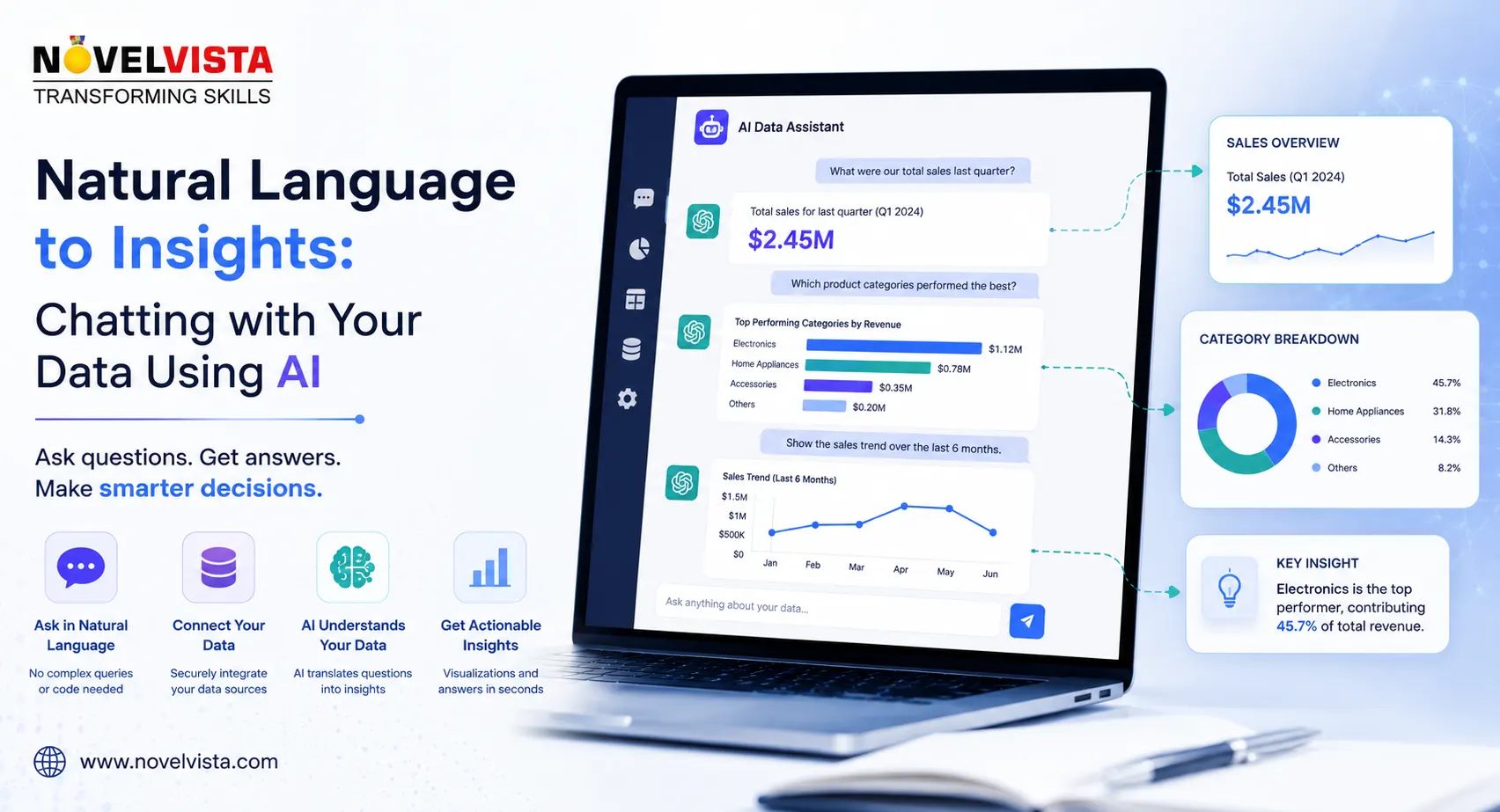
Business data is growing faster than most teams can analyze it. Organizations collect information from customer relationship management platforms, financial systems, marketing tools, support applications, cloud services, and operational databases. Yet accessing meaningful insights often still requires knowledge of SQL, spreadsheets, dashboards, or business intelligence tools.
Conversational Data analytics changes this experience. Instead of manually building queries or navigating complex reports, users can ask questions in everyday language and receive relevant insights, summaries, tables, and visualizations.
A sales leader might ask:
Which regions experienced the largest decline in revenue this quarter?
A support manager could ask:
What are the most common reasons customers contacted us during the past 30 days?
An operations team might request:
Compare delivery delays across warehouses and identify the locations that need immediate attention.
Artificial intelligence translates these natural-language questions into data queries, retrieves the required information, analyzes the results, and presents an understandable response.
How Conversational Data Analytics Works
A conversational analytics system contains several connected components.
The first component is a large language model that interprets the user’s question. It identifies the business metric, filters, dimensions, comparison period, and expected output.
For example, consider the question:
Show me the top five products by revenue in the United States last month.
The system must understand that:
- The metric is revenue.
- The dimension is product.
- The geographic filter is the United States.
- The time period is the previous calendar month.
- The result should contain five records.
- The records should be sorted from highest to lowest revenue.
The AI then converts this intent into a structured query, such as SQL, a business intelligence query, or an analytics API request. The query runs against an approved data source, and the results are returned to the model for interpretation.
Finally, the AI explains the findings using natural language and may generate a chart, table, comparison, or recommended follow-up question.
The Importance of a Semantic Layer
Natural-language analytics depends on more than translating English into SQL. The system also needs to understand the organization’s business terminology.
Terms such as revenue, active customer, conversion, profit, churn, and qualified lead may have specific internal definitions. Two departments may even calculate the same metric differently.
A semantic layer provides a governed definition of business concepts. It connects user-friendly terms to database tables, columns, formulas, and relationships.
For example, “monthly recurring revenue” may be mapped to a specific calculation involving active subscriptions, billing periods, discounts, and currency rules. Without this mapping, an AI system might generate a technically valid query that produces the wrong business result.
A reliable conversational analytics platform should therefore combine language understanding with governed metrics and trusted data models.
From Simple Questions to Deeper Insights
The real value of chatting with data is not limited to retrieving numbers. Users can continue the conversation and progressively investigate a business issue.
A typical interaction might begin with:
What was our total revenue last quarter?
The user could then ask:
How does that compare with the previous quarter?
Followed by:
Which customer segment contributed most to the decline?
And finally:
Summarize the likely factors and suggest areas for further investigation.
Because the conversation maintains context, users do not need to repeat the complete question each time. This creates an analytical experience similar to working with a data analyst.
AI can also help identify patterns that users may not immediately notice. It can highlight unusual changes, compare performance across segments, explain relationships between metrics, and generate plain-language summaries for decision-makers.
Business Applications
Conversational analytics can support teams across an organization.
Sales teams can examine pipeline health, win rates, sales-cycle length, and account performance. Marketing teams can analyze campaign results, lead sources, engagement, and conversion rates.
Finance professionals can review spending patterns, budget variance, cash flow, and profitability. Human resources teams can explore workforce trends, hiring performance, training completion, and employee engagement.
Customer service teams can analyze ticket categories, response times, resolution rates, and customer sentiment. Operations teams can investigate inventory levels, delivery performance, production issues, and supplier reliability.
By reducing dependence on technical reporting skills, conversational analytics makes data more accessible to business users.
Challenges and Risks
Although natural-language interfaces are convenient, they can produce incorrect or misleading results if they are not properly governed.
An AI system may misunderstand an ambiguous question, select the wrong table, apply an incorrect date range, or generate a query that excludes important records. It may also provide a confident explanation even when the underlying data is incomplete.
Organizations should introduce safeguards such as:
- Approved data sources and governed metrics
- Role-based access controls
- Query validation and execution limits
- Clear display of filters and calculations
- Source references and query transparency
- Human review for high-impact decisions
- Monitoring of accuracy and user feedback
The system should also ask clarifying questions when a request is unclear. For example, if a user asks for “best-performing customers,” the AI should confirm whether performance means revenue, profit, growth, retention, or another metric.
Data Security and Access Control
Conversational access should never allow users to bypass existing data permissions. The AI must respect the same authorization rules as dashboards, databases, and enterprise applications.
A regional sales manager should only see the accounts assigned to that region. A human resources employee should not gain access to restricted salary or medical information simply by phrasing a natural-language question.
Sensitive information should be masked or excluded, and every generated query should be associated with the authenticated user. Audit logs should record which questions were asked, which data sources were accessed, and what results were returned.
Building Trust in AI-Generated Insights
Users are more likely to trust an AI analytics system when they can understand how an answer was produced.
A strong response should show the selected time period, filters, metric definitions, data source, and refresh date. Advanced systems may also allow users to inspect the generated SQL or open the result in a traditional dashboard.
The AI should distinguish between direct observations and interpretations. For example:
Revenue declined by 8% in the western region.
is a measurable finding.
The decline may be related to reduced campaign activity.
is an interpretation that requires supporting evidence.
This distinction helps prevent assumptions from being presented as facts.
The Future of Data Interaction
Conversational analytics is shifting business intelligence from dashboard navigation to guided exploration. Instead of waiting for analysts to create every report, business users can investigate questions as they arise.
However, the strongest solutions will not replace data analysts. They will allow analysts to focus on data quality, advanced modeling, governance, and strategic interpretation while AI handles routine queries and initial exploration.
Chatting with data makes analytics more accessible, but accessibility must be supported by trusted metrics, secure architecture, and transparent reasoning. When these foundations are in place, natural language can become one of the most powerful interfaces for turning organizational data into practical business insight.

 English
 French
 Spanish
 Portuguese
 Deutsch
 Turkish
 Dutch
Dutch
 Italiano
 Russian
 Romaian
 Portuguese (Brazil)
 Greek
Greek
