


Closing the AI Value Gap: A Leadership Playbook For 2026
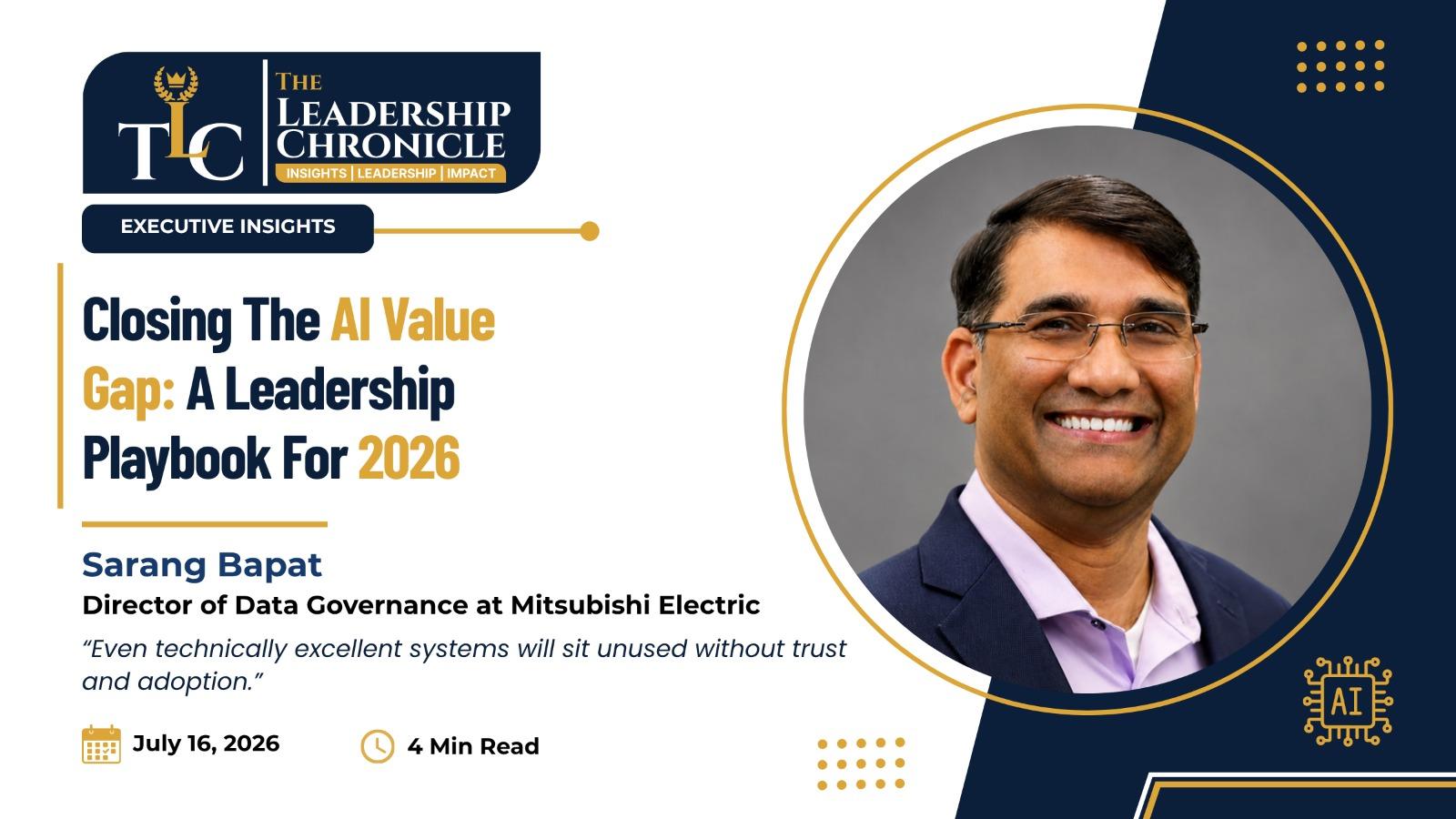
Enterprises poured unprecedented capital into artificial intelligence in 2025, yet measurable business impact remains elusive. The technical foundations — models, compute, and tooling — have advanced rapidly. The real bottleneck is organizational: unclear problem definition, fragmented data ownership, weak operational pathways, and insufficient human adoption. To convert capability into value, leaders must align three domains — strategy, engineering, and adoption — what I call the AI Trifecta: Head, Hands, and Heart.
The Problem at Scale
The headline numbers are stark and instructive: $600 billion invested in US AI in 2025. Technology has matured; organizational readiness has not.
Those two facts capture the central paradox. Organizations are buying capability faster than they can integrate it. Common failure modes recur across industries:
- No clear business problem or ROI target. Teams build models because they can, not because the business needs them.
- Poor data quality and fragmented ownership. Data pipelines and governance are underfunded relative to model licensing.
- No path to deployment or operationalization. Proofs of concept stall at handoff from research to production.
- Lack of crossfunctional alignment. Strategy, engineering, and operations operate in silos.
- Human adoption fails. End users don’t trust or integrate AI into daily workflows.
These are not primarily technical failures. They are structural and cultural. Fixing them requires a different allocation of attention and capital.
“Organizations are buying capability faster than they can integrate it.”
The AI Trifecta
To bridge the gap between capability and impact, organizations must deliberately align three complementary domains.
Think with Head
Define the right problem. Start with domain expertise and business strategy. Prioritize use cases that map to measurable outcomes — revenue, cost, risk, or customer experience. A rigorous problem definition prevents wasted cycles on lowimpact experiments.
Build with Hands
Invest in engineering and governance. Scalable data pipelines, MLOps, lineage, and quality controls are the backbone of reliable AI. Treat data engineering and governance as firstclass investments rather than afterthoughts. Operational readiness — deployment patterns, monitoring, rollback, and compliance — turns prototypes into repeatable products.
Champion with Heart
Drive adoption through trust and change management. People adopt technology when it reduces friction, is explainable, and is supported by training and incentives. Leadership must model use, communicate transparently about limitations, and invest in upskilling. Without this, even technically excellent systems will sit unused.
When these three domains operate in concert, the necessary technical conditions become sufficient for enterprise impact.
“Even technically excellent systems will sit unused without trust and adoption.”
Practical Roadmap for Leaders
Leaders need a pragmatic, prioritized plan that shifts resources and behaviors.
Redesign workflows. Stop retrofitting AI into legacy processes. Reimagine workflows where AI is a core capability, not an addon. This often requires process redesign and role redefinition.
Adopt product thinking. Treat AI deliverables as products with roadmaps, SLAs, and lifecycle management. Products evolve; projects end.
Build crossfunctional squads. Combine strategists, domain SMEs, data engineers, MLOps, and enablement leads into accountable teams. Colocation of responsibility reduces handoff friction.
Measure adoption and impact. Track both technical metrics (latency, accuracy, uptime) and business metrics (conversion lift, cost per transaction, time saved). Use these to prioritize and iterate.
Lead with transparency. Publish model capabilities, failure modes, and governance guardrails. Transparency builds trust and accelerates adoption.
These steps are sequential but iterative: invest in foundations, redesign processes, and then scale through disciplined product management and change leadership.
Talent and Governance
Closing the value gap requires new organizational roles and new emphasis:
- Strategists and SMEs who can translate business needs into measurable AI use cases.
- Data engineers and MLOps practitioners who can build resilient pipelines and deployment systems.
- AI product and enablement leads who focus on adoption, training, and internal marketing.
Governance is the unsung hero: cataloging, lineage, quality checks, and clear ownership reduce risk and accelerate time to value. Frame governance as an enabler of speed and trust, not merely a compliance burden.
Conclusion
In the industrial era, humans automated muscle. In the information era, humans automated information processes. In this AI era, humans are automating logic. That is an entirely different mandate. It means models and intelligence are becoming commodities, while context is your IP. A different kind of leadership thinking is required — one that recognizes the importance of keeping humans in the loop to build that context.
“Models and intelligence are commodities. Context is your IP.”
To ease workplace anxiety, leaders must systematically shift the narrative from “AI will replace us” to “AI will reshape how we contribute.”
The next wave of AI winners will not be those with the most advanced models, but those with the clearest organizational design. Closing the AI Value Gap is a leadership challenge as much as a technical one. By aligning Head (strategy and problem definition), Hands (engineering and governance), and Heart (adoption and culture), organizations can convert investment into measurable, repeatable business outcomes.
The mandate for 2026 is simple and urgent: shift investment to foundations, redesign workflows around AI, and lead with humancentered change management. Do that, and the promise of AI becomes measurable performance rather than an expensive experiment.
For more details, visit: https://theleadershipchronicle.com/
If you would like to get featured or want to know more, connect with us at contact@theleadershipchronicle.com
LinkedInn : https://www.linkedin.com/company/the-leadership-chronicle/
Twitter : @TLChronicle

 English
 Arabic
 French
 Portuguese
 Deutsch
 Turkish
 Dutch
Dutch
 Italiano
 Russian
 Romaian
 Portuguese (Brazil)
 Greek
Greek
