


U.S. Post-Quantum Migration Services Market Poised to Hit USD 30.5 Billion by 2036 as Organizations Accelerate Quantum-Safe Encryption
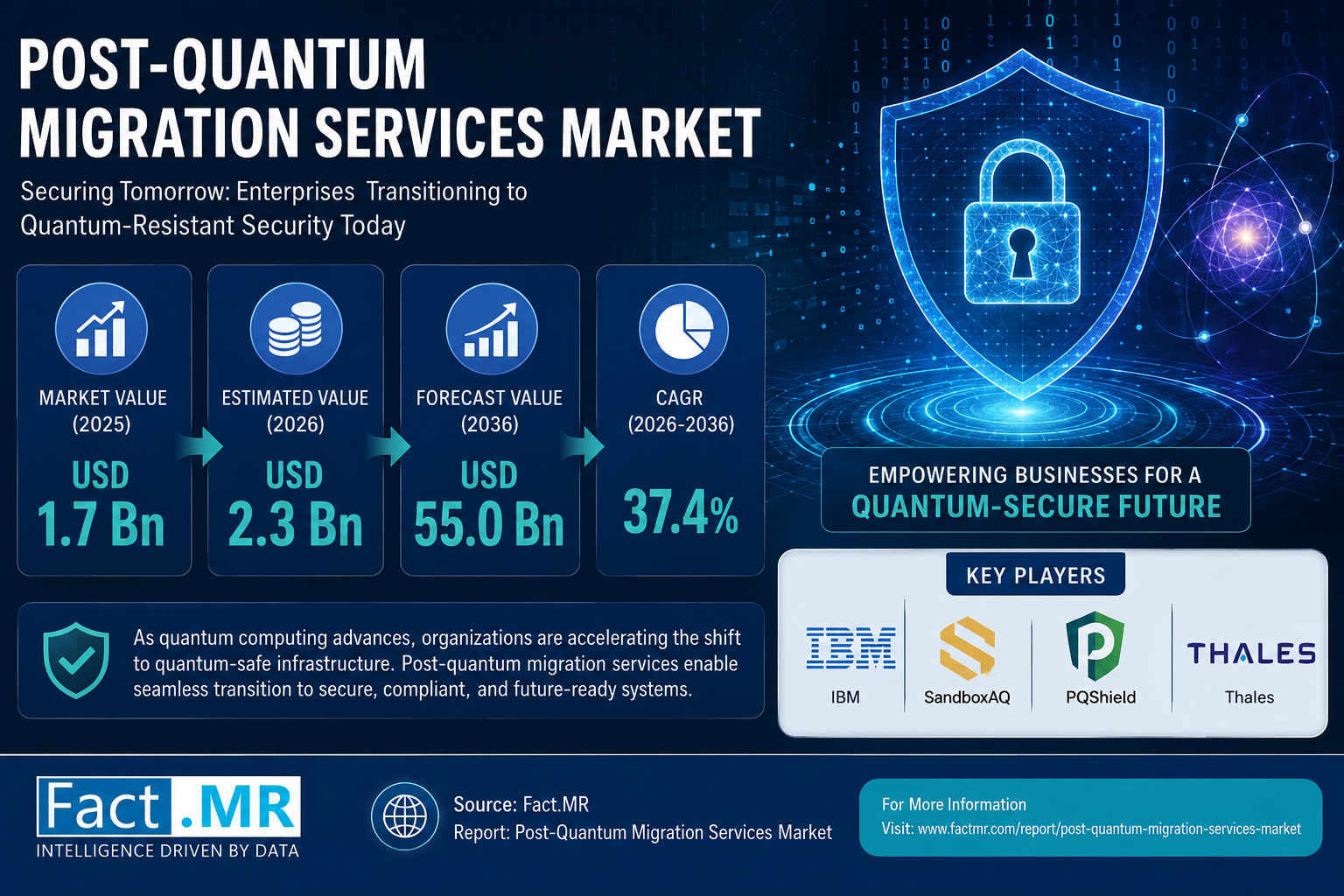
The global post-quantum migration services market is estimated at US$ 2.5 billion in 2026 and is projected to expand rapidly, reaching US$ 30.5 billion by the end of 2036. According to a market study published by Fact.MR, the industry is expected to grow at a compound annual growth rate (CAGR) of 28.5% over the 2026 to 2036 forecast period.
Get detailed market forecasts, competitive benchmarking, and pricing trends: https://www.factmr.com/connectus/sample?flag=S&rep_id=15252
For enterprise decision-makers, chief information security officers (CISOs), and technology investors, this steady upward trajectory underscores a strategic priority: transitioning management to quantum-resistant algorithms is evolving from a future-proofing initiative to a near-term compliance and operational requirement.
Key Market Highlights at a Glance
- Estimated Market Size (2026): US$ 2.5 billion
- Forecast Market Size (2036): US$ 30.5 billion
- Absolute Dollar Opportunity (2026–2036): US$ 28.0 billion
- Compound Annual Growth Rate (CAGR):5% from 2026 to 2036
- Leading Service Type Segment: IT Infrastructure Services holding 41.5% market share in 2026
- Leading Deployment Model: Hybrid Cloud Deployment commanding 52.3% market share in 2026
- Leading End-Use Industry: Banking, Financial Services, and Insurance (BFSI) holding 34.2% market share in 2026
- Fastest-Growing Region: Asia-Pacific growing at a 30.2% CAGR
- Fastest-Growing Country: China expanding at a 31.5% CAGR
Why Is the Post-Quantum Migration Services Market Growing?
The post-quantum migration services market is experiencing significant growth due to the vulnerability of legacy public-key cryptography—such as RSA and ECC—to advancing quantum computing capabilities. Organizations globally face risks from "Harvest Now, Decrypt Later" (HNDL) attacks, where malicious actors intercept and store encrypted data today to decrypt it once cryptographically relevant quantum computers become operational.
- NIST Post-Quantum Cryptography Standardization: Global regulatory mandates and standardized algorithms from the National Institute of Standards and Technology (NIST) are compelling enterprises to inventory and upgrade their cryptographic assets.
- Proactive Protection Against Harvest Now, Decrypt Later Threats: Long-lifecycle data across government, finance, and healthcare must be secured today to prevent future decryption by adversary state actors and cybercriminals.
- Mandates for Enterprise Cryptographic Agility: Organizations are adopting flexible security protocols to swap cryptographic algorithms without disrupting existing operational workflows.
"The transition to post-quantum cryptography is not a simple software update; it is a fundamental overhaul of global trust infrastructure," stated Alex Vance, Principal Cyber Security Analyst at Fact.MR. "Organizations that fail to establish cryptographic visibility today will face severe compliance and operational friction as quantum systems mature over the next decade."
Which Service Type Segment Commands the Largest Market Share?
The market is segmented by service type into IT infrastructure services, cryptographic inventory & discovery, application migration services, and compliance & risk consulting. Among these, IT infrastructure services leads the market, accounting for 41.5% of overall revenue in 2026.
IT infrastructure services dominate because replacing or upgrading fundamental security architectures—including Public Key Infrastructure (PKI), Hardware Security Modules (HSMs), Virtual Private Networks (VPNs), and secure boot systems—requires specialized technical engineering. Organizations are prioritizing core network and server infrastructure overhauls to establish a resilient security baseline before migrating individual software applications.
- IT Infrastructure Services: Holds 41.5% market share in 2026, driven by hardware security module upgrades and PKI modernization.
- Cryptographic Inventory & Discovery Services: Accounts for 24.8% market share in 2026, serving as the essential initial phase for enterprise risk mapping.
- Application Migration Services: Represents 19.3% market share in 2026 as custom software codebases are rewritten for quantum-safe APIs.
- Compliance & Risk Consulting: Holds 14.4% market share in 2026, expanding steadily under regulatory oversight.
Which Deployment Model and End-Use Industry Lead Post-Quantum Migration Spending?
By deployment model, hybrid cloud deployment holds the largest market share at 52.3% in 2026. Enterprise IT ecosystems rely heavily on a combination of legacy on-premises datacenters and multi-cloud environments. Securing hybrid environments requires tailored migration services that bridge legacy hardware constraints with modern cloud-native post-quantum security algorithms.
By end-use industry, the Banking, Financial Services, and Insurance (BFSI) sector commands the primary position with a 34.2% market share in 2026. The BFSI sector manages large volumes of high-value transactional data and long-term financial records that require absolute confidentiality over extended periods, driving immediate investments in post-quantum protection.
- Hybrid Cloud Deployment: Leads deployment models with a 52.3% share in 2026 due to enterprise multi-cloud operational realities.
- On-Premises Deployment: Holds 28.1% market share in 2026, concentrated in high-security defense and government installations.
- Cloud-Native Deployment: Accounts for 19.6% market share in 2026, experiencing rapid adoption among digital-native enterprises.
- BFSI End-Use Industry: Dominates end-use adoption with a 34.2% share in 2026 to secure financial ledgers and payment rails.
- Government & Defense Industry: Captures 26.5% market share in 2026, fueled by national security mandates and intelligence protection requirements.
What Are the Core Market Dynamics Driving and Restraining Growth?
Key Market Drivers
The primary driver of the post-quantum migration services market is the strict implementation of government cybersecurity directives and international standardization frameworks. Furthermore, the rapid expansion of cloud computing and connected IoT devices broadens the cryptographic attack surface, prompting enterprises to engage third-party service providers to execute quantum-safe migration strategies.
Key Market Restraints
A major restraint facing the market is a shortage of qualified quantum cybersecurity professionals and specialized cryptographic engineers. Additionally, the high cost and technical complexity of discovering embedded legacy algorithms within complex enterprise codebases present budget constraints for small and mid-sized enterprises.
Key Market Trends
A key industry trend is the increasing adoption of automated cryptographic discovery tools driven by artificial intelligence. Organizations are utilizing AI-powered platforms to scan source code, network traffic, and digital certificates to generate real-time Cryptographic Bill of Materials (CBOM) inventories.
Regional Analysis: North America Leads Expenditure, Asia-Pacific Accelerates Rapidly
North America holds the largest revenue share of the global post-quantum migration services market in 2026, supported by federal directives in the United States and early investments from cybersecurity vendors. However, the Asia-Pacific region is projected to experience the fastest growth, expanding at a CAGR of 30.2% over the forecast period from 2026 to 2036.
- United States: Forecast to grow at a 27.8% CAGR, fueled by Federal PQC Migration Directives and commercial financial sector adoption.
- China: Forecast to expand at a 31.5% CAGR, representing the fastest-growing national market due to state-level quantum technology investments.
- Japan: Expected to register a 28.2% CAGR, supported by national initiatives to safeguard manufacturing supply chains and communications networks.
- United Kingdom: Anticipated to post a 27.1% CAGR, guided by central banking security mandates and government cybersecurity guidelines.
- Germany: Projected to achieve a 26.9% CAGR, driven by European Union data protection regulations and industrial IoT security updates.
In the United States, direct regulatory intervention from federal agencies is compelling critical infrastructure operators to construct migration roadmaps immediately. In Asia-Pacific, rapid digital transformation across China, Japan, and South Korea, combined with investments in quantum computing capabilities, is prompting enterprises to secure their telecommunication networks and financial platforms ahead of global timelines.
Who Are the Key Players in the Post-Quantum Migration Services Market?
The competitive landscape is characterized by strategic collaborations between legacy IT consulting firms, specialized cybersecurity providers, and dedicated post-quantum cryptography startups. Market leaders focus on automated cryptographic migration tools, strategic consulting frameworks, and hybrid quantum-safe solutions.
- IBM Corporation: Offers end-to-end Quantum Safe Transformation services, combining cryptographic discovery tools with quantum-resilient systems.
- Accenture plc: Provides PQC strategic advisory, cryptographic agility engineering, and enterprise system integration.
- Deloitte Touche Tohmatsu Limited: Delivers executive-level PQC risk assessment, regulatory compliance mapping, and cryptographic governance programs.
- Thales Group: Specializes in quantum-safe Hardware Security Modules (HSMs) and data protection infrastructure integration.
- DigiCert, Inc.: Focuses on automated lifecycle management for hybrid and post-quantum digital certificates.
- PQShield: Delivers post-quantum cryptography licensing, hardware IP, and migration consulting.
- SandboxAQ: Provides AI-driven cryptographic discovery platforms to inventory and modernize enterprise cryptographic assets.
- Isara Corporation: Supplies cryptographic agility management tools and hybrid PQC algorithm integration solutions.
Competition in the post-quantum migration services market is intensifying as service providers acquire niche cryptography firms to expand technical capabilities. Leading vendors are increasingly offering "Crypto-Agility-as-a-Service" models to help enterprises manage algorithm updates without operational disruptions.
Read the Comprehensive Industry Report: https://www.factmr.com/report/post-quantum-migration-services-market
Frequently Asked Questions
What is the projected size of the post-quantum migration services market by 2036?
The global post-quantum migration services market size is projected to reach US$ 30.5 billion by the end of 2036, growing from an estimated US$ 2.5 billion in 2026.
What is the expected growth rate (CAGR) of the post-quantum migration services market from 2026 to 2036?
The post-quantum migration services market is expected to grow at a compound annual growth rate (CAGR) of 28.5% over the 2026 to 2036 forecast period.
Which service type segment dominates the post-quantum migration services market?
The IT infrastructure services segment dominates the post-quantum migration services market, accounting for a 41.5% market share in 2026.
Which end-use industry accounts for the largest share of post-quantum migration services spending?
The Banking, Financial Services, and Insurance (BFSI) industry accounts for the largest share of spending, capturing 34.2% of the market in 2026.
Which region is the fastest-growing market for post-quantum migration services?
The Asia-Pacific region is the fastest-growing market for post-quantum migration services, expanding at a CAGR of 30.2% through 2036.
What is driving the growth of the post-quantum migration services market?
Market growth is primarily driven by NIST PQC standardization mandates, proactive protection against "Harvest Now, Decrypt Later" cyber threats, and the need for enterprise cryptographic agility.
Who are the key market players providing post-quantum migration services?
Key providers in the market include IBM Corporation, Accenture plc, Deloitte Touche Tohmatsu Limited, Thales Group, DigiCert Inc., PQShield, SandboxAQ, and Isara Corporation.
To View Related Report:
5G Services Market: https://www.factmr.com/report/5g-services-market
Managed Services Market: https://www.factmr.com/report/managed-services-market
Internet Services Market: https://www.factmr.com/report/internet-services-market
Read the Comprehensive other Reports:
Backside Via Inspection Market: https://www.openpr.com/news/4587212/backside-via-inspection-market-to-reach-900-0-million-by-2036
Sub-Nanometer eBeam Market: https://www.openpr.com/news/4587217/sub-nanometer-ebeam-market-to-reach-2-380-0-million-by-2036

 English
 Arabic
 Spanish
 Portuguese
 Deutsch
 Turkish
 Dutch
Dutch
 Italiano
 Russian
 Romaian
 Portuguese (Brazil)
 Greek
Greek
