


Change Management Strategies for Enterprise Copilot Adoption
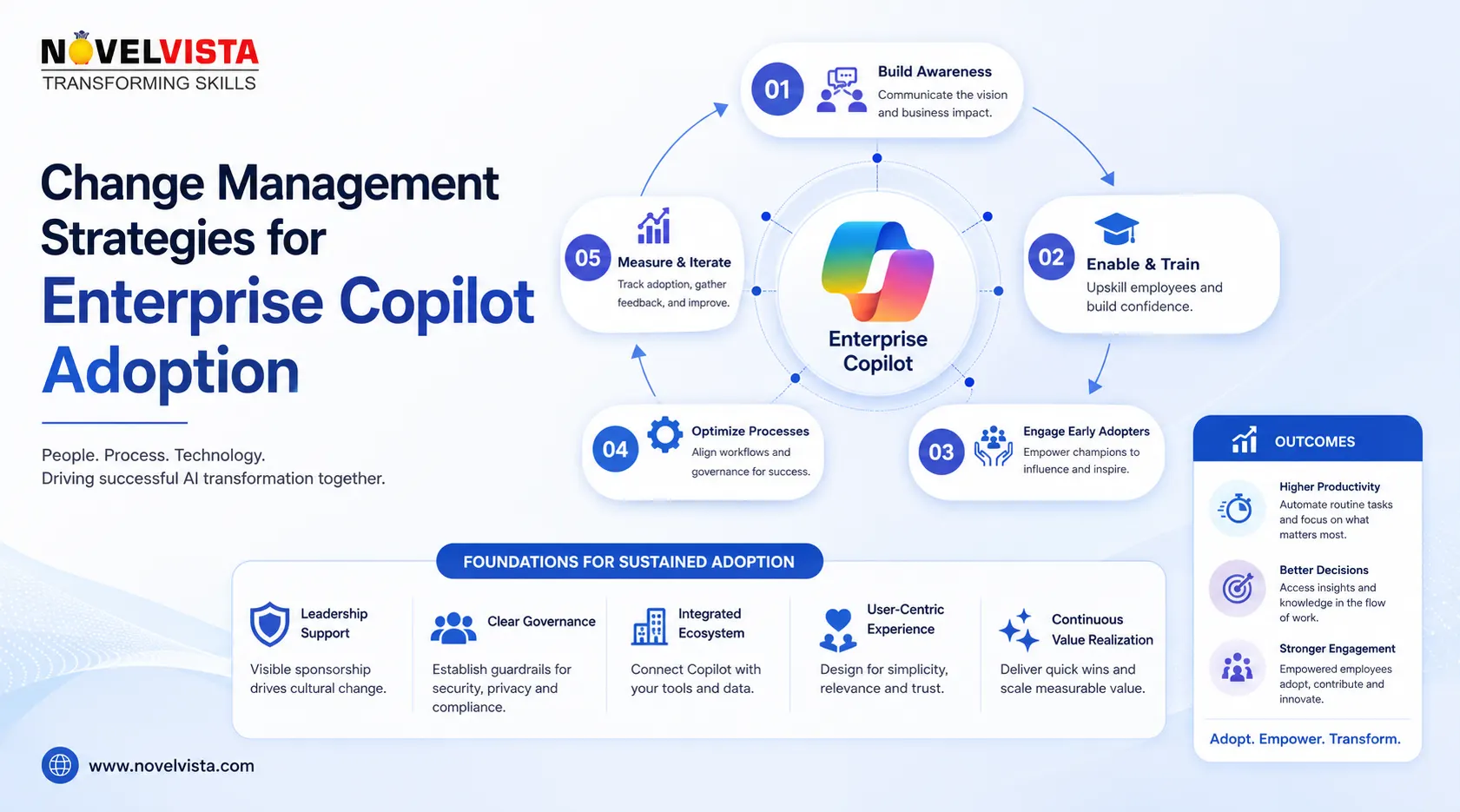
Enterprise Copilot adoption is not simply a technology rollout. It is a workplace transformation that changes how employees search for information, create documents, analyze data, prepare communications, and make decisions. While the technical deployment may be completed quickly, meaningful adoption depends on people understanding how Copilot fits into their daily work.
Organizations that treat Copilot as another software installation often struggle with low usage, inconsistent outcomes, and employee uncertainty. A structured change management strategy helps employees move from awareness to confidence, and from experimentation to measurable business value.
Begin With a Clear Business Purpose
Employees are more likely to adopt Copilot when they understand why the organization is introducing it. Leaders should connect the initiative to specific business priorities such as improving productivity, reducing repetitive work, accelerating decision-making, or enhancing customer service.
Avoid positioning Copilot only as a general productivity tool. Instead, identify practical use cases for different departments. Human resources teams may use it to summarize policies, finance professionals may analyze reports, sales teams may prepare meeting briefs, and project managers may generate status updates.
A clear purpose prevents the initiative from becoming a technology experiment without measurable outcomes.
Build Visible Leadership Support
Leadership involvement plays a critical role in adoption. Employees often look to managers to understand whether a new technology is genuinely important or simply another temporary initiative.
Senior leaders should communicate their expectations, share examples of how they use Copilot, and encourage responsible experimentation. Managers should also create space for employees to learn without fearing that early mistakes will be judged negatively.
Leadership support should go beyond launch-day announcements. Regular updates, success stories, and business reviews help reinforce that Copilot adoption is part of the organization’s long-term strategy.
Segment Users and Use Cases
Not every employee needs the same training or guidance. A one-size-fits-all approach often results in generic sessions that fail to address real work challenges.
Organizations should group users according to their roles, responsibilities, technical confidence, and likely use cases. Executives may need support with briefing documents and meeting preparation, while analysts may need deeper guidance on data interpretation and report generation.
This segmentation allows training teams to create role-based learning paths that are more relevant and practical.
Develop a Network of Copilot Champions
Copilot champions are early adopters who help colleagues understand the technology and apply it effectively. They can answer common questions, demonstrate useful prompts, collect feedback, and identify new opportunities.
Champions should come from different functions and levels of the organization. A finance champion may understand use cases that a central IT team may overlook, while an HR champion may identify important privacy or communication considerations.
This community-based approach creates local support and reduces dependence on a small implementation team.
Provide Practical, Workflow-Based Training
Training should focus on real business tasks rather than only explaining features. Employees learn faster when they can connect Copilot to work they already perform.
For example, instead of demonstrating how to generate text, show employees how to create a first draft of a client proposal, summarize a long meeting, compare versions of a policy, or prepare questions for a project review.
Training should also cover prompt-writing techniques, output validation, data handling, and responsible AI use. Employees must understand that Copilot-generated content should be reviewed before it is shared or used for important decisions.
Short workshops, guided practice sessions, prompt libraries, and office hours can make learning more accessible.
Address Concerns Transparently
Employees may worry that Copilot will replace jobs, expose confidential information, or create additional monitoring. Ignoring these concerns can damage trust and slow adoption.
Organizations should clearly explain how the technology will be used, what information it can access, and what responsibilities remain with employees. Policies should define acceptable use, sensitive-data handling, human review requirements, and restricted scenarios.
Transparent communication helps employees see Copilot as an assistant that supports their work rather than a hidden threat.
Start With Controlled Pilots
A pilot program allows the organization to test use cases, training methods, governance controls, and support processes before expanding adoption.
Choose participants from different roles and business units. Collect both quantitative data, such as usage and time saved, and qualitative feedback, such as employee confidence and task quality.
Pilot results can reveal which use cases deliver value, where employees need additional support, and which policies require clarification.
Measure Adoption and Business Impact
Login counts alone do not prove successful adoption. Organizations should measure how Copilot affects real work.
Useful indicators may include time saved, reduced document preparation effort, faster response times, improved meeting follow-up, increased employee satisfaction, and better access to organizational knowledge.
Feedback surveys, interviews, usage reviews, and departmental performance metrics can provide a balanced view. These insights should guide future training, licensing, and process improvements.
Make Adoption an Ongoing Program
Copilot adoption does not end after deployment. New capabilities, business processes, and employee expectations will continue to evolve.
Organizations should regularly update training materials, prompt libraries, governance policies, and success measures. Communities of practice can help employees exchange ideas and develop new use cases.
Successful enterprise Copilot adoption depends on aligning people, processes, leadership, and technology. With a thoughtful change management strategy, organizations can move beyond initial excitement and build a sustainable culture where AI becomes a trusted part of everyday work.

 English
 Arabic
 French
 Spanish
 Portuguese
 Deutsch
 Turkish
 Dutch
Dutch
 Italiano
 Romaian
 Portuguese (Brazil)
 Greek
Greek
