


India's Quartz Manufacturing Boom: Who's Leading and Why
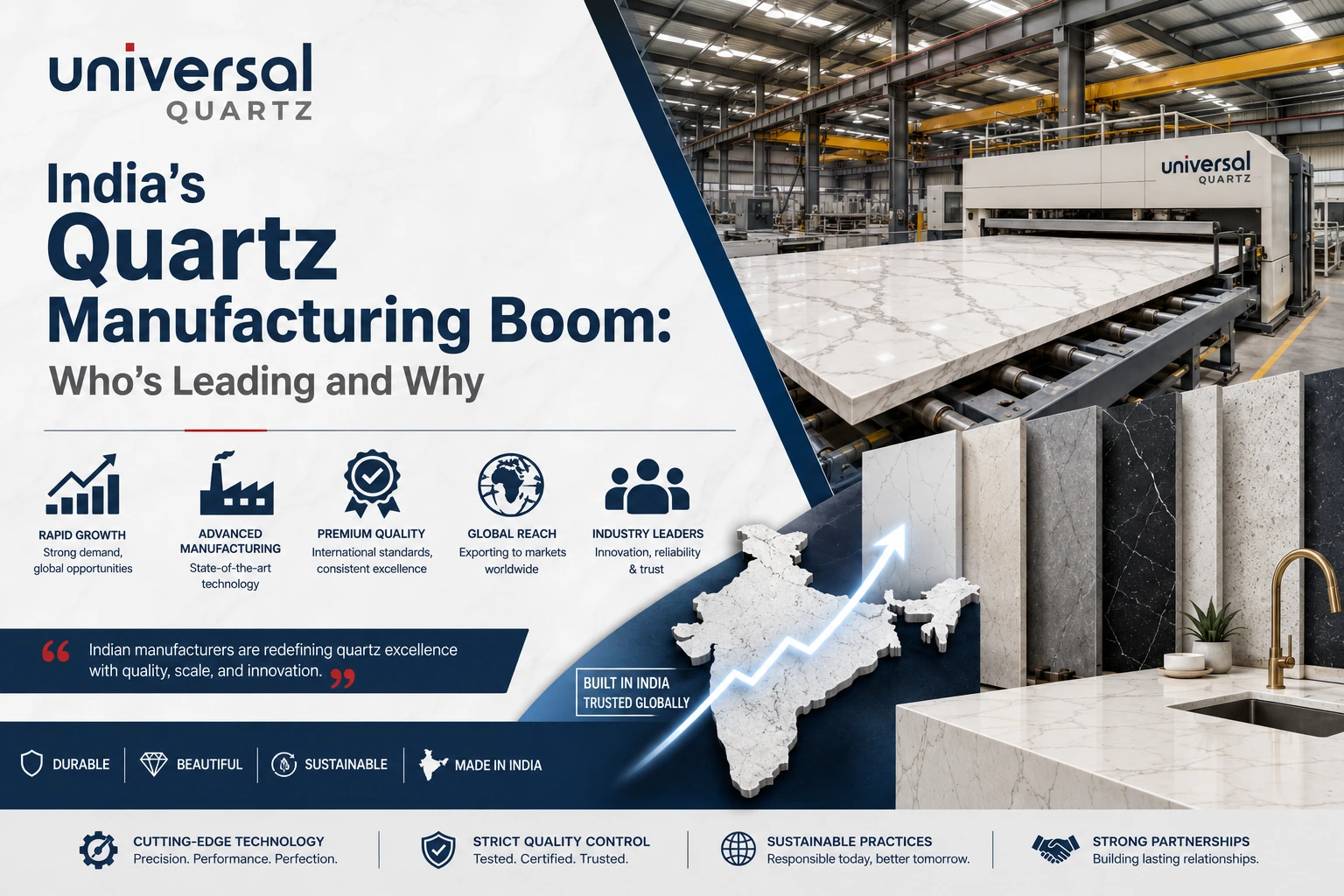
A decade ago, "quartz countertop" almost always meant an imported slab — Italian, Spanish, or American brands dominated premium projects, and Indian manufacturing was seen as a budget alternative at best. That's changed. India is now one of the world's fastest-growing engineered quartz producers, supplying not just its own booming construction and interior design sector but exporting at scale to the US, Europe, the Middle East, and Australia.
That shift didn't happen by accident. It's worth understanding what actually drove it, and which kinds of manufacturers are positioned to lead the next phase of growth.
What Changed: Three Forces Behind the Boom
Construction and real estate growth. India's residential and commercial construction sector has expanded rapidly, and interior finishing standards have risen alongside it. Quartz surfaces — valued for being non-porous, low-maintenance, and design-flexible compared to natural stone — became a default specification in kitchens, bathrooms, and commercial interiors rather than a premium upgrade.
Investment in production technology. Early Indian quartz production leaned on older casting methods that struggled to match the density and consistency of European slabs. Over the past several years, manufacturers have invested heavily in automated vibro-compression pressing lines and tighter quality-control systems, closing much of that quality gap while keeping a cost advantage.
Export demand and price competitiveness. International buyers, particularly in the US and Middle East, started sourcing more aggressively from India once quality caught up, because landed costs remained meaningfully lower than European alternatives. That export demand created a feedback loop: more export revenue funded further investment in equipment and certification, which made Indian manufacturers even more competitive globally.
Who's Actually Leading — and What "Leading" Should Mean
Rankings of "top" manufacturers tend to focus on brand visibility, but visibility isn't the same as manufacturing leadership. The companies genuinely leading this boom tend to share three traits:
Independently verified quality systems. Certifications like ISO 9001:2015, NSF/ANSI 51, GREENGUARD Gold, and CE marking aren't just compliance paperwork — they're what allow a manufacturer to credibly compete for international specifications in the first place. Manufacturers without this certification stack are largely limited to price-sensitive domestic buyers.
Real export infrastructure, not one-off shipments. There's a meaningful difference between a manufacturer that has occasionally exported and one with an established export operation — consistent documentation, freight relationships, and batch consistency across large international orders. Universal Quartz, for instance, has built out active US export operations alongside a nine-branch domestic network, which is the kind of dual infrastructure that separates an exporter from a manufacturer that merely ships abroad occasionally.
Technology reinvestment. The manufacturers pulling ahead are the ones continuing to invest in pressing technology, raw material sourcing (Christobalite powder blends are increasingly common as an alternative to standard quartz powder), and design R&D — rather than resting on early gains.
Where the Boom Goes Next
Growth in this sector isn't slowing. Sustainability credentials are becoming a bigger differentiator as green building certification (LEED, IGBC) becomes standard on commercial projects, and large-format slab production is opening up new architectural applications beyond countertops — flooring, wall cladding, and facades.
For buyers, the practical takeaway is this: India's quartz manufacturing boom is real, but not every manufacturer riding the wave has the certifications, export infrastructure, or technology investment to back up the claim. The companies actually leading it are the ones you can verify — not just the ones that show up first in a search.

 English
 Arabic
 French
 Portuguese
 Deutsch
 Turkish
 Dutch
Dutch
 Italiano
 Russian
 Romaian
 Portuguese (Brazil)
 Greek
Greek
